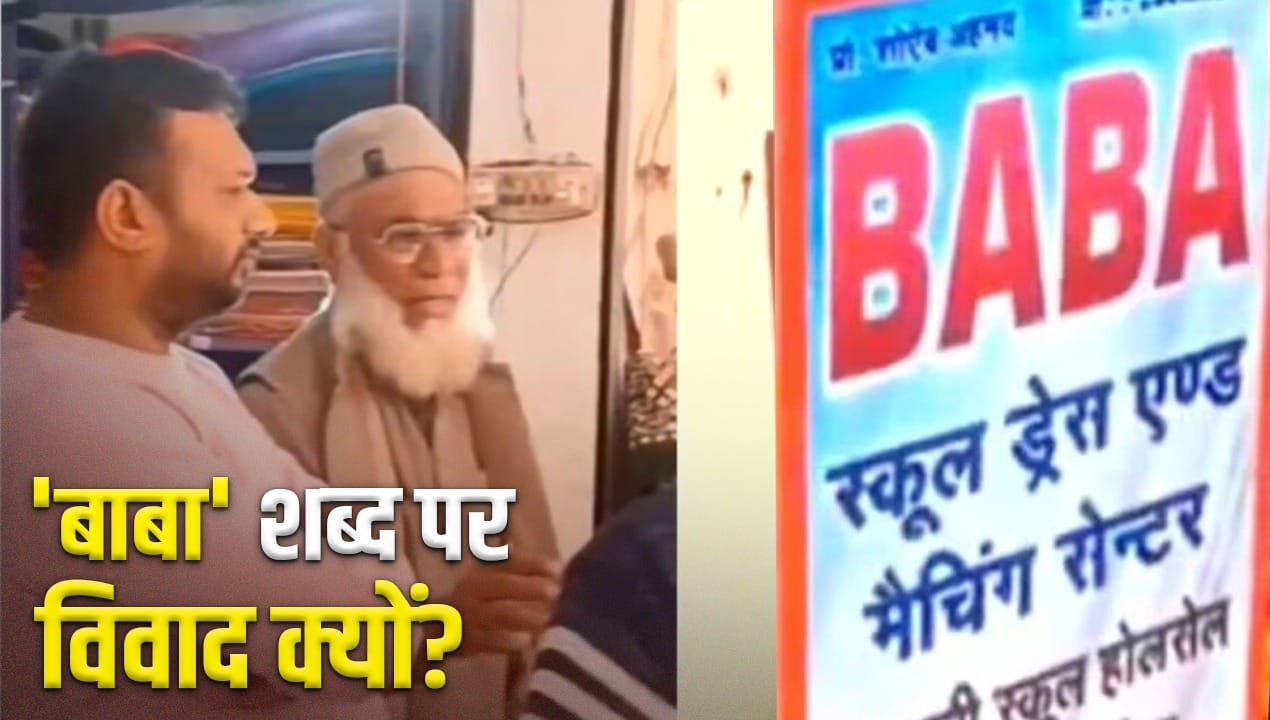
The word ‘Baba’ is in discussion regarding changing the name of a shop in Kotdwar town of Uttarakhand. Security arrangements have been tightened amid tension in the town. The dispute is related to a shop named Baba Dress located on Patel Marg of Kotdwar. This shop is said to be of Mohammad Shoaib. Bajrang Dal workers alleged that the name of the shop creates confusion over the name of Siddhabali Baba, the famous Hanuman temple of Kotdwar.Police say that Bajrang Dal workers had put pressure on Shoaib to change the name of the shop two and a half months ago. However, even after opening the shop at a new place on Patel Marg, the protest did not end.
The word Baba used in the Indian subcontinent today is not limited to any one religion, culture or community. It is an address that shows respect, affection, reverence and closeness. Now the question arises that where did the word Baba come from? Does it come from Persian language? How did its use start in Hindu and Muslim societies? Let us, under this pretext, understand the historical and cultural journey of the word Baba.
How did the word Baba originate?
According to linguists, the use of Ba sound in many languages of the world comes from the early pronunciation-based language of children. Like Baby in English, Babushka in Russian, Baba in Turkish, Papas in Greek and Baba in Sanskrit Baba as a paternal elder.
These examples show that the sounds Ba and Pa evolved from human infant speech. Therefore, the word Baba is not the contribution of any one language, but is part of a natural, natural phonetic development. In Persian the word Baba means elder, father, saint or respected man. It was used as a sign of respect for sages, Sufis and elders in medieval Persia and Central Asia. This Persian word Baba came to India during the Delhi Sultanate and Mughal period and became widely popular here by mixing with local traditions.
Video of controversy went viral
My name is “Mohammad Deepak” — In Kotdwar, Uttarakhand, Hindu man Deepak Kumar fearlessly stood up for a Muslim shopkeeper, proving that humanity and unity rise above all religious divides.#resolve_to_donate_life#silver #Uttrakhand #AusOpen pic.twitter.com/J0R4D6a6m0
— Ch_Tabasum_Yaseen (@TabasumYaseen_) January 30, 2026
Pre-existing forms in Indian languages
Words like Baba are also found in Sanskrit and Prakrit. For example, in Sanskrit Bapa or Baba means father-like person, old man, teacher. It is clear from this that this word was not completely foreign in India, but matches the already existing sounds and word groups.
Use of Baba in Hindu society
In the Indian Hindu tradition the word Baba has been used in three main forms. The word Baba is common for saints and ascetics. In the Sanatan tradition, it has been very common to respectfully call any ascetic, Mahatma, Pandit or Guru as Baba. In Hindu tradition, God is also addressed as Baba.
Like, Baba Kedarnath, Baba Badrinath, Baba Bholenath, Neem Karauli Baba, Baba Gorakhnath, Baba Balaknath, Siddha Bali Baba etc. Here also Baba is a spiritual, worshipable address. This word is also common for the elders in the family. In villages, there is a tradition of calling a grandfather or a father-like man as Baba. In Eastern India, grandfather is also called Baba and father is called Babu. This shows that the use of Baba is deeply rooted in Hindu society.
Tradition of word Baba in Muslim society
The widespread use of this word has come from the Sufi tradition in Muslim society. In the Sufi tradition, Baba refers to an elder, wise man or wali who has spiritual prestige. For example, Baba Farid, Baba Bulleh Shah, Baba Shahmard, Baba Tajuddin, Khwaja Baba etc. are common in Ajmer Sharif. Baba has been a very respectable word for Sufis in the Persian-Turkish tradition and the same has been accepted in India also. In many Muslim societies, father is also addressed with addresses similar to Abba or Baba.
Shared use of the word in Hindu and Muslim societies
Baba has become a common cultural heritage in India from the medieval period till today. Some of the following reasons are found for this.
Similarities of Sufi and Saint Traditions: Both Hindu and Muslim saints were associated with folk language, folk songs, and common life in the Bhakti and Sufi traditions. In both traditions Baba became readily accepted as a respectable term.
No religious demarcation in folk culture: In the villages and towns of India, both Hindu and Muslim communities visit many Baba places with devotion. For example, the names of Baba Farid’s Darbar, Baba Gurughasidas of Satnam sect, Sufi Baba Shah etc. are taken with respect.
The period of meeting of Persian, Hindi and Sanskrit words: Persian and local Indian languages met in medieval India. Many words were adopted equally by both the societies. Like: tailor, market, book, court, and Baba.
Baba, I don’t belong to any one religion.
Some groups objected to the use of the word Baba in the name of a shop in Kotdwar town of Uttarakhand and demanded a change in the name. This controversy raises the question whether Baba belongs to any one religion? Both history and linguistics show that this word is neither exclusively Hindu, nor exclusively Muslim, but is a popular, shared, cultural term which is used by every community.
Social, cultural and psychological meaning of the word Baba
Baba is not just a word. Many things are hidden in it. Respect, affection, sense of security, spiritual closeness, experience of the elderly and familiarity with folk culture. For this reason, children in India are often heard calling their father or grandfather as Baba and devotees also call their favorite deity or Guru.
Then why do disputes occur?
In today’s time, sensitivity regarding religious identity has increased. But the history of words shows that language is always like a flowing river, not a single bank. The role of shared symbols in social vocabulary strengthens group harmony. Claim or opposition to words like Baba does not match the cultural reality.
Ultimately, we can say that the word Baba evolved from the natural sound of child language, from both Persian and Sanskrit, from both Hindu Sufi spiritual streams and from the folk culture of India and became a shared and universally accepted address. Tying it to any religion, caste or community is against both the language and the comprehensiveness of Indian culture. From Kotdwar to Kashmir, Punjab, Bengal, Maharashtra, South India – everywhere the sweetness, respect and public sentiment of the word Baba is the same. This is its strength and this is the beauty of the cultural diversity of Indian society.
Also read: Will the rare earth corridor being built in India prove to be a setback for China? Announcement made in the budget