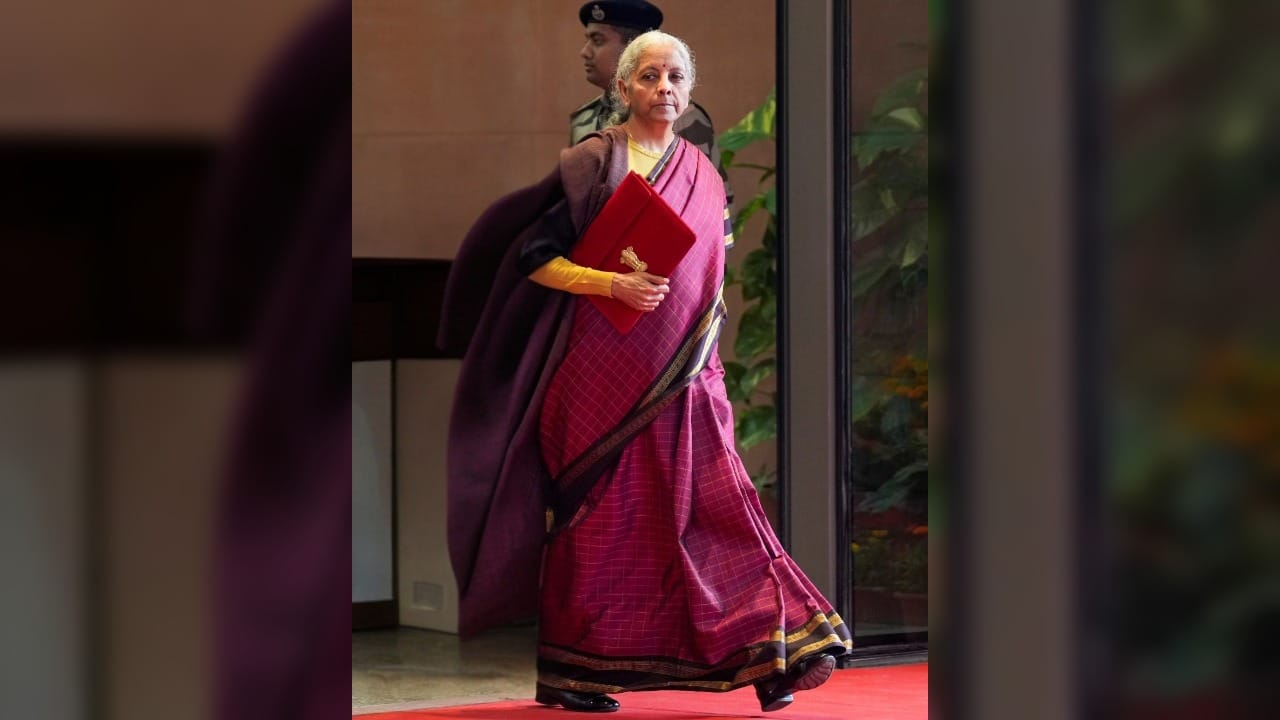
Union Budget Day for the Finance Minister arrives with two curiosities. One, obviously, is about the numbers and policies. And since Nirmala Sitharaman took over as the Finance Minister in 2019, the other curiosity — and this is entirely self-inflicted — is about her saree choice for presenting the Budget.
The Budget and the drape
Somewhere along the way, Nirmala Sitharaman’s Budget drape stopped being just attire and became an annual guessing game. Before economists finish their first take on fiscal deficit, someone has already tweeted the weave, the state and, inevitably, the “signal”.
She has made a habit of wearing handlooms from different states. Admirable, certainly. But in politics, even admirable habits acquire interpretation. A gesture rarely stays a gesture for long.
When timing draws attention
This year, it was a magenta Kanjeevaram from Tamil Nadu. Gold checks. Solid border. Temple-town gravitas. Elegant, no doubt. Also conspicuously not from Bengal. Not Murshidabad silk. Not Kantha. Not Assam’s Muga either. The list of what wasn’t worn circulated almost as fast as what was.
In a non-election year, this might have remained a fashion footnote. But this is not a quiet year. Tamil Nadu, West Bengal, Assam, Kerala, and Puducherry — all heading to polls. In such a season, even a blouse colour can attract theory.
Her sarees, frankly, now get read like budget fine print. That may sound absurd, but Indian politics has always loved symbolism. Leaders localise their language, their meals, their shawls. Voters notice. Commentators certainly do. Clothes are part of the script, whether acknowledged or not.
On February 1, 2026, she walked in with the digital ‘Bahi Khata’ and the usual fiscal weight in her hands. The speech spoke of policy and offerings for electoral states. The saree spoke to a different audience — the one that reads optics.
Reading what is worn — and what is not
West Bengal sits at the centre of this curiosity. The BJP’s Bengal project has been ambitious, sometimes over-ambitious. In early 2024, before the Lok Sabha elections, Sitharaman wore a Kantha saree while presenting the interim Budget. The party was making a strong pitch then. The results were respectable, not transformative. Since then, the Bengal strategy looks quieter, more booth-level than banner-level.
So this year, no Bengali weave. Does it mean retreat? Confidence? Indifference? Possibly none of the above. Possibly just a wardrobe choice. But once a pattern is spotted, it develops a life of its own.
A pattern in the weave, that people remember
And there is a pattern, or at least enough coincidence to keep drawing-room analysts busy. A Madhubani saree in a Bihar election year. Mangalgiri ahead of Andhra polls. Kasuti when Karnataka was voting. Then Kantha during a Bengal push. After results, a neutral white silk. One can call it cultural outreach. One can also call it tidy timing.
To be clear, elections are not won on sarees. They are won on caste arithmetic, welfare delivery and ground machinery. No party strategist is sitting with a mood board of textiles.
But symbolism has its limits
However, politics runs on perception as much as planning. Optics fill the space where data cannot. A small gesture can suggest attention, respect or outreach — even if unintended.
Perhaps the more telling story is not what Finance Minister Nirmala Sitharaman wears, but how hungry we are to decode it. In a media ecosystem addicted to subtext, every detail becomes a clue. Choices become signals. Silences become strategy.
The politics of interpretation
A Kanjeevaram on Budget Day may just be a Kanjeevaram. But neutrality, in election season, is a fragile claim. Politics encourages pattern-seeking, and observers are rarely short of imagination. In a media environment hungry for cues, symbolism is politicised almost on arrival. Every choice gathers meaning; every omission invites theory.
People search for patterns. They usually manage to find one.
A Union Budget shapes the economy. A saree shapes the chatter. Yet in Indian politics, chatter has its own currency.
Whether Bengal reads this year’s silk as a message or a miss will depend less on fabric and more on how the campaign unfolds. Elections, in the end, are woven from tougher threads than symbolism — though symbolism, as we know, never quite leaves the loom.