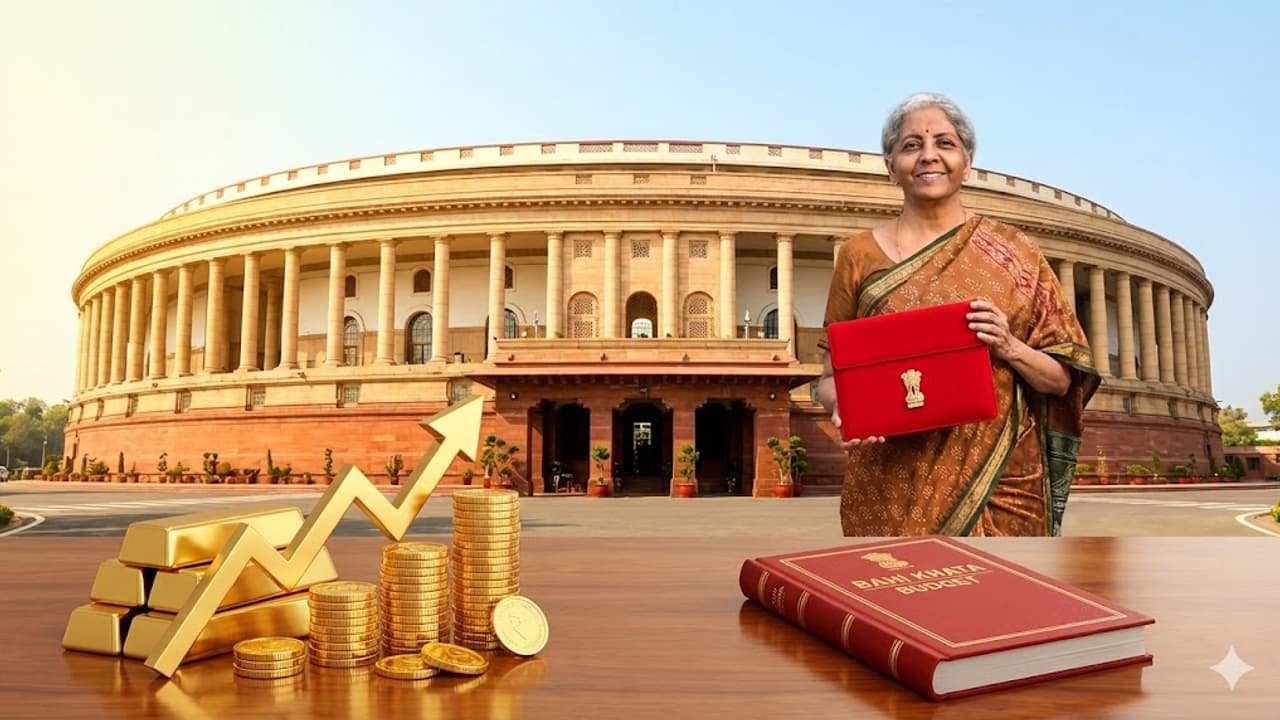
As Nirmala Sitharaman prepares to present her 9th straight Union Budget, markets watch key numbers on fiscal deficit, capex, debt roadmap, borrowing, GST, tax revenue and GDP growth.
Finance Minister Nirmala Sitharaman is set to present her record ninth consecutive Union Budget on Sunday, with expectations running high around customs reforms, fiscal consolidation and capital spending. Sitharaman had made history in her first Budget in 2019 by replacing the traditional leather briefcase with a red-cloth wrapped ‘bahi-khata’, signalling a break from colonial-era symbolism. Like the last four years, the Union Budget 2026-27 will also be presented in a paperless format.
As markets, economists and industry leaders look ahead, here are the key numbers and themes to watch in the upcoming Budget.
Fiscal Deficit: Roadmap Beyond FY26 in Focus
The budgeted fiscal deficit for FY26 (April 2025 to March 2026) stands at 4.4 per cent of GDP. This marks a significant milestone in the government’s fiscal consolidation journey, having brought the deficit below the 4.5 per cent target.
With this goal achieved, attention will now shift to the medium-term fiscal strategy. Markets will closely watch whether the government provides a specific fiscal deficit target for FY27, with expectations that it could be pegged at around 4 per cent of GDP.
Clarity on how the government plans to further reduce debt levels will be crucial for investor sentiment.
Capital Expenditure: Infrastructure Push Likely to Continue
The government has budgeted capital expenditure at Rs 11.2 lakh crore for FY26, underlining its continued emphasis on infrastructure-led growth.
In the upcoming Budget, the government is expected to retain its capex-heavy approach, with a possible 10–15 per cent increase over current levels, especially as private sector investment remains cautious.
With the next pay revision due only in FY28, fiscal space is expected to remain available, raising expectations that capital expenditure could cross Rs 12 lakh crore.
Debt Roadmap: When Will Debt-to-GDP Begin to Fall?
In her 2024-25 Budget speech, Sitharaman had stated that from 2026-27 onwards, fiscal policy would aim to ensure that central government debt begins declining as a percentage of GDP.
Markets will now look for a clear debt consolidation roadmap from FY27 onwards, particularly on how and when the government plans to bring general government debt-to-GDP down to the 60 per cent target.
As of 2024, general government debt stood at 85 per cent of GDP, including 57 per cent central government debt.
Borrowing Programme: Market Impact Under Watch
The government’s gross market borrowing for FY26 is budgeted at Rs 14.80 lakh crore.
This figure is closely tracked by bond markets, as it offers insights into the government’s fiscal health, revenue assumptions and expenditure plans. Any sharp deviation could have implications for bond yields and liquidity conditions.
Tax Revenue: Double-Digit Growth Assumed
The 2025-26 Budget has pegged gross tax revenue at Rs 42.70 lakh crore, reflecting an 11 per cent increase over FY25.
This includes:
- Rs 25.20 lakh crore from direct taxes, covering personal income tax and corporate tax
- Rs 17.5 lakh crore from indirect taxes, including customs duty, excise and GST
How realistic these projections are — especially amid global uncertainty — will be a key point of debate.
GST Collections: Momentum Expected in FY27
GST collections for FY26 are estimated to rise 11 per cent to Rs 11.78 lakh crore.
FY27 projections will be watched closely, as GST revenue growth is expected to gain momentum following the government’s rate reductions implemented since September 2025.
Sustained GST growth will be critical for both fiscal stability and state finances.
Nominal GDP: Inflation Signals Ahead
India’s nominal GDP growth for FY26 was initially estimated at 10.1 per cent, with real GDP growth at 7.4 per cent as per NSO.
However, nominal GDP growth has since been revised downward to 8 per cent, after inflation turned out lower than earlier assumptions.
Looking ahead, the FY27 nominal GDP projection will offer important clues about the government’s inflation outlook, with expectations ranging between 10.5 and 11 per cent.
Spending Priorities: Welfare and Social Sectors in Spotlight
Apart from macro numbers, the Budget spotlight will also be on allocations for key welfare schemes such as G RAM G, along with spending on health and education, which remain politically and economically significant.
How the government balances fiscal discipline with social sector commitments will define the broader narrative of Budget 2026-27.