Hence, it was no surprise that the anticipation was going through the roof for the second edition of the World Cup in the UK.
The 2009 tournament saw the innocence of the 2007 edition fade, but there was still some rawness as the ruthlessness of modern T20 hadn’t yet arrived, and only a few batters showed the stomach to go all out and launch a full-blown onslaught from the get-go. Hence, it was not surprising that we got intense drama and vulnerability in the 2009 World Cup.
The 2009 T20 World Cup wasn’t flashy or the highest-scoring by any stretch of the imagination. It didn’t even have the polish of later editions. But it had something rarer, teams, finding their way. It taught teams how to bowl at the death, value spin, and pace a chase.
Today, when T20 feels industrial and relentless, 2009 stands as a reminder of when the format still surprised us – when twenty overs could feel like a lifetime, and cricket, once again, felt beautifully human.
16 years have passed since the second edition of the T20 World Cup, and the time is perfect to reflect on the games gone by and the biggest highlights that emerged from the tournament, where Pakistan came out on top in a thrilling final against Sri Lanka at Lord’s Cricket Ground.
Here are some of the talking points moments from the 2009 World Cup:
The tournament gets off to an unexpected but thrilling start
The T20 World Cup opener in 2009 was played between England and the Netherlands. Heading into the match, there were question marks about whether England would be an ideal venue for the tournament, given that it was not an obvious destination for slam-bang cricket, with overcast skies and pitches that favoured swing bowling. The opener between England and the Netherlands was a delayed start due to rain at Lord’s, but the result made up for a late start as the minnows came out on top in a last-ball thriller. Netherlands chased down the target of 163 on the final ball, and the hosts were given a shock right on the opening day of the tournament itself.
The fall of the defending champions – India fails to make the semi-finals
India arrived as the tournament favourites, carrying the glow of 2007. However, the defending champions were in for a rude reality check as India looked oddly out of sync with the tournament’s rhythm. Losses to England, the West Indies and South Africa came quickly and brutally in the Super Sixes stage. These three defeats led to India bowing out.
West Indies and the real flair of Chris Gayle
If there is one sound that echoes from the 2009 T20 World Cup, it is the music coming out of Chris Gayle’s bat. West Indies played T20 cricket with a freedom that bordered on defiance and flamboyance. They didn’t calculate; they just unleashed. Gayle’s 88 against Australia at The Oval remains one of those innings that live outside time. The ball disappeared into the stands, into the London sky, into folklore. West Indies didn’t win the trophy, but they left behind an idea – that power is the real deal in T20, not finesse.
Pakistan show why they will forever be a maverick team
Pakistan, which came up short in the final of the 2007 World Cup against India, were once again picked as one of the favourites to go the distance. However, their tournament began shakily, but something slowly clicked. The side suffered a defeat in their opening match against England, but Umar Gul led the team’s emergence, discovering a mastery of death bowling that would influence a generation. Along with Gul, Saeed Ajmal turned the ball just enough to make batsmen doubt themselves. And then there was Shahid Afridi – mercurial, frustrating, brilliant. In 2009, he found balance. Not recklessness, not restraint, but control.
Lord’s, June 21, and a thrilling finale at Lord’s
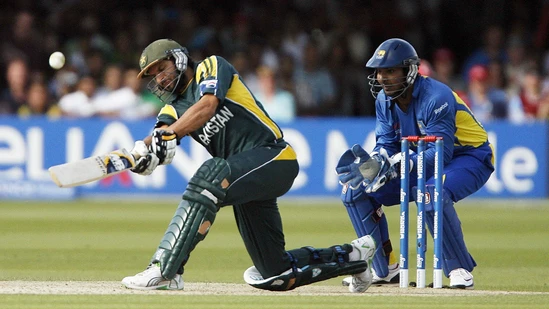
Lord’s has hosted countless finals, but few felt as emotionally charged as this one, and it was expected. Asian dominance was on show as Sri Lanka and Pakistan squared off in the finale. Sri Lanka faced a top-order collapse, but Kumar Sangakkara steered the ship and the eventual total of 138 was built around the left-hander’s elegance – a reminder that even in T20 cricket, sometimes you do need anchors.
Pakistan’s chase wobbled early. Wickets fell. Doubt crept in. It was then that Afridi walked in and refused to let the moment dictate terms. His unbeaten 54 was not chaos; it was clarity. When he struck the winning six, the release was overwhelming. Players collapsed. Smiles turned to tears. For Pakistan, it was more than a trophy – it was healing.