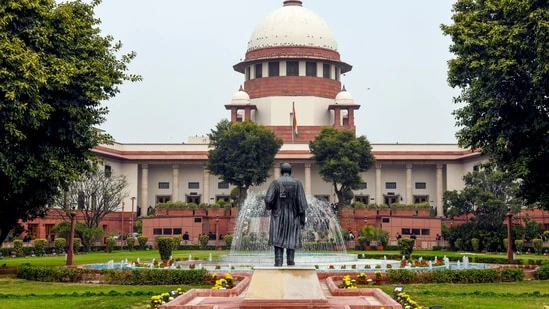
The Supreme Court on Friday directed all states and Union Territories to ensure that schools provide biodegradable menstrual sanitary pads to students for free.
Recognising the right to menstrual hygiene and access to menstrual hygiene products, the court said that it is part of the right to life under Article 21 of the Indian Constitution.
A bench of Justices J B Pardiwala and R Mahadevan told states and Union Territories to ensure separate toilets for female and male students and ensure availability of sanitary pads in classes 6 to 12, HT reported.
It also said all schools, irrespective of whether they are state-run or controlled, will have to provide disabled-friendly toilets, sanitary napkins, water and soap, along with spare uniforms for girls.
The ruling was passed in relation to the implementation of the Centre’s policy on ‘Menstrual Hygiene Policy for School-going Girls’ in government schools.
The bench also said that it would hold governments accountable if they too fail to provide for toilets and free sanitary pads to girls.
The Court also emphasised that the right to a healthy reproductive life also leads to embracing the right to access education and information about sexual health. Connecting the idea of menstrual health to equality of opportunity, the court rules that “equality of opportunity necessitates that everyone has a fair chance to acquire the skills necessary to access benefits.”
Menstrual hygiene a fundamental right
The Court ruled that the right to menstrual health comes under the right to life in Article 21. Further highlighting the need for affordable menstrual hygiene measures, the Court said that it can help a girl child “attain the highest standard of sexual and reproductive health.”
“The right to life under Article 21 of the Constitution includes the right to menstrual health. Access to safe, effective, and affordable menstrual hygiene management measures helps a girl child attain the highest standard of sexual and reproductive health. The right to a healthy reproductive life embraces the right to access education and information about sexual health. The right to equality is expressed through the right to participate on equal terms. At the same time, equality of opportunity necessitates that everyone has a fair chance to acquire the skills necessary to access benefits,” read the order issued by the top court as per Bar and Bench.
Inaccessibility to menstrual hygiene amounts to violation of dignity
In its ruling, the Court said that the inaccessibility of menstrual hygiene management is equal to a violation of the dignity of a girl child. They said that dignity is connected to living without humiliation and avoiding suffering.
The Court said that this ruling is meant for the classroom, where girls hesitate to ask for help and where teachers are limited by their resources to help students.
It said that the judgment was a message to every girl forced into absenteeism because her body became a burden. “The fault is not yours.”