
New Delhi: The safety and oversight of India’s rapidly expanding aviation industry have come under the spotlight following a startling set of data released by the Ministry of Civil Aviation.
In a written response to a series of pointed questions from Member of Parliament Rachana Banerjee, the government has admitted to massive personnel shortages across the nation’s three primary aviation bodies, the Directorate General of Civil Aviation (DGCA), Air Traffic Control (ATC), and the Airports Authority of India (AAI).
A Statistical Breakdown
The data, presented by Minister of State Murlidhar Mohol, paints a worrying picture of an industry operating with significantly fewer personnel than required.
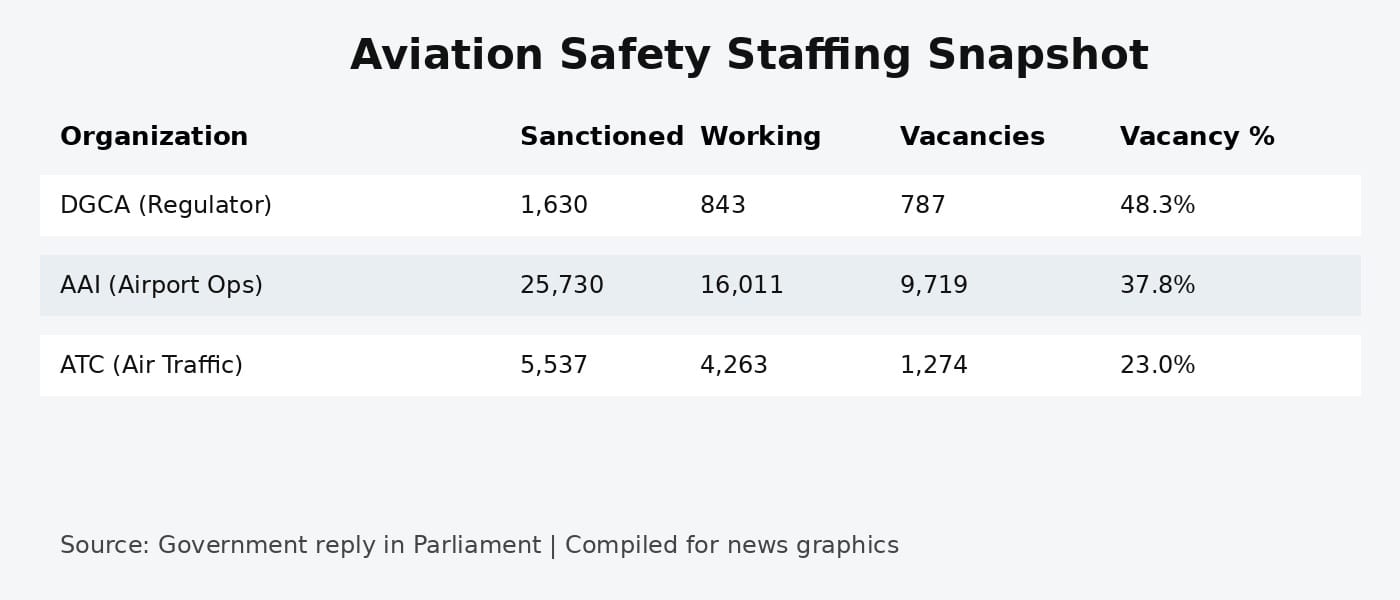
The most glaring gap is found within the DGCA, the very body responsible for enforcing safety regulations, where nearly half of all positions remain unfilled.
A five-year trend of staffing shortfalls
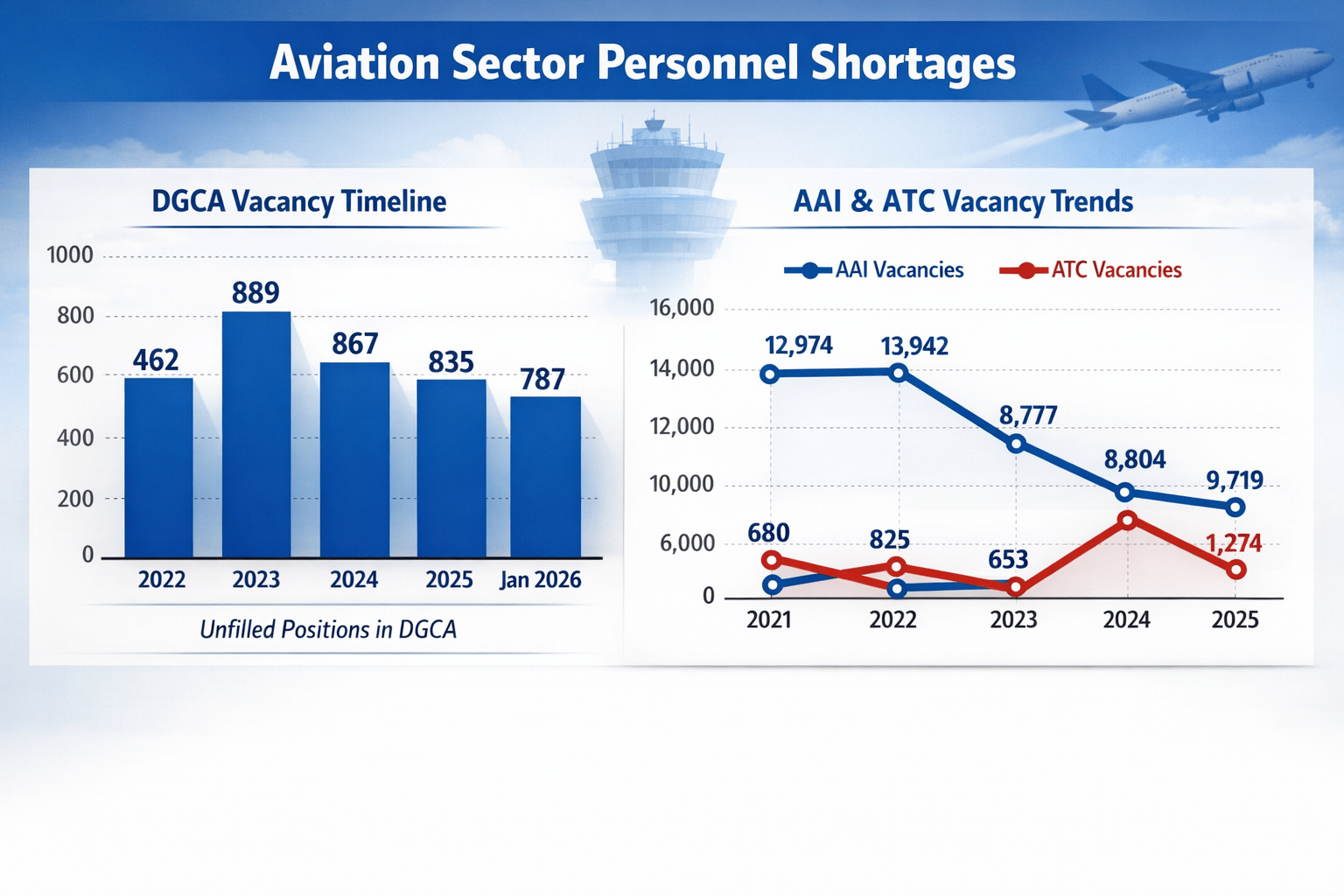
The parliamentary reply provided a deep dive into how these vacancies have fluctuated over the last half-decade, showing that despite some improvements, the numbers remain high.
DGCA vacancy timeline
| Year | DGCA vacancies |
|---|---|
| 2022 | 462 |
| 2023 | 889 |
| 2024 | 867 |
| 2025 | 835 |
| Jan 2026 | 787 |
AAI & ATC vacancy trends
| Year | AAI vacancies | ATC vacancies |
|---|---|---|
| 2021 | 12,974 | 680 |
| 2022 | 13,942 | 825 |
| 2023 | 8,777 | 653 |
| 2024 | 8,804 | 1,609 |
| 2025 | 9,719 | 1,274 |
Critical Safety Roles Left Vacant
Perhaps the most concerning aspect of the disclosure is the shortage of “Group A” Technical Officers and Flight Operations Inspectors (FOIs). These individuals are directly responsible for the safety of aircraft, passengers, and cabin crew.
While the government increased the sanctioned strength for these safety-critical roles from 643 in 2022 to 1,063 in 2026, recruitment has struggled to keep pace. As of January 22, 2026, there are still 526 vacancies in this category, meaning nearly 50% of the top-tier safety oversight team is missing, the government said in response.
The implications for Indian aviation
MP Rachana Banerjee’s inquiry was driven by concerns over whether the current workforce can effectively manage the surge in Indian air traffic. The revelation that the AAI is missing nearly 10,000 employees and the ATC is short by over 1,200 controllers raises serious questions about employee burnout and the long-term sustainability of aviation safety standards.
While the Ministry provided the detailed “answer sheet” requested, the numbers suggest that the path to a fully staffed and secure aviation environment remains a steep climb for the government.