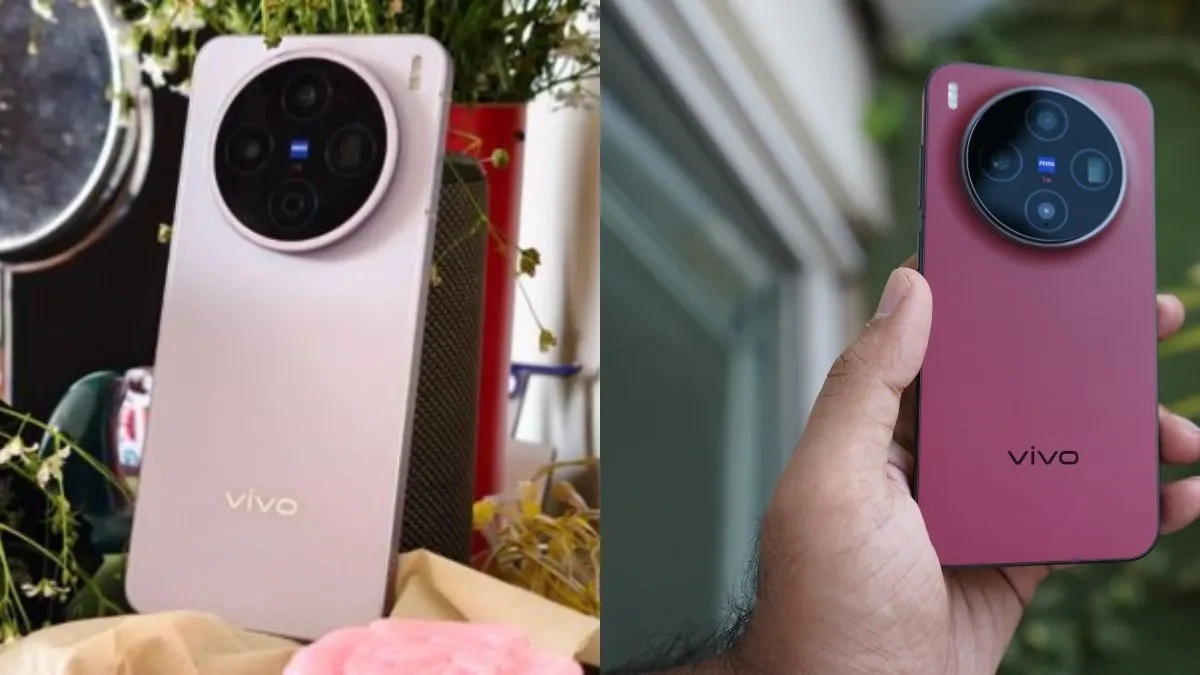
To clear your confusion, we’ll explain the differences between the Vivo X200T and the Vivo X300 and help you understand who should buy which smartphone and why. Let’s take a look at our detailed comparison of both the Vivo X200T and X300.

Vivo X200T vs Vivo X300: Features & Price Comparison
| Feature | Vivo X200T | Vivo X300 |
|---|---|---|
| Design & Protection | Metal frame, flat display, IP68 + IP69 | Metal frame, flat display, IP68 + IP69 |
| Thickness & Weight | 7.99mm, 203g | 7.95mm, 190g |
| Display | 6.67″ 1.5K AMOLED, 120Hz, 5,000 nits | 6.31″ 1.5K LTPO AMOLED, 120Hz (adaptive), 4,500 nits |
| Processor | MediaTek Dimensity 9400+ | MediaTek Dimensity 9500 |
| RAM & Storage | LPDDR5X, UFS 4.1 | LPDDR5X, UFS 4.1 |
| Software Support | Android 16, OriginOS 6, 5 OS + 7 Security | Android 16, OriginOS 6, 5 OS + 7 Security |
| Camera Setup | 50MP (OIS) + 50MP UW + 50MP 3x telephoto; 32MP selfie; 4K@60fps | 200MP (OIS) + 50MP 3x periscope + 50MP UW; 50MP selfie; 4K@120fps |
| Battery & Charging | 6,200mAh, 90W wired, 40W wireless | 6,040mAh, 90W wired, 40W wireless |
| Starting Price | ₹59,999 | ₹75,999 |
Vivo X200T vs X300: Price
The Vivo X200T price in India starts from Rs 59,999 for the base 12GB/256GB model, while the 12GB/512GB configuration will cost Rs 69,999. The Vivo X200T is offered in Seaside Lilac and Stellar Black shades.
On the other hand, the Vivo X300 comes in Elite Black, Mist Blue and Summit Red colours and starts at Rs 75,999 for the 12GB/256GB model. While the 12GB/512GB and 16GB/512GB models are priced at Rs 81,999 and Rs 85,999, respectively.
Vivo X200T vs X300: What’s the Difference?
The Vivo X200T and the X300 retain a similar design language, featuring a box-shaped metal frame with rounded edges and a flat display. Both units also come with a large circular rear camera module and IP68/IP69 ratings, ensuring strong durability.
The key difference in design lies in their physical dimensions and weight. The Vivo X200T measures 7.99mm in thickness and weighs 203g, while the Vivo X300 is slightly slimmer at 7.95mm and noticeably lighter at 190g, making it more comfortable for one-handed use.

In terms of display, the Vivo X200T features a 6.67-inch 1.5K (2800 × 1260 pixels) AMOLED panel with a 120Hz refresh rate and up to 5,000 nits of peak brightness. On the other hand, the Vivo X300 sports a more compact 6.31-inch 1.5K LTPO AMOLED display (2640 × 1216 pixels) with up to a 120Hz adaptive refresh rate and 4,500 nits of peak brightness.
While the resolution difference between the two is minimal, the overall viewing experience varies due to screen size and panel technology. Users who prefer a compact smartphone with an LTPO display will find the Vivo X300 better. Meanwhile, the Vivo X200T is perfect for those who want a larger display with higher peak brightness.
Both smartphones are powered by a MediaTek chip and paired with LPDDR5X RAM and UFS 4.1 storage, ensuring smooth performance. The Vivo X200T has the MediaTek Dimensity 9400+ chipset, while the Vivo X300 features the MediaTek Dimensity 9500 processor.
In terms of performance, both devices are touted to surpass an AnTuTu score of 3 million points. They can easily handle day-to-day usage and gaming as well. While the Dimensity 9400+ is a slightly older chipset, it still delivers smooth performance. On the other hand, the Vivo X300’s newer processor is claimed to fix battery drain during heavy use and camera smarts that work without the cloud.
On the software front, both phones run Android 16 with OriginOS 6 and are confirmed to get five years of OS updates along with seven years of security updates. In terms of battery, the Vivo X200T packs a larger 6,200mAh battery with 90W wired and 40W wireless charging. Meanwhile, the Vivo X300 features a 6,040mAh battery, also supporting 90W wired and 40W wireless charging.
For optics, the Vivo X200T features a triple rear camera setup, including a 50MP Sony IMX921 primary sensor with OIS, a 50MP Samsung JN1 ultra-wide lens, and a 50MP Sony IMX882 telephoto camera offering 3x optical zoom. Upfront, it gets a 32MP front camera and supports 4K video recording at up to 60fps on both front and rear cameras.
In comparison, the Vivo X300 offers a more advanced camera system headlined by a 200MP HP5 primary sensor with OIS, a 50MP Sony LYT-602 periscope lens with 3x optical zoom and a 50MP JN1 ultra-wide camera. It is also backed by Vivo’s V3+ imaging chip and supports 4K video recording at up to 120fps. For selfies, you will get a 50MP sensor with support for 4K video recording at up to 60fps.
Which One Should You Buy?
The Vivo X200T is definitely a great choice, which brings most of the high-end features at a lower price compared to the X300. However, the Vivo X300 justifies its higher price with a powerful processor, compact design, and an advanced camera system. If you don’t want to spend more than Rs 60K, the X200T is the smarter pick, but if you want pro-level features in a non-Pro model, the X300 is worth considering in 2026.
Buy the Vivo X200T if: You want a premium Android phone at a relatively lower price with a larger display, wireless charging, and an impressive camera.
Buy the Vivo X300 if: You prefer a more compact and lighter phone with high-end performance and advanced imaging capabilities.