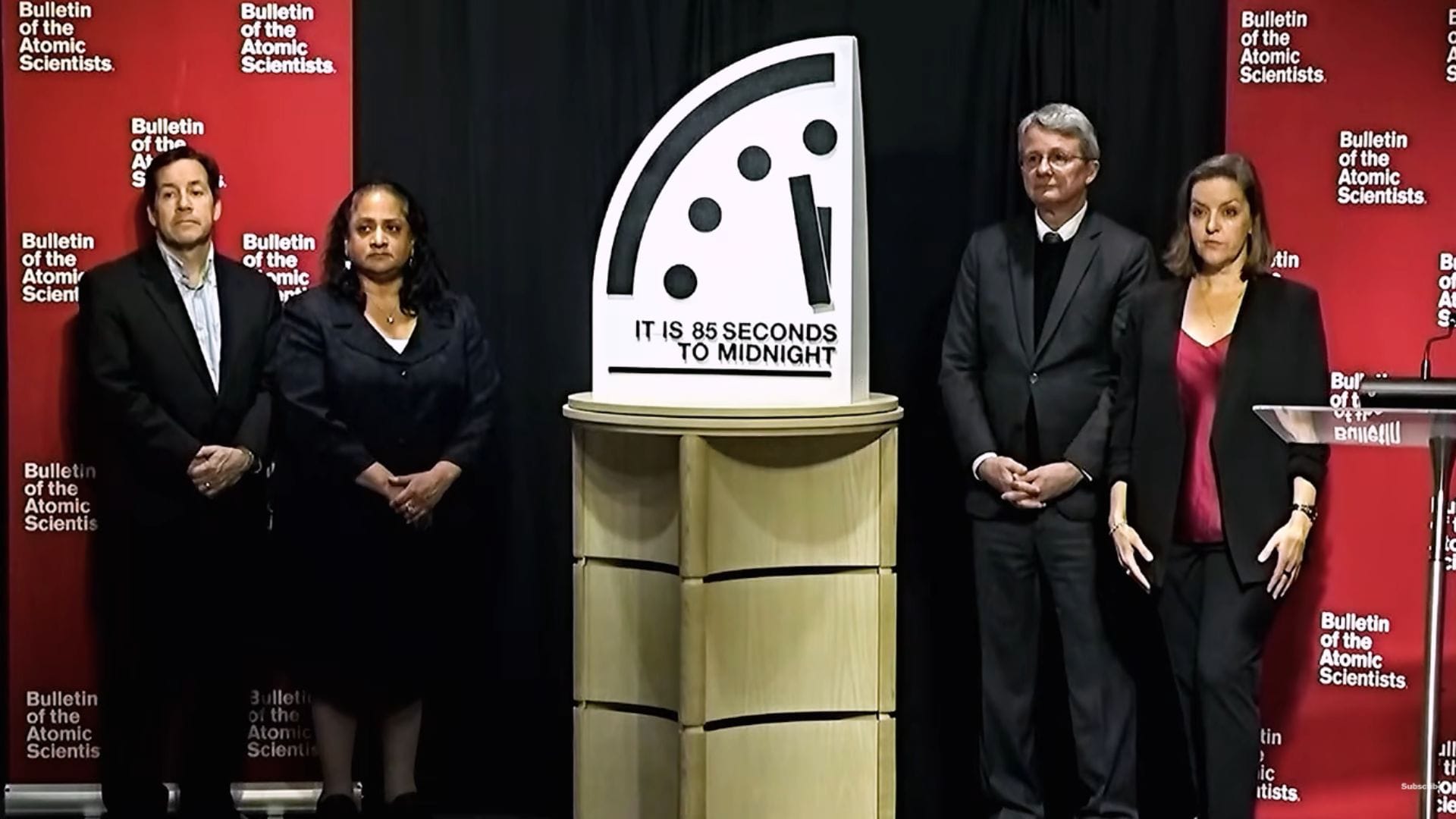
New Delhi: The Doomsday Clock is a symbolic representation of how close humanity is to the end of the world, maintained by The Bulletin of Atomic Scientists since 1947. The Clock was created after the nuclear bombings of Hiroshima and Nagasaki, to serve as an indicator of how close humanity is to global disaster, with midnight denoting the apocalypse. The Doomsday Clock has been set at 85 seconds to midnight in 2026, which is the closest point to global catastrophe in its history. The adjustments reflects escalating risk from nuclear brinkmanship, climate change, biological threats and AI, in times of deteriorating global cooperation.
The Bulletin of Atomic Scientists announced the position of the clock citing a year of intensified international turmoil and leadership failures. Last year, it stood at 89 seconds, with the four second advance highlighting emerging biotech hazards, unchecked AI integration, record climate extremes, and collapsing arms control agreements. The scientists have also attributed the advancement to aggressive nationalism in major powers such as Russia, China and the United States, which has eroded multilateral efforts to mitigate existential threats that humanity is facing. The announcement calls for urgent measures, including renewed dialogues on nuclear weapons, and regulatory frameworks for emerging technologies.
Nuclear Risks
Nuclear threats intensified in 2025 through three regional conflicts involving nuclear states. This includes the ongoing Russia-Ukraine war with novel tactics, the border conflict between India and Pakistan featuring drone and missile strikes, and the US-Israeli attacks on Iranian nuclear sites, potentially driving covert weaponisations. China expanded its arsenal of warheads, while USA, Russia and China modernised their delivery systems. The planned Golden Dome missile defence system of the US includes space-based interceptors, that risks sparking an arms race in space. The extended deterrence of the US has prompted non-nuclear states to consider proliferation. The expiry of the Strategic Arms Reduction Treaty (START) between the US and Russia is on the verge of expiring, ending limits on nuclear weapons. There have been to talks around stability or disarmament.
Climate Change
Atmospheric carbon dioxide has hit 150 per cent of preindustrial levels, with global temperatures matching the record high in 2024. Sea levels are peaking from melting glaciers, and erratic hydrology has resulted in widespread droughts in South America and Africa. Floods have displaced 350,000 people in Congo and over 500,000 people in brazil. For the third time in four years, 60,000 heat-related deaths have been recorded in Europe. UN summits have ignored fossil fuel phaseouts and emissions monitoring. The Trump administration in the US has dismantled incentives for renewable energy, along with climate-focused policies, and has prioritised the use of fossil fuels. These trends together amplify feedback loops such as thawing permafrost releasing methane. This thawing permafrost can also release long-trapped pathogens.
Biological Threats
In December 2024, scientists created synthetic mirror-image cells that could evade controls and spread globally, disrupting ecosystems. These lifeforms use chiral molecules incompatible with natural biology, and have the potential of outcompeting life forms. There are calls for bans for the creation of such microbes, but there is no international plan in place yet. AI-enabled pathogen design can be used to create novel bioweapons with no defences. State-sponsored oversight has been eroded because of weakening norms. China and Russia have opaque biological research programmes. There is a need for an updated biological weapons convention.
Disruptive Technologies
The growing sophistication of AI has sharply increased global risks. Large language models are now embedded in critical systems despite persistent hallucinations. The US, Russia and China have integrated AI into military operations, including nuclear command systems, raising the odds of accidents or unintended escalations from misread data or false positives in early warning systems. The US has revoked prior executive orders designed to provide guardrails to AI. AI also fuels disinformation through deepfakes, eroding trust, and hampering responses to major threats. Rising autocracy in nuclear powers fosters zero-sum attitudes that are a roadblock to cooperation.
Humans are closer than ever to a global disaster.