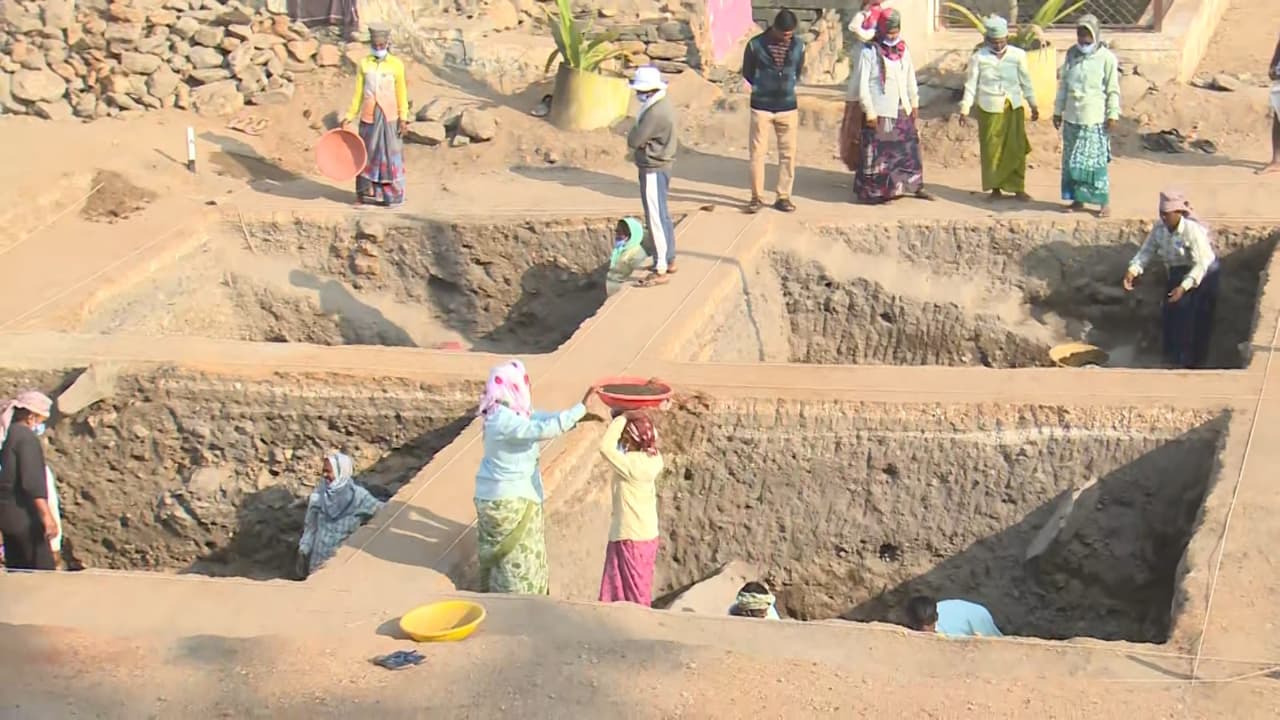
During the 10th day of excavation in historic Lakkundi, archaeologists discovered an ancient inscription and a Linga-shaped stone near Chandramouleshwara Temple. Around seven feet of soil has been dug, revealing temple foundations.
On Tuesday, the 10th day of the ongoing excavation in the historic village of Lakkundi, archaeologists discovered an ancient inscription and a small Linga-shaped stone embedded in a pillar beam near the village’s renowned Chandramouleshwara temple. The excavation, aimed at uncovering the temple’s historic foundation and surrounding structures, has so far revealed remarkable traces of the region’s rich architectural and religious heritage, attracting attention from both historians and local devotees.
Labourers Work Amid Anxiety
After a two-day break for Republic Day, work at the excavation site resumed on Tuesday. Cracks appeared in the A-1 and B-1 pits, among the four blocks identified for digging. This forced 35 labourers to continue working cautiously beneath the unstable soil, highlighting the challenges and risks involved in unearthing centuries-old structures.
Seven Feet of Soil Excavated, Key Foundations Revealed
So far, approximately seven feet of soil has been excavated. Archaeologists have uncovered a foundation connecting the Veerabhadreshwara temple and the Pushkarani (Kalyani). In the same area, a recently laid water supply pipeline was also visible, indicating that this spot had been previously excavated or altered. The findings provide new insights into the temple’s original layout and suggest multiple phases of construction and restoration over time.