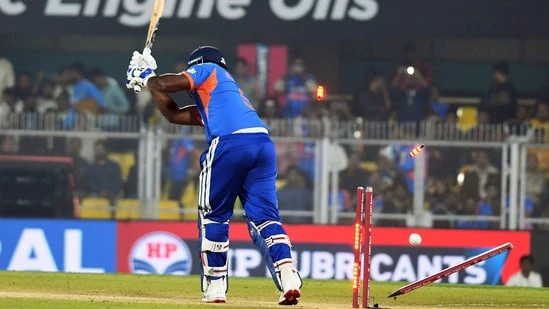
Sanju Samson’s spot in India’s playing XI is once again under the spotlight after a series of low scores in the ongoing T20Is against New Zealand.
The opener has struggled to make an impact, while Ishan Kishan has impressed on his return, increasing the pressure on Samson to perform in the remaining matches. With Tilak Varma set to return from injury, the team management faces a tough decision between Samson and Kishan.
Across 11 years and 55 T20Is, Samson has scored 1,048 runs at a strike rate north of 147, with three fifties and three hundreds – two of those centuries coming in South Africa in late 2024. While averages matter less in modern T20 metrics, his returns against top sides make for mixed reading: a strike rate of 131 against Australia, 118 against England, and 113 versus New Zealand.
Former India batter WV Raman offered a detailed assessment of Sanju Samson’s recent struggles, pointing to a mix of technical shortcomings and mental pressure as key factors. While breaking down issues related to bat speed and adaptability against varying pace, Raman also stressed that competition for the wicketkeeper-batter’s spot may be weighing on Samson, even as he backed his talent and ability to come good for India.
“Sanju has a bit of problem both on technical and mindset front. The bat-speed on his downswing is the same for bowlers with different speeds. It will fetch him success against bowlers in the 130 kmph mark.
“But anything above or less than 130 kmph mark with variations in pace either way, will create issue. The solution is to adjust his bat-speed on the downswing according to the pace of the ball. Once he does that, he should be alright,” Raman said when asked about whether problem is of technical nature or it is the mindset. “On the mental front, he knows that there is a lot of competition for the wicketkeeper-batter’s slot in white ball cricket. That’s all probably putting pressure on him because he still has enough talent to work this out. He is capable player and can deliver for India,” Raman said. However Raman doesn’t necessarily believe that slotting him in the middle-order could have disturbed his rhythm as players of this generation love walking the talk on being flexible.
Raman further shared his views on Sanju Samson’s ideal role in the T20I setup, suggesting that the batter is best suited to operate in the top order. While acknowledging the modern-day emphasis on adaptability and flexibility, Raman felt Samson’s strengths are maximised higher up the order, as long as he isn’t pushed too far down the lineup.
“In the T20Is, he is suited for top three and he shouldn’t have any issues on that front because that is where he can perform at his best. These days, these boys talk about adaptation and being able to bat anywhere. There shouldn’t be a problem unless you are sent extremely down the order,” Raman said.
“It’s all in the mind for Sanju Samson”
Meanwhile, Rajasthan Royals High Performance Director Zubin Bharucha, who has worked closely with Samson, also shared his take on the matter and said for a player like him, it’s more about mental rather than technical.
“There is nothing technical at all. It’s all in the mind for him. He oscillates from mercurial to average because of a lack of clarity, but it happens with everyone.
Bharucha put Sanju Samson’s lean phase into perspective, stressing that such phases are part and parcel of a cricketer’s journey. Drawing parallels with Suryakumar Yadav’s recent struggles, he highlighted the need for better game management and targeted work on weaker areas as the key to finding form again.
“Every player that’s played the game goes through this, he is no exception – Surya (Suryakumar Yadav) just recently. It’s just a matter of learning to manage it better,” feels Bharucha, who has extensive research on finer technical aspects of batting.
“In such situation, it’s just about hitting a few more balls in areas you feel might be weaker than your strength. He has been scoring a lot more runs on the off-side than on-side, deliberately,” Bharucha said.
“This is what all batters do, making the bowler bowl an off stump line but get into positions to score from that line. Now this immediately prompts the bowler to compensate and come inside (middle and leg) and from that position it should be easier and less risky to hit into the on-side.
“Sometimes when you overly set-up to open up the off-side, you can be a little out of position for the leg-side. Just requires a little more awareness around it because Samson already has the on-side shots.”
Asked about the solution, Bharucha replied: “Hit a few more balls in that area during practice. Ideally, constantly get the throwdown expert to move from the off stump line to the leg stump line.”