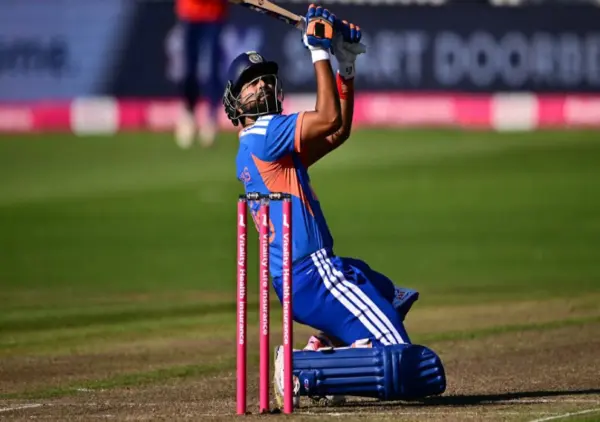
Bristol: India captain Shreyas Iyer etched his name into the record books with a remarkable unbeaten 80 in the fourth T20I against the England cricket team, matching a major milestone previously held by Virat Kohli . While the innings stood out as a significant personal achievement, it came amid another challenging outing for India in the ongoing series.
Iyer’s knock not only helped India post a fighting total of 158 for 7 but also equalled the highest individual score by an Indian captain against England in T20 Internationals. Kohli had earlier set the benchmark with an unbeaten 80 in Ahmedabad in 2021, and Iyer’s effort now places him alongside one of India’s most successful T20I leaders.
Record-breaking feat for Iyer
With this innings, Iyer also became the first Indian captain to score multiple half-centuries in a bilateral T20I series against England. His consistent performances with the bat have been one of the few positives for India in an otherwise difficult tour.
Highest individual scores by an Indian captain vs England in T20Is:
- 80* – Shreyas Iyer (2026)
- 80* – Virat Kohli (2021)
- 77* – Virat Kohli (2021)
- 73* – Virat Kohli (2021)
- 68 – Shreyas Iyer (2026)
The innings highlighted Iyer’s ability to anchor the batting line-up under pressure while also accelerating when required.
A captain’s knock under pressure
India’s innings began on a shaky note, with early wickets putting the team under pressure. The top order once again struggled against England’s disciplined pace attack, leaving Iyer to rebuild the innings.
He found support in Shivam Dube, with the duo adding 53 runs for the fourth wicket. Dube’s contribution of 22 helped stabilise the innings temporarily, but regular wickets meant Iyer had to shoulder the responsibility almost single-handedly.
Adapting to the situation, Iyer played the role of a sheet anchor, carefully rotating the strike while punishing loose deliveries. His innings included four boundaries and five sixes, showcasing a balance of composure and aggression.
Key moment against Adil Rashid
One of the defining passages of play came in the 18th over when Iyer took on leg-spinner Adil Rashid. He smashed two sixes and a four in a 20-run over, providing India with much-needed momentum in the death overs.
However, that burst proved to be an exception rather than the norm, as England’s bowlers quickly regained control. The disciplined efforts in the closing stages restricted India from reaching a more competitive total.
England bowlers maintain control
England’s bowling unit delivered a clinical performance, executing their plans with precision. Sam Curran conceded just four runs in the penultimate over, while the final two overs yielded only eight runs without a single boundary.
Jofra Archer capped off the innings brilliantly, finishing with figures of 2 for 20. His final over included a crucial run-out of Axar Patel, ensuring India could not accelerate further.
Earlier, Archer had dismissed Vaibhav Sooryavanshi, while Josh Tongue removed Ishan Kishan during the powerplay. Rashid also struck early to dismiss Abhishek Sharma, leaving India struggling at 48 for 3 inside seven overs.
India’s recurring batting concerns
The match once again highlighted India’s vulnerability at the top of the order. The inability to build partnerships and capitalise on starts has been a recurring issue throughout the series.
While Iyer’s innings prevented a complete collapse, the lack of contributions from other batters meant India could only post a below-par total. The extra bounce and disciplined bowling from England exposed technical and tactical shortcomings in the Indian line-up.
Conclusion
Shreyas Iyer’s unbeaten 80 will be remembered as a milestone innings that placed him alongside Virat Kohli in the record books. However, the broader context of the match underlined India’s ongoing struggles in the series. As the team navigates a transition phase, performances like Iyer’s offer hope, but greater collective effort will be required to turn individual brilliance into team success.