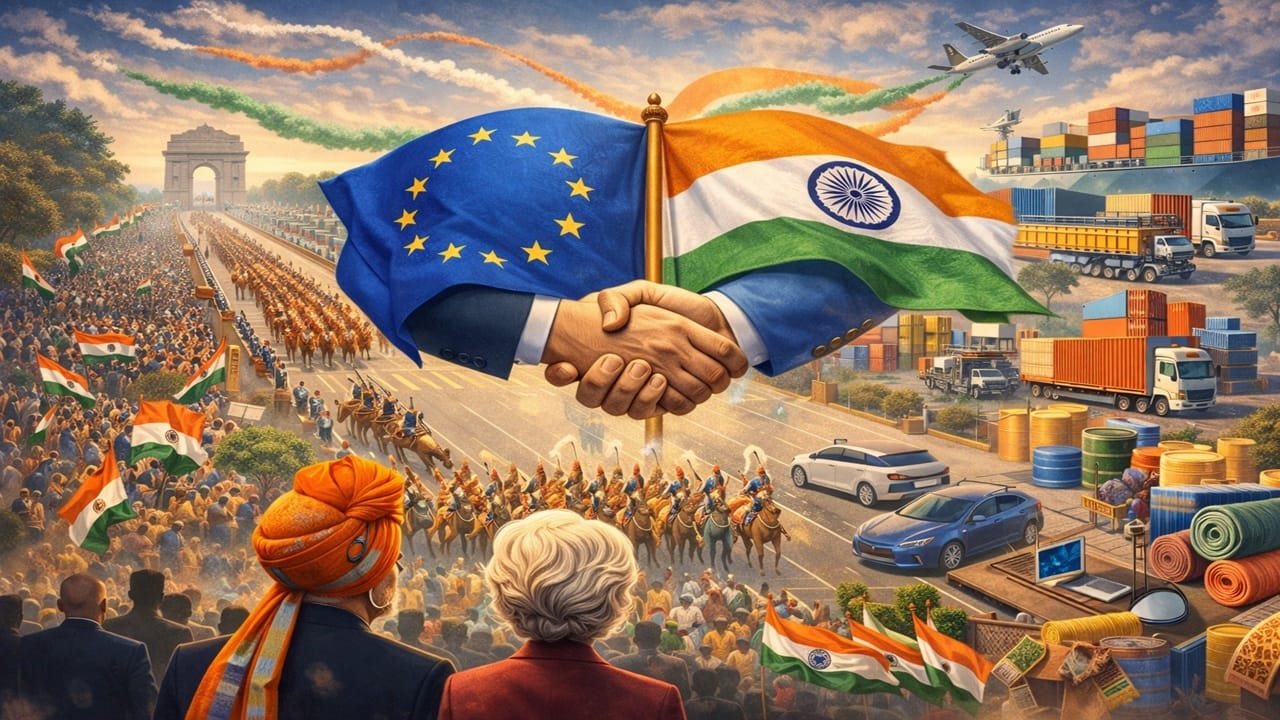
On the occasion of Republic Day, the country’s Kartavya Path witnessed a future worth Rs 12 lakh crore.Image Credit source: ChatGPT
26 January i.e. Republic Day is no less than a great day for the country. On this day, the whole world sees the bravery and strength of the country on the path of duty. Sees different shades of the country’s culture. She also sees a unity in which people of every color and religion are together. Such an example cannot be seen in any country in the world. Despite that, this time’s republic is something special. On this occasion, not only the country but the world saw on the path of duty a golden future worth Rs 12 lakh crore which no one had expected. Everyone from China to America was shocked.
In fact, this time a gathering of trade diplomacy was also seen in the Republic Day celebrations. After this ceremony, a historic trade deal is to be signed between the European Union and India. In such a situation, including the top leadership of the EU as the chief guest in this ceremony was considered an important step. It was also confirmed that a trade deal is going to happen between India and EU. This deal will be signed at the India-European Union summit on January 27. This has been possible due to the strong trade relations between India and the European Union.
In FY 2024-25, bilateral goods trade is set to reach a staggering $136 billion, making the EU India’s largest goods trading partner. Continuous growth has also been seen in service. Indian exports have almost doubled from Rs 19 billion in 2019 to Rs 37 billion in 2024, while European exports to India have increased to Rs 29 billion. In other words, this partnership is not just a formality – it is a financial giant marching ahead gracefully on the path of duty.
Final stage of ‘most important agreement’
India and the European Union are expected to use the summit on January 27 to take stock of the progress in negotiations on a proposed free trade agreement (FTA), which has been under discussion on and off for more than a decade. However, officials have indicated that the talks are in the advanced stage and a formal conclusion is expected soon.
The agreement aims to improve market access for both sides, including reduction in duties on select European exports such as automobiles and wines and expanding access to the 27-member European Union market for Indian goods and services, such as textiles, chemicals, electronics and IT-based services.
European Union chief Ursula von der Leyen tweeted that it is the honor of a lifetime for me to be the chief guest at the Republic Day celebrations. A successful India makes the world more stable, prosperous and secure. Trade analysts say that even after the talks are over, the final legal draft will have to go through the rectification process within both the EU and India before it can be implemented.
A report by the Global Trade Research Initiative has described the agreement as India’s most complex trade negotiation to date, covering goods, services and trade rules under the European Union’s customs union.
Why did this deal become necessary?
Talks between both the sides have been going on for more than a decade. But why is there a rise in it in the present time? This question has become the biggest. In fact, due to the changes seen in global trade due to the current Trump tariffs, this deal has seen a rise. Rising protectionism, supply chain disruptions and US-related trade tensions have heightened the need for both India and the EU to diversify economic partnerships.
Indian exporters also face challenges following the withdrawal of the European Union’s Generalized System of Preferences benefits in 2023, making better access to the European consumer market of approximately 450 million people and an economy estimated at between 18 trillion and 22 trillion euros an important goal. However, trade experts caution that key issues such as regulatory alignment, sustainability standards and dispute resolution mechanisms are still sensitive and unresolved.
Highlighting the broader strategic context, External Affairs Ministry spokesperson Randhir Jaiswal welcomed European Union Vice President Kaja Kallas on her first official visit to India. In a post on The visit comes at an opportune time to further strengthen the India-EU strategic partnership, which will build on the momentum of regular high-level meetings.
Security and defense cooperation taking new shape
Along with trade, security cooperation has emerged as a strong pillar of India-European Union relations. Speaking at the European Parliament earlier this week, Kallas said the European Union has agreed internally to pursue a new security and defense partnership with India. He said that Europe is ready to realize a powerful new agenda with India.
Today, the European Union has agreed to sign a new security and defense partnership. This will expand our cooperation in sectors like maritime security, anti-terrorism and cyber security. I look forward to signing it during the European Union-India Summit in New Delhi next week.
Officials say that although a political agreement has been reached, operational details and implementation framework will evolve over time. Defense relations between India and Europe have traditionally focused on procurement, but now topics like co-development, industrial cooperation and strengthening of supply chains are also increasingly included in the discussions.
France, Germany, Spain and Italy are among the major defense suppliers to India, while Indian exports to European countries – especially ammunition and related products – have increased due to the rebuilding of stockpiles by European governments. The political significance of the tie-up was clearly visible during the Republic Day parade, when a small European Union contingent participated for the first time, according to officials familiar with the plans.
Automobiles, electric vehicles and cautious expectations
- People familiar with the discussions say the free trade agreement is expected to drastically reduce import duty on automobiles, including electric vehicles, from the group of 27 countries, which will be reduced by about 10-15 per cent.
- The move could lead to a significant change in the prices of European luxury electric vehicles in India, creating new demand in a segment that is still small but growing rapidly.
- The agreement, expected to be announced at the bilateral summit on January 27, is being seen as a catalyst to establish India as a manufacturing hub for premium electric vehicles.
- Currently, India imposes almost 100 per cent import duty on European cars with a landed cost of more than $40,000 (about Rs 37 lakh), which falls within the scope of most luxury electric vehicles.
- The drastic reduction in duty will help European makers to price their electric models more competitively and expand their potential market. On the other hand, this agreement is not expected to have any significant impact on budget electric vehicles manufactured by domestic companies and produced locally.
- However, negotiators are exercising caution. According to experts, the FTA has the potential to balance better market access with safeguards for domestic makers like Tata Motors and Mahindra & Mahindra. Instead of comprehensive duty cuts, the discussion has focused on phased duty cuts and quota-based access.
- India’s electric vehicle policy, which mandates 25 per cent domestic value addition by the third year of operation and 50 per cent by the fifth year, is expected to remain an important guiding principle.
- BMW Group India President and CEO Hardeep Singh Brar said in an ET report that we believe this (India-EU free trade agreement) will benefit both sides, expand trade and promote exchange of tech and innovation.
- He said that by leveraging each other’s strengths, it will increase the consumption of luxury vehicles in India and improve supply chain integration – which is extremely important in the current geopolitical context.
A market of 200 crore people will be created
India and the EU have been strategic partners since 2004, but both sides have acknowledged that economic outcomes have often lagged behind political engagement. The current coordination of high-level visits, symbolic Republic Day events and summit diplomacy reflects an effort to bridge this gap. Speaking at the World Economic Forum in Davos earlier this month, von der Leyen said the talks were moving towards an important stage, while stressing that there was still much work to be done.
He said that there is still a lot of work left to do. But we are on the verge of a historic trade deal. Some people call it the biggest agreement ever. An agreement that would create a market of 2 billion people, accounting for almost a quarter of global GDP. As European Union leaders play key roles at India’s Republic Day celebrations, officials from both sides are signaling their intention to use the occasion to cement a deeper, more sustainable partnership that could reshape trade and strategic cooperation for years to come.