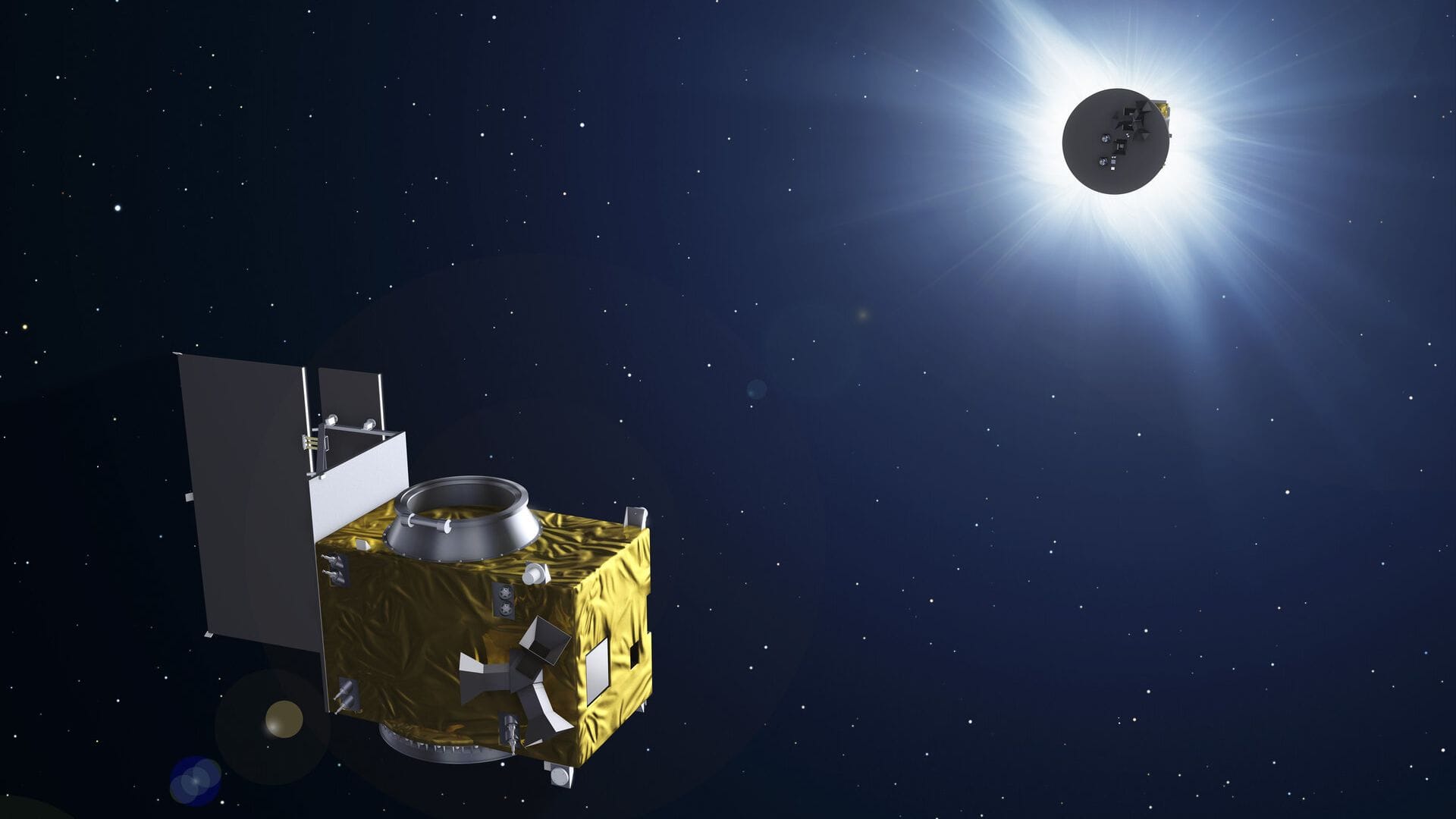
New Delhi: The ESA General Director has admitted that the Proba 3 mission is a current favourite in a post on X. The Proba 3 mission was launched by ISRO’s PSLV-C59 mission on 5 December 2024, to monitor the corona or outer atmosphere of the Sun. The Indian launcher was picked because of its capability of precisely injecting the mission into a highly elliptical orbit. On the same day, a Vega-C launcher carrying the Sentinel-1 mission launched from the European spaceport in French Guiana, providing critical radar imagery. Proba 3 consists of a pair of satellites, a Coronagraph and an Occulter, that fly in precise formation down to a single millimetre.
We shouldn’t have favourite missions…but we all secretly do, don’t we? 😉
2025 was a remarkable year for @esa, with many achievements to celebrate. One that truly captures a sense of wonder is the world’s first-ever artificial solar eclipse in orbit, created by ESA’s Proba-3… pic.twitter.com/NOwZp3Faof
— Josef Aschbacher (@AschbacherJosef) January 23, 2026
Solar scientists travel all over the world to observe eclipses, carrying high-spec telescopes to reveal streamers and plumes, and other fine-scale features in the outer atmosphere of the Sun, which is otherwise lost in the glare. The corona is a million times fainter than direct sunlight. Total Solar Eclipses last between two and four minutes. The Proba 3 mission creates an artificial eclipse, allowing for continuously studying the corona for up to six hours at a time. The principle behind the Proba 3 mission was demonstrated in 1975 by the Apollo-Soyuz mission, where the Apollo spacecraft attempted to block out the Sun while the Soyuz observed the corona. The propellant produced by Apollo foiled the attempt.
Proba 3 can possibly catch sungrazing comets
Proba-3 covers a critical gap between one and three solar radii, that are not observed by other heliophysics observatories. Incidentally, ISRO’s Aditya-L1 mission also covers the same gap, allowing scientists to observe the early stages of coronal mass ejections. The planned mission duration is two years. Principal Investigator for the ASPIICS instrument on the Proba 3 mission, Andrei Zhukov says, “I think it is possible Proba-3 might even show us some previously unknown Sun-grazing comets, despite our relatively small field of view. Any comets would have to come very close to the Sun, but we are hopeful – this is a mission that encourages hope!”