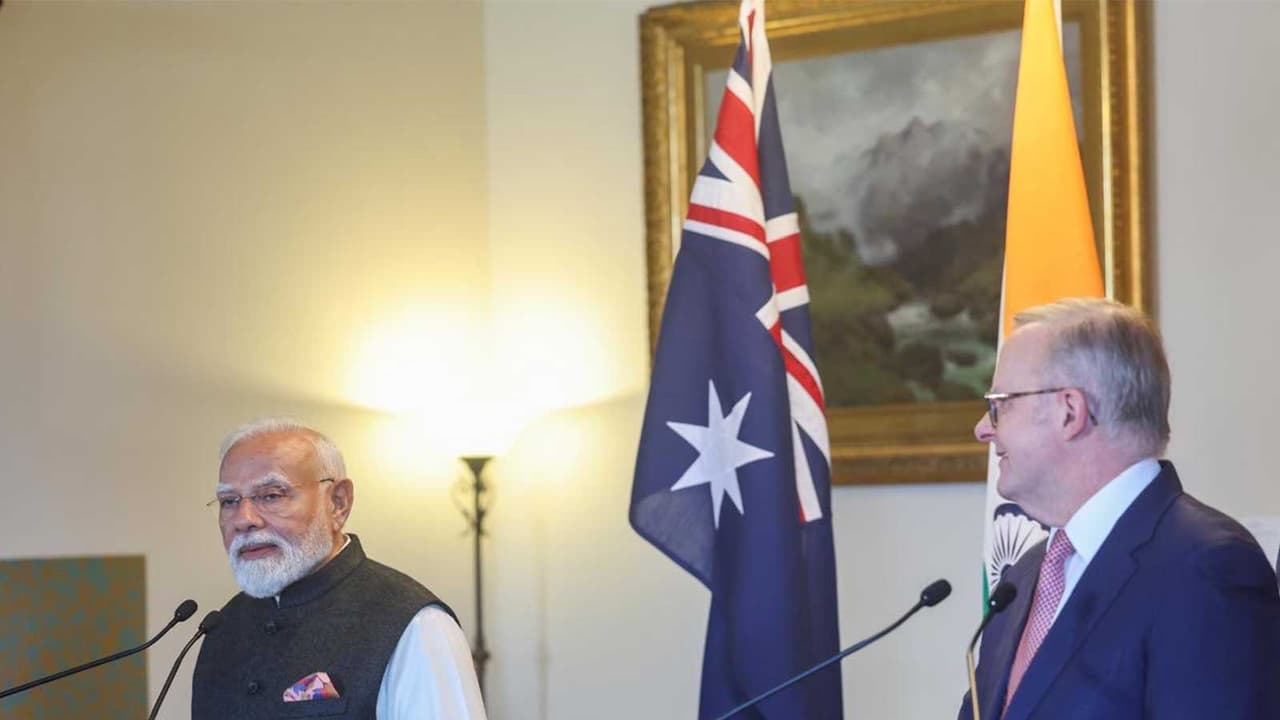
Australia will establish a temporary space tracking station on the Cocos (Keeling) Islands to support India’s Gaganyaan human spaceflight mission, announced PM Anthony Albanese alongside PM Narendra Modi, boosting New Delhi’s space ambitions.
India-Australia Space Cooperation
In a major boost to New Delhi’s extraterrestrial ambitions, Australian Prime Minister Anthony Albanese on Thursday announced the establishment of a temporary space tracking infrastructure on the Cocos (Keeling) Islands to actively support India’s maiden human spaceflight endeavour.
The announcement came during a joint press interaction alongside Prime Minister Narendra Modi, who met his Australian counterpart during the second leg of his three-nation visit. The two leaders shared a warm handshake as they posed for the media in Melbourne, underscoring the deepening strategic convergence between the two democracies.
Addressing the media, PM Albanese highlighted the expanding technological alignment between Canberra and New Delhi. “As we expand our cooperation in space and technology, we have agreed to commission a temporary space tracking terminal on the Cocos (Keeling) Islands, which will support India’s landmark Gaganyaan Human Space Flight Programme,” PM Albanese said.
ISRO’s Technical Breakthrough
The strategic announcement coincides with significant technical breakthroughs back in India, where the Indian Space Research Organisation (ISRO) successfully executed a pivotal validation trial of the main parachute systems designed for the Gaganyaan crew module. According to an official statement, the critical drop test was conducted at the Aerial Delivery Research and Development Establishment (ADRDE) facility in Sheopur, Madhya Pradesh, on Tuesday.
Details of the Parachute Test
Detailing the parameters of the deployment, ISRO stated on Wednesday, “The objective of this test was to qualify the main parachute for its structural integrity and design margins under the maximum expected load conditions in the first uncrewed Gaganyaan G1 mission.”
During the technical evaluation, a simulated setup featuring a single main parachute coupled with a dummy mass was released from an altitude of 2.5 km using an Indian Air Force IL-76 transport aircraft. Following the mid-air release, a drogue parachute was initially deployed. Space officials noted that these specialised parachutes are engineered to stabilise the crew module and drastically decelerate its descent velocity. Subsequently, the primary canopy was deployed, successfully slowing the heavy payload to a safe terminal velocity.
Emphasising the importance of the trial, the space agency noted that the exercise represents a major milestone in certifying the crew recovery framework. “This is the fifth test in a series of Integrated Main Parachute Airdrop Tests (IMAT) to qualify the critical main parachute for the Gaganyaan Mission. The successful completion of IMAT-05 provides the necessary confidence in the performance and reliability of the Main Parachute System for the first uncrewed Gaganyaan Mission (G1),” ISRO added. (ANI)
(Except for the headline, this story has not been edited by Asianet Newsable English staff and is published from a syndicated feed.)