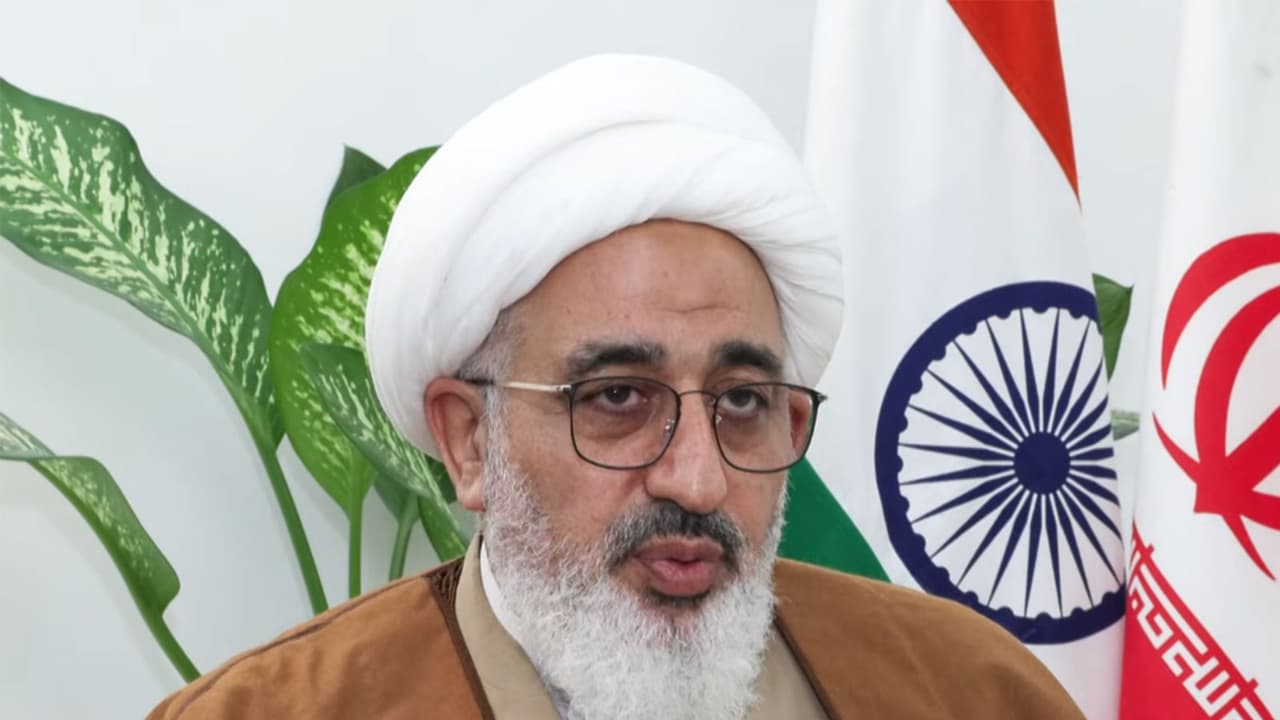
An Iranian representative expressed confidence in the Chabahar port’s progress with India, highlighting deep historical ties. This comes as India engages with the US on sanctions waivers and monitors new tariff threats for doing business with Iran.
Confidence in Chabahar Port Progress
Emphasising the long-standing civilisational and cultural ties between India and Iran, Abdul Majid Hakeem Ilahi, Representative of Iran’s Supreme Leader, has expressed confidence in progress on the Chabahar port in his country, in which India is a development partner.
In an exclusive interview with ANI, Abdul Majid Hakeem Ilahi said that the history of the relationship and collaboration between Iran and India dates back 3,000 years before the emergence of Islam. “The Supreme Leader of the Islamic Republic of Iran always insists on good relations and collaboration between Iran and India…Till now Indian government never affected by sanction of other countries and two governments want to have good relationship and collaboration and I hope that in Chabahar they will work nicely,” he said.
India’s Engagement Amid US Sanctions
He was asked about the fate of the strategically-located Chabahar port, where India has made investments. India said last week that it is engaging with the United States to ensure that work linked to India’s projects at Iran’s Chabahar Port continues under a time-bound sanctions waiver from Washington, which is set to expire on April 26 this year.
“On the question of Chabahar, on 28 October, 2025, as you are aware, the US Department of Treasury had issued a letter outlining guidance, the guidance on the Conditional Sanctions Waiver, which is valid until 26 April, 2026. We remain engaged with the US side in working out this arrangement,” Ministry of External Affairs spokesperson Randhir Jaiswal had said in the weekly media briefing.
India is also monitoring developments related to the 25 per cent additional tariffs announced by the United States for countries doing business with Iran. US President Donald Trump posted on Truth Social earlier this month that any country doing business with Iran will face a 25 per cent tariff. The tariff will be applicable on “any and all business being done with the United States of America and is effective immediately,” Trump said.
Answering a query, Jaiswal said that India-Iran bilateral trade stands at USD 1.6 billion, with exports to Iran at USD 1.2 billion and imports at USD 0.4 billion.
Chabahar Port: A Strategic Initiative
India proposed developing the Chabahar Port in 2003 to provide an alternative route for Indian goods to reach landlocked Afghanistan and Central Asia via road and rail connectivity under the International North-South Transport Corridor, bypassing Pakistan. The progress on the project had slowed earlier due to US sanctions on Iran linked to its suspected nuclear programme. To operationalise India’s role at the port, a long-term agreement was signed between Indian Ports Global Limited (IPGL) and the Port & Maritime Organisation of Iran. The agreement replaces the initial 2016 pact covering India’s role at the Shahid Beheshti terminal in Chabahar Port, which had been extended annually.
Deep-rooted Civilisational Ties
Answering another query, Abdul Majid Hakeem Ilahi said the history of the relationship and collaboration between Iran and India dates back 3,000 years before the emergence of Islam. “Even at that time, we were using philosophical books of India. Even at the university, we studied philosophical books of India, and in mathematics, astronomy, and medicine, we were also using your civilisation, your knowledge, and we always learned through our schools the relationship between Iran and India,” he said.
Representative on Iran’s Internal Situation
He said Iran has economic problems due to sanctions against it and some people are angry “but other people use this opportunity to reach their target and achieve their aims” and noted that the situation at the moment “is very good, under control” and is not like what is being mentioned on some social media handles.
Abdul Majid Hakeem Ilahi said that there is need to distinguish between “reality of the situation” and “imagination” about the situation in Iran. “Concerning the situation in Iran, actually we have two things which we have to divide and differentiate between them. The first one is the fact and the reality of the situation. The second one is imagination, which is created by the journalist’s narration, by the enemies, or by other people. There is a very deep gap between these two realities,” he said.
“The first one is fact, reality, and the second one is imagination…Yes, we have economic problems; some are angry with the situation of the economy, which was created by some countries against Iran, based on the sanctions. But other people use this opportunity to reach their target and achieve their aims. Now, at the moment, the situation is very good, is under control and is not as much as mentioned on social media,” he added.
On Protests and Casualties
Asked about people killed in Iran during the crackdown on nationwide protests, Abdul Majid Hakeem Ilahi, said there are some people who are killed, but the numbers are not clear.. “At first, these protesters attacked civilians, policemen, and businessmen and killed them as they wanted to benefit from this situation, and they mentioned that these people were killed by policemen, which is not true…Yes, the number of killings was mentioned by some organisations which are based in the UK, the US, and in European countries or other countries. But these numbers are incorrect and fake. They want to increase the number of killings to mention that the government killed them,” he said. (ANI)
(Except for the headline, this story has not been edited by Asianet Newsable English staff and is published from a syndicated feed.)