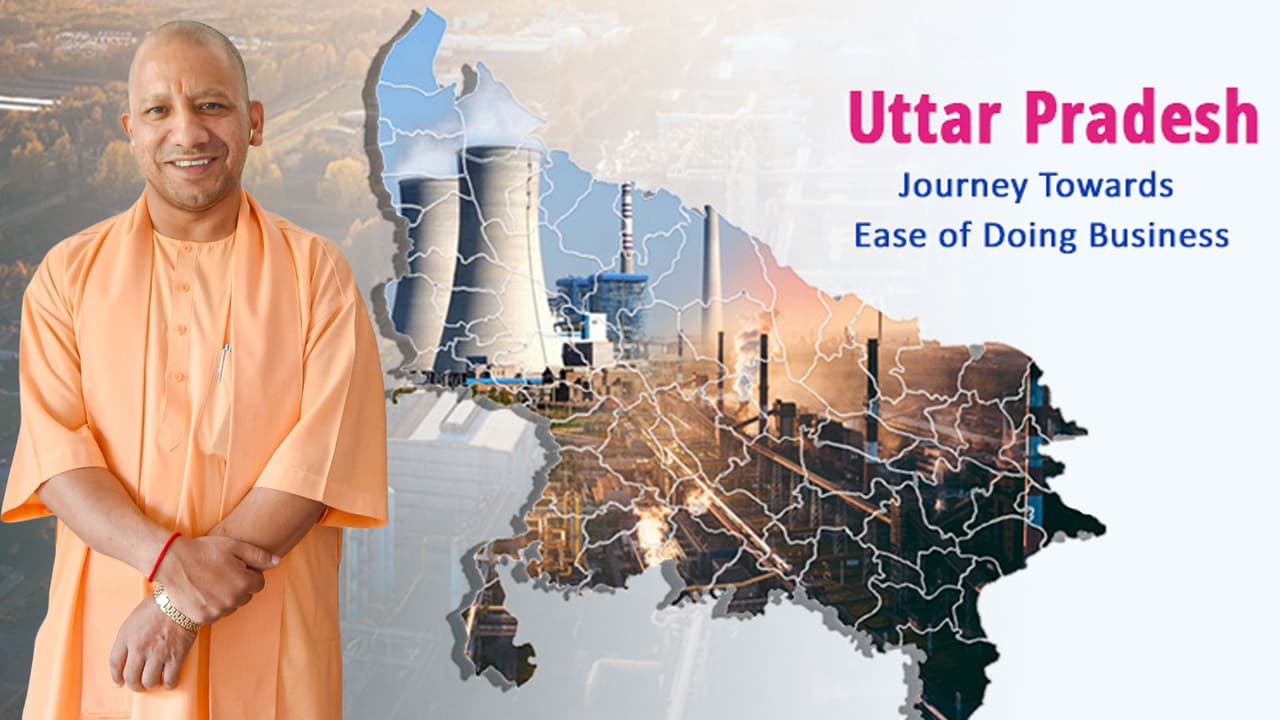
Under the leadership of Yogi Adityanath, Uttar Pradesh has taken a big leap in ease of doing business. With the digital portal Nivesh Mitra, simplification of rules and transparent administration, the state is becoming the first choice of investors.
Lucknow. There was a time when the mention of starting a business in Uttar Pradesh brought complex rules, piles of files and hassles with departments. Investors saw opportunities, but complicated processes put them off. Today Uttar Pradesh has become an example of ‘Ease of Doing Business’ and is included among the leading states of the country. This change did not happen suddenly, but is the result of planned, sustained and concrete reforms under the leadership of Chief Minister Yogi Adityanath. The government made it clear that development does not come through announcements but through systemic reforms.
Jump from 12th place to top states
The Ease of Doing Business rankings provide the strongest testimony to this change. Uttar Pradesh was ranked 12th in the Business Reform Action Plan (BRAP) in the year 2017-18. Due to continuous reforms, the state reached second place in the country in the year 2019.
Uttar Pradesh topped the Commerce and Industry category in the Good Governance Index for the year 2021. After this, in 2022 and 2024 the state got the status of ‘Top Achiever’ in Ease of Doing Business. Uttar Pradesh also remained in the category of ‘achievers’ in logistics ranking in 2022, 2023 and 2024.
Business picture changed due to business reforms
Under BRAP 2024, Uttar Pradesh was declared the ‘top achiever’ in three key areas such as enterprise setup, simplification of labor processes and land administration. After the year 2024, 426 major reforms were implemented in 24 sectors under BRAP and BRAP-Plus. Processes like enterprise registration, land reforms, labor registration, environmental clearances, single window system and construction permits were made simple and time-bound.
Nivesh Mitra: One Portal, Every Solution
‘Nivesh Mitra’ became the center of these reforms, which is included in the country’s largest digital single window portals. More than 525 services of 45 departments are available online through this portal. It is also linked to the National Single Window System, through which state and central processes are being operated simultaneously. Nivesh Mitra has over 97% application disposal rate and over 20 lakh digital approvals have been given so far.
Transparency and trust through digital governance
Yogi government has decided that now no physical applications will be accepted for licenses and approvals. All applications will be through Nivesh Mitra portal only. This increased transparency and reduced the possibility of human interference and corruption. According to user feedback, 96% users are satisfied with Nivesh Mitra, which reflects the public trust in digital governance.
Preparing for the future with Nivesh Mitra 3.0
To further improve the ease of doing business, the government is developing ‘Nivesh Mitra 3.0’. This new version will be equipped with AI based smart dashboard, real-time data analysis, faster complaint redressal and WhatsApp, email and app based notification system. It will be linked to IGRS, Nivesh Sarathi, OIMS, India Industrial Land Bank and Chief Minister’s dashboard ‘Darpan’.
Reduction in compliances, ease of doing business
The government reduced 4,675 regulatory compliances across about 65 departments. Of these, 4,098 compliances were simplified and digitalized, 577 were decriminalized and 948 old laws and rules were abolished. Now, registration under Uttar Pradesh Shops and Commercial Establishment Act-1962 is sufficient for business in Uttar Pradesh. The requirement of trade license has been abolished and shops with less than 20 employees have also been exempted from registration.
Business environment based on trust, not fear
Many offenses have been decriminalized in the fire, labour, transportation and legal metrology departments. The provisions of imprisonment in the Industrial Peace Act have been removed. Today Uttar Pradesh is becoming the first choice of investors not just because of its size or population, but because of its stable policies, digital governance and transparent administration.