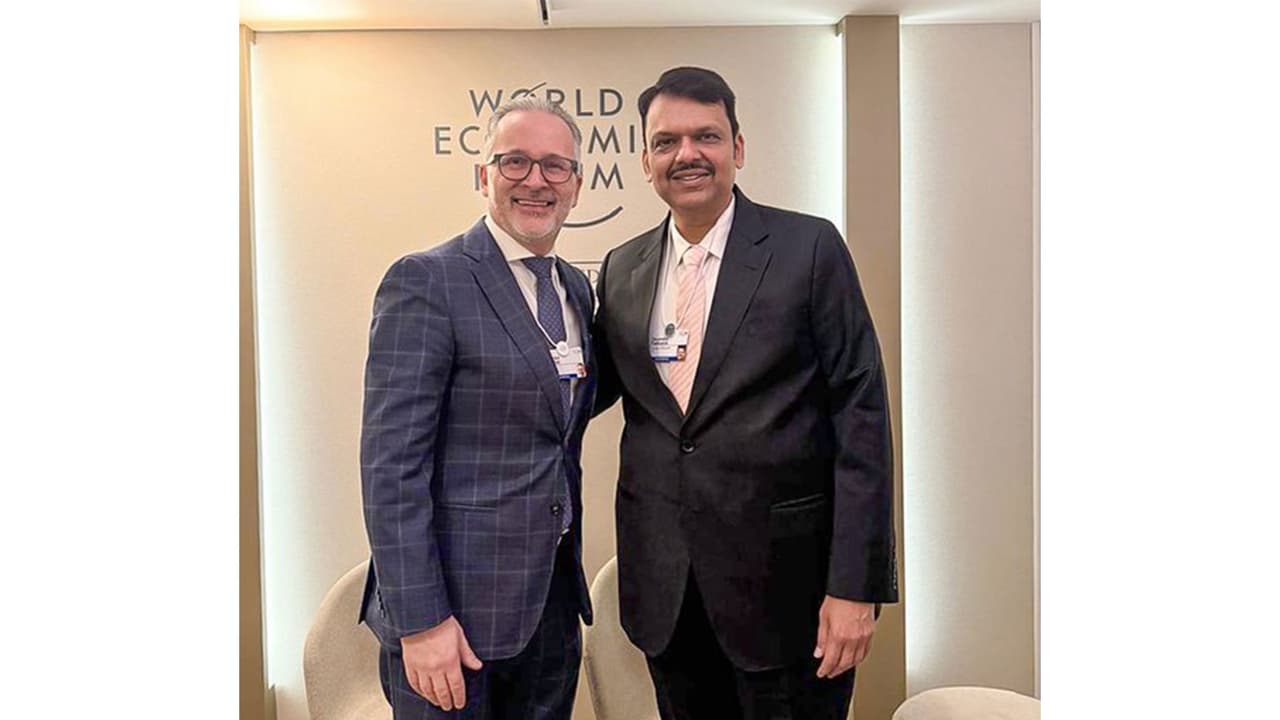
Maharashtra CM Devendra Fadnavis engaged with global leaders from Henkel and NVIDIA at WEF 2026, discussing expansion plans focused on sustainability, AI, and a new Pune office, positioning the state as a top innovation and technology hub.
Fadnavis Engages with Global Tech Leaders
Maharashtra Chief Minister Devendra Fadnavis held high-level interactions with global industry leaders on the sidelines of the World Economic Forum (WEF) 2026 on Thursday, underscoring the state’s growing prominence as a hub for innovation, sustainability, and advanced technology. He met Carsten Knobel, Henkel’s Global CEO, and representatives from NVIDIA to discuss the multinational companies’ expansion plans in India, with a special focus on Maharashtra
The discussions with Carsten Knobel covered Henkel’s sustainability initiatives, including the development of green, environmentally responsible products, as well as future investment opportunities in innovation, research, and development. CM Fadnavis welcomed Henkel’s interest and reiterated the state government’s support for creating world-class products under Maharashtra’s innovation-driven ecosystem.
In another key engagement, CM Fadnavis met representatives of NVIDIA to discuss the company’s growing footprint in India. The talks focused on partner-led data centre GPU deployments, support for sovereign AI initiatives, the development of Indian-language large language models (LLMs), and the proposed establishment of an NVIDIA office in Pune’s Yerwada business district. The Chief Minister highlighted Maharashtra’s readiness to support investments in advanced AI, semiconductors, and digital infrastructure.
Mumbai to Host India’s First Innovation City
Earlier, speaking to ANI on the sidelines of the World Economic Forum in Davos, Switzerland, Fadnavis highlighted on Wednesday that the idea was proposed under the AI and the Innovation Ecosystem theme of the 2025 WEF conference before more than 400 investors, and this year the location has been finalised with the project set to begin in six to eight months. “The city will bring global innovation ecosystems to Mumbai, India. Our goal is to make Mumbai a hub where anyone in the world can easily access a plug-and-play innovation system. Tata Sons has committed $11 billion to develop the Innovation City, including a data centre. Following this announcement, international investors are now expressing serious interest in investing in this city. We are set to build India’s first innovation city near Mumbai,” CM Fadnavis told ANI.
“We have just identified the location and sketched one of its details, which we can now refer to as the contour. The plan is to take the next six to eight months before we begin,” he added.
According to the CM, Tata Sons has committed around USD 10 billion in investment, including infrastructure including a data centre. “I discussed this idea with the chairman of TATA Sons and sought his support. I am delighted that, nearly a year later, we have officially announced this innovation city in Davos before 400-450 international investors,” he said.
Focus on Energy Transition and Nuclear Power
Apart from the city, the CM also discussed focusing on energy transition, particularly the International Solar Alliance. Ministers from Zimbabwe and our Union ministers participated in the discussion, engaging in extensive discussions on energy transition. Notably, Maharashtra has also signed MoUs with Indian and Russian companies to build Small Modular Reactors (SMRs) for nuclear energy use in smaller clusters in the state, made possible by the passage of the SHANTI bill in Parliament.
India’s Broader AI Strategy Outlined
The plan for the city comes as Union Minister of Electronics Ashwini Vaishnaw detailed India’s comprehensive strategy to dominate the global artificial intelligence landscape, emphasising a shift from big-tech-controlled resources to a public-private partnership model. During the ongoing global summit, the Minister pointed out that the world, especially the AI industry, is recognising that India is working methodically across all five layers. “The whole world today, and especially the AI-related industry, is appreciating the fact that India is working methodically on all five layers,” he commented.
Five Layers of India’s AI Mission
He described the five distinct elements that form the backbone of India’s artificial intelligence mission. During the ongoing global summit, the Minister pointed out that the world, especially the AI industry, is recognising that India is working methodically across all five layers. Breaking down the technical framework, the Minister said, “If we look at what AI is, AI has five elements. The first element is the application layer, that is, how we use it. The second is the model layer, the models that are created. The third is the chip layer, the semiconductor layer. The fourth is the infrastructure layer, the data centres. The fifth layer is energy.”
Strategic Shift in AI Economics
The Minister also highlighted a strategic shift in the economics of the Fifth Industrial Revolution, suggesting that the massive ROI of the future will come from cost-effective, scalable solutions rather than just “brute-force” computing. He debunked the myth that all AI progress requires expensive hardware, noting that “nearly 95 per cent of AI work can be done using the 20-50 billion parameter models.” (ANI)
(Except for the headline, this story has not been edited by Asianet Newsable English staff and is published from a syndicated feed.)