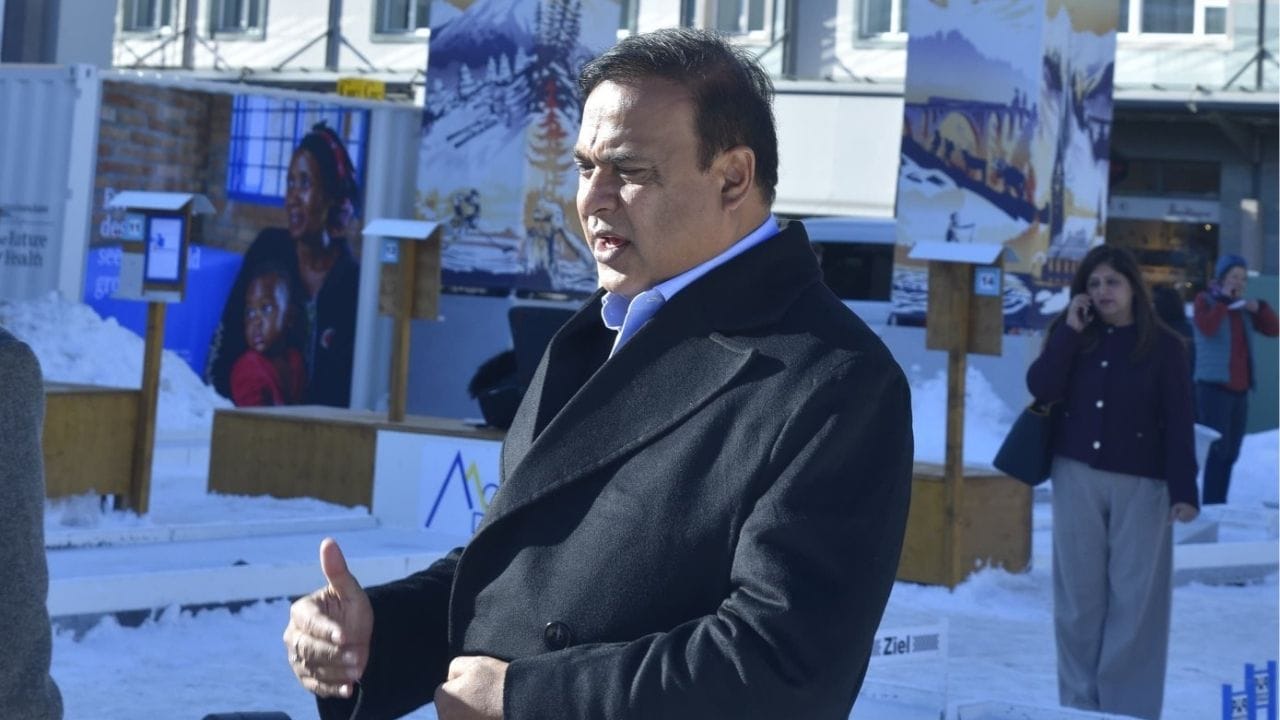
Himanta Biswa Sarma made his debut at the World Economic Forum in Davos with the kind of remarks that travel faster than any investment pitch. The Assam Chief Minister couldn’t resist seasoning the usual script of investment, growth and global opportunity with a generous pinch of domestic political drama.
Davos debut, Delhi-style drama
Davos was his stage, and Himanta Biswa Sarma revelled in the bright spotlight, using the global platform to take aim at his former party, the Congress. More specifically, the Gandhi family. Even in the Swiss Alps, the politics stayed thoroughly desi.
In a conversation with NDTV Editor-in-Chief Rahul Kanwal, Sarma insinuated “a cold war” between Rahul Gandhi and Priyanka Gandhi Vadra and declared himself a “casualty” of what he called “a long-running family theatre”.
Sarma, who spent over two decades in the Congress before switching to the BJP, claimed he has “inner information” on what he sees as a leadership tussle. In his telling, the Congress’s decision to give Priyanka organisational responsibility in Assam is not some strategic masterstroke but a “polite push” out of Kerala.
And trust Sarma to deliver it with the confidence of a man who has spent enough time in party corridors to know where secrets are kept — and where knives are quietly sharpened.
Priyanka in Assam? ‘It’s a “transfer”, not strategy’
Priyanka Vadra, Congress MP from Kerala’s Wayanad, now heads an election committee in Assam. To Sarma, that is the political equivalent of “sending someone to supervise a match in a stadium they have never visited”.
His reading of the move was blunt: Rahul Gandhi, he argued, does not want Priyanka stepping into Kerala’s Congress ecosystem, particularly one shaped around senior leader KC Venugopal. Priyanka, Sarma insisted, is “an outsider” to that inner circle, and so she has been “transferred” elsewhere.
“Flop family” and political one-upmanship
Sarma did not stop at internal Congress dynamics. He took a swipe at the Gandhis themselves, calling them the “world’s biggest flop family”. In a line designed to sting and stick, he added that his own family, having “grown up struggling”, was better than theirs.
It was less policy talk and more personality politics — the sort of punchline that lands well on television and even better on social media.
‘No rivalry with Gaurav Gogoi — just a “constitutional” duty’
Sarma also used the Davos stage to address the controversy around Assam Congress president Gaurav Gogoi. And he did it in classic Himanta style: dramatic, firm, and perfectly built for a primetime clip.
He insisted there was no personal rivalry driving his attacks, claiming it was simply “his duty as Chief Minister to alert the Centre” about what he described as “links with Pakistan’s intelligence agency, the ISI”. Sarma has earlier alleged that Gogoi and his wife have such connections, and in Davos, he showed no sign of softening that stance.
His argument was simple: if the matter involved routine corruption or political mudslinging, he wouldn’t have chased it with this intensity. But when the issue involved what he called an “enemy country”, he said he had “no option but to act”.
The Gogoi row: Security or spectacle? A touch of ‘Dhurandhar’
In other words, Sarma framed the row not as a political spat, but as a national security obligation — the kind where, in his view, silence would be a bigger crime than a wrong accusation.
And then came the punchline. Borrowing straight from the world of Hindi spy thrillers, Sarma dropped a Dhurandhar-style quip: if you catch a spy, will you not expose him?
It was a line designed to do two things at once — portray him as the vigilant protector of the state and cast his opponent in the shadowy role of a suspect who must answer uncomfortable questions.
Whether it’s security or spectacle depends entirely on who you ask. Either way, Sarma knows one truth of modern politics: in the age of viral clips, nothing travels faster than a good spy story.
Bangladesh concerns: ‘Friendly neighbours matter more than we admit’
Sarma also spoke about Bangladesh, expressing concern that changing relations could revive militant activity across the border. He credited the former Sheikh Hasina government with helping Assam tackle extremism, saying the Northeast’s peace owed a lot to cooperation from Dhaka.
Sharing a long border — roughly 800 kilometres — with Bangladesh, Assam, he argued, cannot afford instability next door. He warned that any rise in hostility could have serious consequences. He ominously presaged that “if militancy finds space across the border again, the risks for the Northeast would be grave”.
Assam, he added, is watching developments with Bangladesh closely.
Big development pitch, familiar identity politics, and a final jab
On the issue of development, Sarma tried to strike a more statesmanlike tone. He spoke of transforming Assam “beyond oil and gas, aiming to tap into the semiconductor boom and the wider global economy”. Assam may be landlocked and border-adjacent, “but it remains among India’s fastest-growing large states,” he noted.
As the state gears up for the upcoming Assembly elections in the months ahead, Sarma leaned into familiar themes: identity and demography, calling them “major concerns for Assam”. And, of course, World Economic Forum was the perfect stage to raise the issues of development and national security, especially when these are the key selling points in the upcoming Assembly elections. And, as if to end on brand, he concluded with a dig at West Bengal, calling Assam “peaceful” — with “no fear of stones being thrown”.
At Davos, Sarma came to talk business. He left, making headlines — true Himanta style.