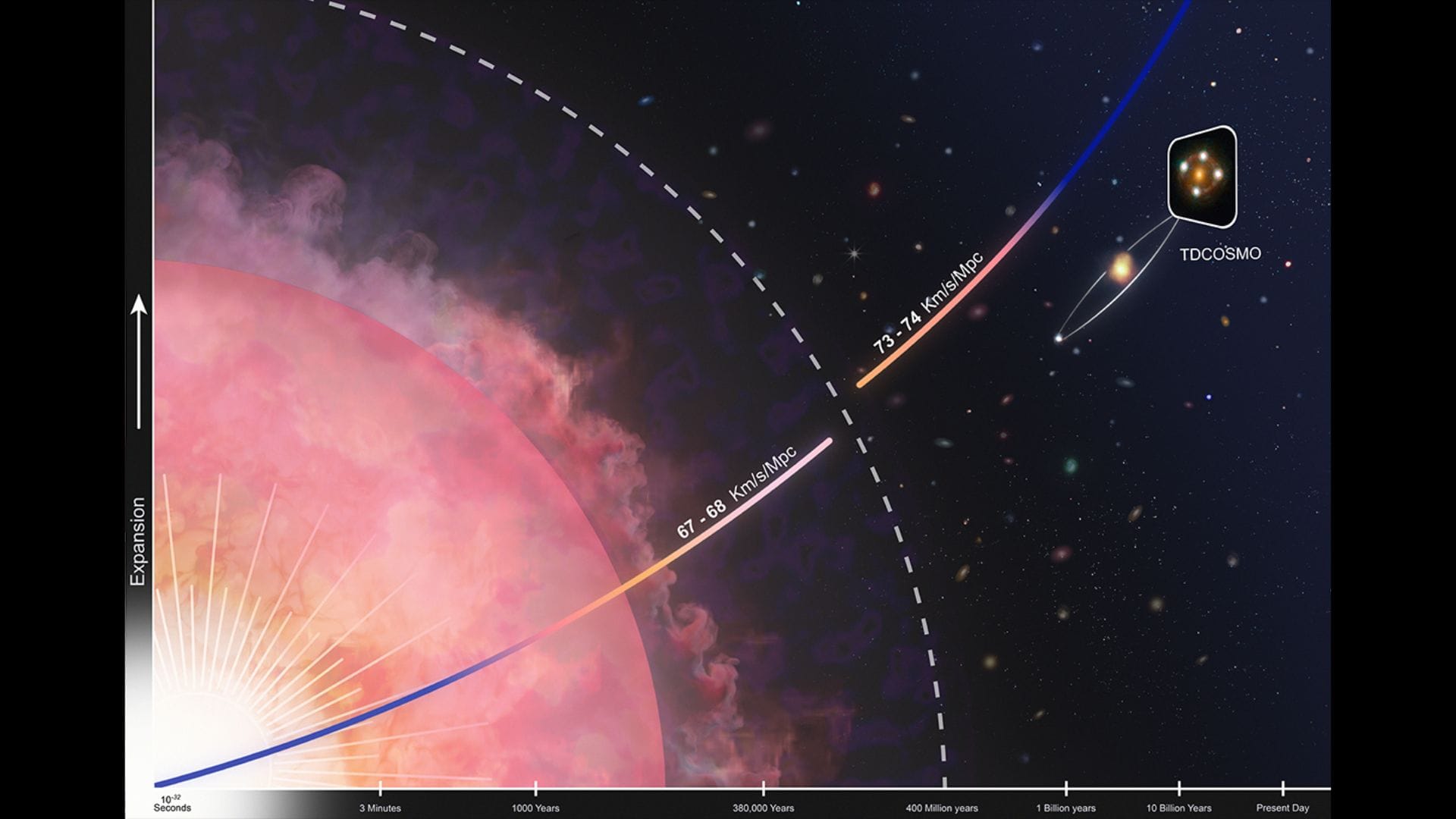
New Delhi: A team of astronauts have conducted one of the most precise independent measurement of the rate at which the universe is expanding, confirming the Hubble Tension, a major conflict in cosmology where different methods used to measure the Hubble Constant cannot be reconciled. The researchers were able to independently confirm that the current rate of expansion of the universe, known as the Hubble Constant, does not patch the predicted measurements for a younger universe. The Hubble Tension may point to novel physics governing the universe.
A paper describing the research has been published in Astronomy and Astrophysics. The rate of expansion of the universe was first calculated in 1929 by the American astronomer Edwin Hubble. A century later, scientists have been unable to agree on the exact value. The Hubble Constant can be measured by probing the early universe, as well as the nearby or local universe. The early universe techniques uses cosmological models to indirectly determine the expansion rate, favouring a value of around 67 km/s/Mpc. Measurements conducted in the local universe result in a value of around 73 km/s/Mpc.
Hinting at unknown physics
For the new precise measurements, the researchers used a method called time-delay cosmography, by tracking massive galaxies that bend the light of even more distant galaxies, producing multiple images of the same object. By tracking how long it takes for changes in the distant object to appear on each image, scientists can determine cosmic distances, and consequently, the rate at which the universe is expanding.
The confirmation of the tension is pushing scientists to rethink the makeup of the universe itself. There may be new particles, or even an ‘early dark energy’ phase that briefly accelerated the expansion of the universe soon after the Big Bang. The implications of the Hubble Tension are so profound, that astronomers highlight the need for multiple independent methods to cross-check the results. The researchers aim to improve the precision of their technique.
Also Read:
Gravitationally lensed supernovae may help resolve Hubble tension
Webb, Hubble team up to measure rate of expansion of universe
Observed distribution of matter in universe not in line with conventional theories