Dhar Bhojshala
Bhojshala Saraswati Puja: Basant Panchami is the day when Goddess Saraswati, the goddess of knowledge, art and music, is worshiped in yellow colour. In schools, books are kept in worship, children’s hands are made to write letters for the first time and there is a sense of devotion to knowledge everywhere, but just before this holy festival, an ancient heritage Bhojshala located in Dhar, Madhya Pradesh has once again come into the center of controversy because the Bhojshala located in Dhar is not just a building, but for millions of Hindus, it is considered to be the holy temple of Goddess Vagdevi i.e. Mother Saraswati, the presiding deity of knowledge.
At the same time, the Muslim community has also been presenting its claim by calling it Kamal Maula Masjid. This year the root of the controversy is the coincidence of dates because Basant Panchami and Friday’s Friday prayers are being offered on the same day. This dispute reached the Supreme Court, where the Hindu side demanded from the apex court that they should be given full right of worship on this holy day and the entry of the Muslim side should be banned. The hearing on this matter took place on Thursday i.e. 22 January. After the hearing, the Supreme Court, while giving its verdict, has said in the order that the people of the Muslim community should come to offer Namaz at a different place in the same complex from 1 to 3 pm, while the Hindu side should organize Basant Panchami at another place in the same complex. In such a situation, let us know about the history of Dhar Bhojshala which came into discussion due to controversy and the beliefs related to it.
Raja Bhoj’s legacy
The history of Bhojshala is a saga of pride and struggle. In the 11th century, King Bhoj of the Parmar dynasty established it as a great university and Saraswati temple. Even today, Sanskrit verses, Surya Peeth and Chandra Peeth are found engraved on the pillars and walls of Bhojshala, which testify to its ancient grandeur and Hindu identity. Petitioner Hindu Front for Justice says the Masjid was built on the site of a pre-palace during the reign of Alauddin Khilji, while the Kamal Maula Masjid was built in 1514 during the reign of Mahmud Khilji II.
What is the whole controversy about Dhar Bhojshala?
Regarding this controversy, Radheshyam Yadav, former convenor of Indore division of Hindu Jagran Manch, says that Indian and foreign historical research shows that the Bhojshala complex, including the Vagdevi temple, existed centuries before the Kamal Maula Masjid. The mosque was constructed by demolishing ancient Hindu temples. He said, ‘Muslims, citing the ASI survey of Bhojshala in 1902-03, ask why there is a need for a fresh study. Today we have such technology and scientific tools which were not available at that time. This survey conducted on the lines of Gyanvapi and Ayodhya surveys will help in revealing the truth about Bhojshala.
At the same time, it has also been mentioned in the ASI report that some parts of Bhojshala and Vagdevi temple were demolished to build the mosque. They present inscriptions, carvings and religious structures as evidence of the pre-existence of the temple. Regarding this, Dhar Shahr Qazi Sadiq said, ‘Namaz has been being offered in Kamal Maula Masjid for 700 years. How can this be a temple? It was never a temple or a school, nor was any idol ever installed here.
Actually, this controversy started in the year 1893 when ASI’s German Indologist Alois Anton Fuhrer saw some sutras inscribed on the pillars, but he had no proof of it. After this, the word “Bhojshala” became popular in the year 1903. The one who propagated this word is Dhar Dewas, who was the then Education Commissioner KK Lele. However, it was revised by the Imperial Gazetteer in the year 1908.
Historical importance of Dhar Bhojshala
Bhojshala is associated with the great ruler of Parmar dynasty, Raja Bhoj. Raja Bhoj was a great patron of education, literature, scriptures and art. According to historians, Bhojshala was a learning center (Gurukul or Pathshala), where Sanskrit, grammar, philosophy and scriptures were studied. For this reason it was called Bhojshala. Historically Bhojshala was also known as Saraswati Kanthabharan. This was a grand temple dedicated to Goddess Saraswati. In the medieval period, the statue of Vagdevi located here was famous for its beauty and craftsmanship, which is currently kept in the British Museum in London, which has been demanded to be brought back to India for decades.
Archaeological Survey of India maintains
The Archaeological Survey of India (ASI) currently maintains this protected monument. According to the current arrangement, Hindus are allowed to perform puja and Satyagraha here on Tuesday, while on Friday the Muslim community is allowed to offer namaz. On the day of Basant Panchami, the Hindu side gets the right to worship from sunrise to sunset, but when this day falls on Friday, a situation of tension is created because the importance of Basant Panchami in Hindu religion is not limited to just one date. It is believed on this day that Mother Saraswati, the goddess of knowledge, music and art, appeared from the mouth of the creator of the universe, Brahma Ji.
Who is Vagdevi Devi?
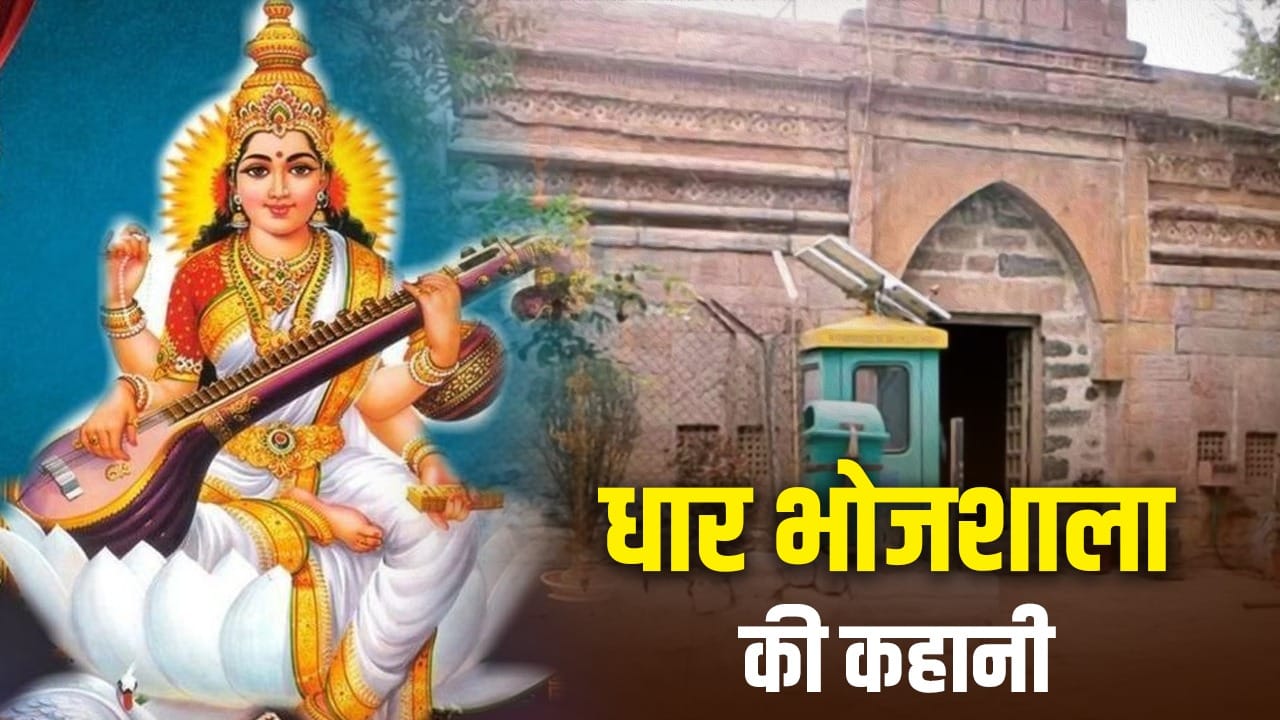
In Indian culture and Hindu religion, Mother Saraswati is considered the presiding deity of knowledge, music, art, intelligence and learning. She is also called Vaagdevi i.e. Goddess of Speech because she symbolizes the power of words, language and expression. She wears a white saree and sits on a white lotus. The veena in his hands shows that knowledge is not just thought, but also music and harmony.
Having a book in one hand symbolizes that they are the source of all the scriptures and worldly and supernatural knowledge. Crystal beads are a symbol of meditation and spirituality. His vehicle ‘Ha’ gives the message that a wise person is the one who can differentiate between good and bad. She resides on our tongue in the form of Vaagdevi. It is believed that whatever a person speaks or writes is possible only by the grace of Mother Saraswati.
Also read: On one side Friday prayers and on the other side celebration of Basant Panchami Supreme Court’s order on Bhojshala controversy