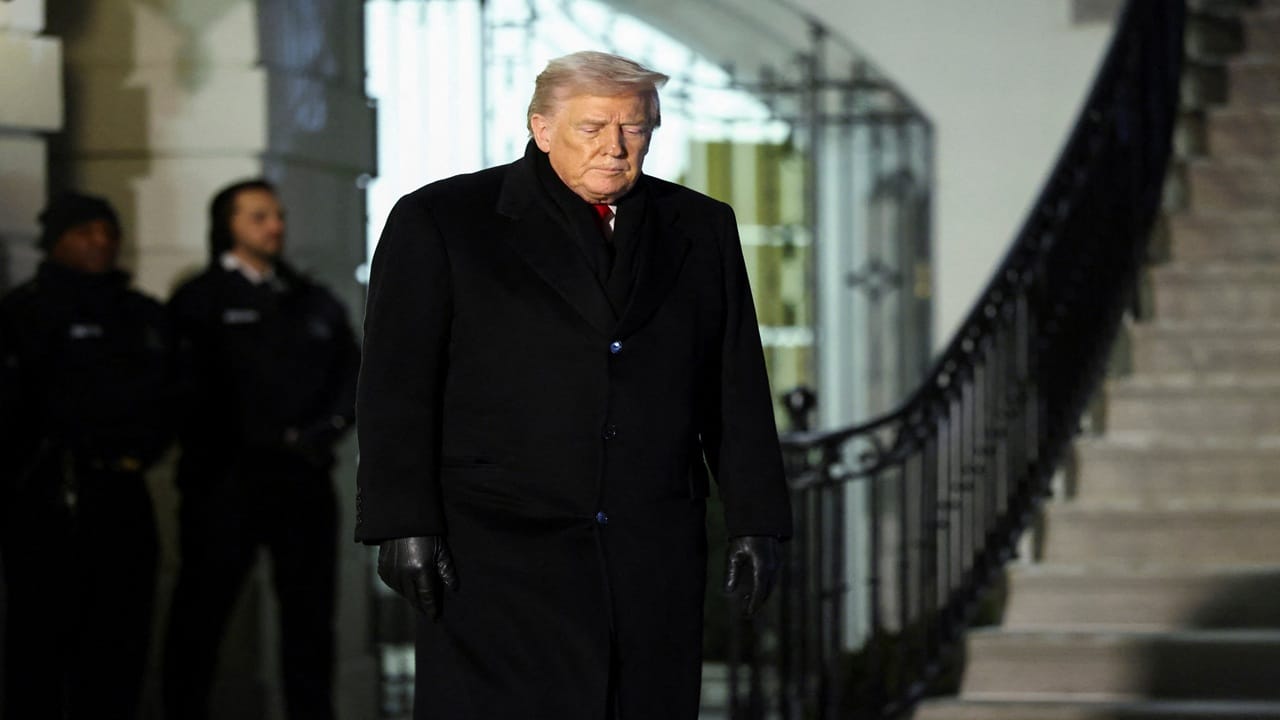
New Delhi: At the World Economic Forum in Davos this week, focus was not just on global finance, but on the world’s largest island, Greenland. European leaders were seen recalibrating their position toward Trump’s increasingly hostile bid to take over Greenland.
The annual gathering focused on global economic challenges thus quickly turned into a geopolitical event. Transatlantic relationships are thus clearly under strain as European leaders tried to use Davos as a platform to showcase unity against the US.
Trump’s Greenland offensive continues
While the US and EU, seen collectively as the ‘West’, looked to be an unshakable allyship, it is now slowly showing signs of weakness. Behind this is Donald Trump’s renewed and now continuous insistence that the United States should have control over Greenland, a semi-autonomous territory of Denmark, for its national security.
This has become a major geopolitical flashpoint now. Trump has even threatened tariffs on imports from European countries that oppose US takeover of Greenland. This has now resulted in a major shift in global power dynamics, testing Europe’s ability to defend its interests without fracturing transatlantic cooperation. This struggle was on display in Tuesday’s Davos Summit as well.
European attempts at pushback
At Davos, French President Emmanuel Macron stole the spotlight, in what was one of the clearest acts of defiance against Trump’s recent aggression over Greenland. He talked of how the EU should not bend to “the law of the strongest”, warning that yielding to pressure from Washington would undermine Europe’s credibility and values.
European Commission President Ursula von der Leyen also used the Davos stage to speak for a more independent and self-assured Europe. Without directly naming Trump, der Leyen spoke of the need for a Europe less reliant on external powers. Sharing similar sentiments was Belgium’s Prime Minister Bart De Wever, urging unity and collective firmness, warning that past attempts to appease Trump had left Europe in a “very bad position”. Meanwhile, Sweden’s Deputy Prime Minister Ebba Busch dismissed efforts at flattery, insisting the EU must “toughen up” and keep trade retaliation options ready.
While this was some commendable pushback from EU leaders, much still needs to be done as rhetoric alone cannot substitute action as Trump’s aggressive stance becomes more and more pronounced day by day. Europe’s approach remains divided and the main thing it has to resolve is standing against Trump’s expansionism and the economic and military dependence it has on the US. Davos is a perfect outlet to resolve or at the least examine this conundrum, and while much was said in this regard, on ground action and proactive deliberation remained missing.