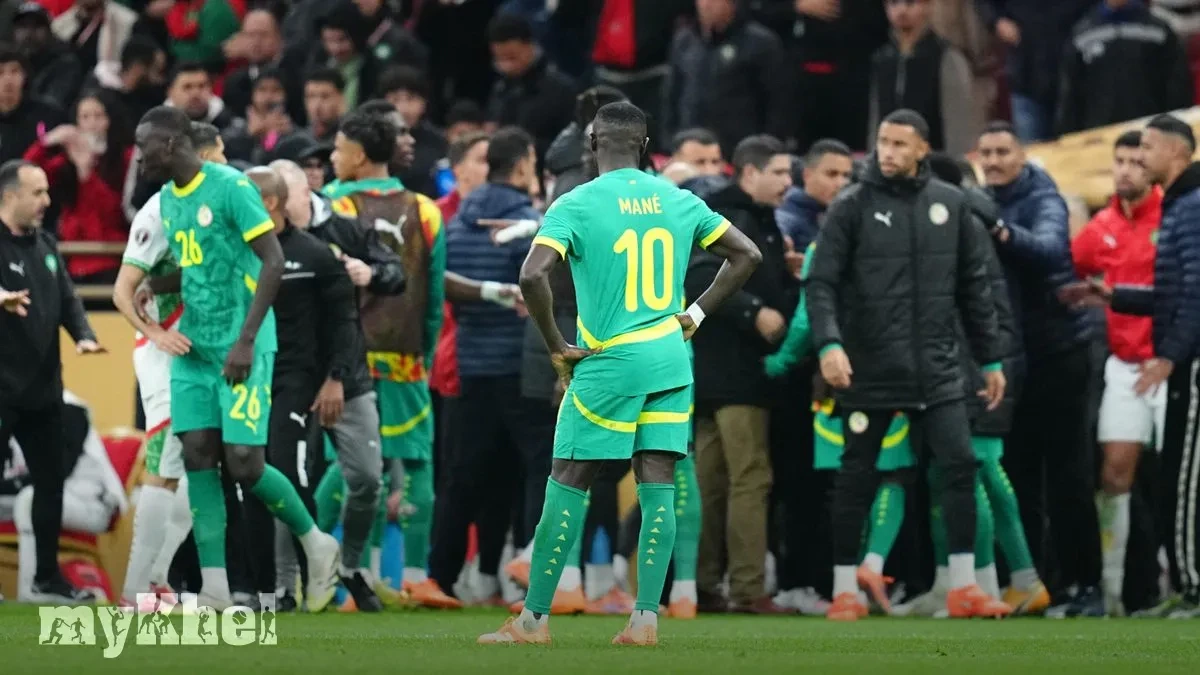
The final at Stade Prince Moulay Abdallah turned tense in the eighth minute of second-half stoppage time, when referee Contact gave Morocco a penalty. El Hadji Malick Diouf was ruled to have pulled down Brahim Diaz, shortly after Ismaila Sarr saw a potential Senegal goal cancelled for a foul on Achraf Hakimi.
Senegal head coach Pape Thiaw reacted by ordering the team off the pitch, and the match paused for around 15 minutes. Mane, the captain, persuaded team-mates to return, before Edouard Mendy denied Diaz’s Panenka and Pape Gueye scored a long-range extra-time winner to secure Senegal’s second AFCON title.
Mane explained that abandoning the match would have harmed African football’s image and history. Mane told reporters, “It would have been a shame and sad to see this kind of scenario happen. Just imagine for a second going into the locker rooms and the football match stopping there. I think that would convey a negative image of our football.”
Mane continued, “I think Africa today does not deserve that. African football has evolved in an incredible way and the proof is that it is followed all over the world. So, on my side, I did what I had to do. I think it would be crazy not to play this game because, what, the referee gave a penalty, and we go out of the game? I think that would be the worst thing, especially in African football. I’d rather lose than have this kind of thing happen to our football.”
The win meant Senegal have now triumphed in each of their last two AFCON finals, adding the 2025 crown to their 2021 success, after defeats in the 2002 and 2019 showpieces. Mane again led their campaign, scoring key goals and shaping attacks across the tournament in Morocco.
Mane’s semi-final winner against Egypt took the forward to 11 AFCON goals, making Mane the ninth player to reach double figures in the competition. Only Samuel Eto’o, Laurent Pokou, Rashidi Yekini and Hassan El-Shazly have scored more, keeping Mane among a select group of consistent AFCON scorers.
Opta data also highlighted Mane’s creative influence in this edition. Mane created 19 chances, all from open play, the highest open-play total recorded by one player at a single AFCON since detailed statistics began in 2010, underlining how often Mane supplied opportunities for Senegal’s attack.
Sadio Mane future beyond AFCON
At 33, with the 2026 World Cup approaching, Mane confirmed this tournament would be Mane’s last AFCON. Mane stressed that future Senegal squads are ready to lead, while Mane intends to support from outside the pitch instead of playing in the 2027 edition.
Mane said, “My last AFCON? Yes, I think I said it, it’s just the repetition. The AFCON with me is a different story. Me, if all goes well, God willing, I’ll stop here. I think the succession is assured, they will do the job, I will be their 12th man.”
Senegal now hold two AFCON titles and have reached three of the last four finals, confirming a period of sustained success in the competition. Mane’s role in the 2025 final, from calming the walk-off protest to influencing play, capped a major chapter in Mane’s AFCON career while helping protect the reputation of African football.