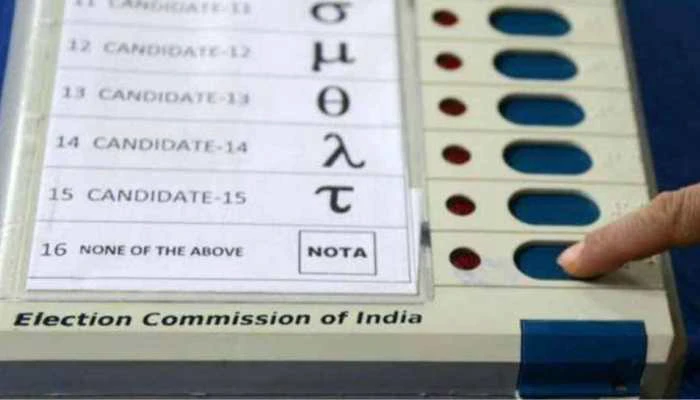
As per Election Commission data, out of the 54,76,043 votes cast in Mumbai during the January 15 elections, 1,00,327 voters chose the NOTA option. The overall voter turnout stood at 52.94%, with NOTA accounting for 1.83% of the total votes polled.
Among all parts of the city, the western suburbs recorded the highest number and share of NOTA votes. From Dahisar to Bandra, a total of 47,936 voters chose NOTA, making up 1.9% of the votes cast in that region. The western suburbs, especially Borivli and Dahisar, also saw the highest voter turnout.
The highest voter turnout was seen in Borivlis ward 18 at 62.04%, followed by ward 4 in Dahisar with 60.67% turnout. In the eastern suburbs, from Bhandup to Sion, 29,101 voters chose NOTA, which made up 1.7% of the votes. Meanwhile, 23,290 NOTA votes were recorded in areas like Colaba, Mahim, and Matunga, accounting for 1.8% of the total votes.
In South Mumbai, ward 226 had the highest number of NOTA votes, with 1,404 people opting for it. This amounted to 5.1% of the votes in that ward, where the overall voter turnout was 50%.
What is NOTA ?
The Election Commission of India (ECI) has introduced a separate symbol for the None of the Above (NOTA) option, similar to other election symbols, to help voters easily choose it. The NOTA option appears as the last button on all Electronic Voting Machines (EVMs).
NOTA has been available on EVMs and ballot papers since October 11, 2013, following a Supreme Court order issued on September 27, 2013.NOTA was first used in the 2013 Assembly elections in Chhattisgarh, Mizoram, Rajasthan, Delhi, and Madhya Pradesh.
According to the ECI, the purpose of introducing NOTA is to allow voters who do not want to support any candidate to exercise their choice, while ensuring the secrecy of their vote. NOTA empowers citizens to express dissatisfaction with contesting candidates without having to boycott or skip the election.
PIL filed to make NOTA option compulsory in all the election
Vidhi Centre for Legal Policy filed a Public Interest Litigation (PIL) in the Supreme Court in May 16, 2025, seeking to make the NOTA option compulsory in every elections, comprising those having single candidate.
NOTA is provided in Lok Sabha, State Assembly, and Panchayat elections, but its availability is not consistent across all local bodies.
Those who are in favour of compulsory NOTA argue it expands voter choice by allowing citizens to reject all contesting candidates without abstaining, thereby strengthening voter autonomy and democratic expression. While, those against the compulsory NOTA say NOTA is rarely used and has no impact on electoral outcomes, since the candidate with the highest number of votes wins regardless of the NOTA count.