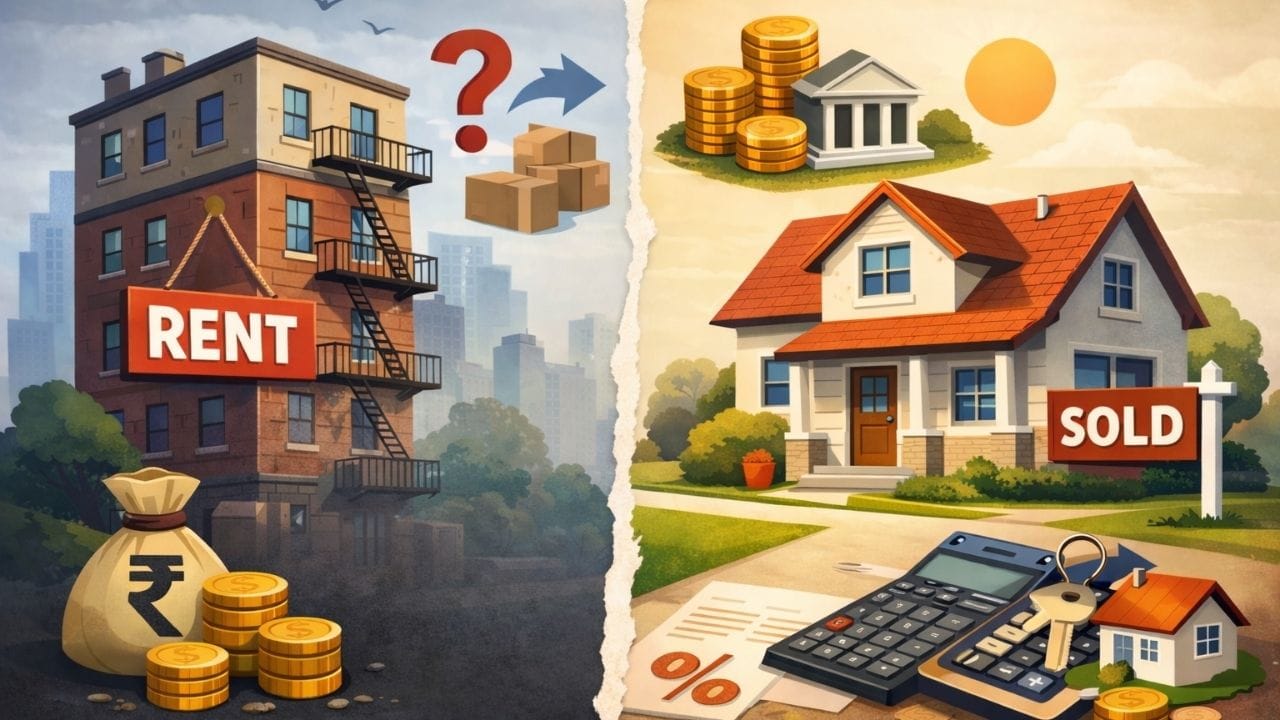
Live in a rented house or buy your own house?Image Credit source: ai generated
There comes a time in every person’s life when he gets stuck in a big dilemma – should he live in a rented house all his life and fill the landlord’s pocket or buy his dream house by taking a huge loan from the bank? This decision is not so easy, because your entire life’s earnings are at stake. If you are also in the same dilemma, then a famous ‘1% rule’ of the real estate world can help you. This rule not only shows you the right direction of investment, but also tells you whether a property is financially beneficial for you or not.
What is this 1% rule?
The ‘1% Rent vs. Buy Rule’ is a very simple metric in the world of real estate investing. This rule says that if you are buying a house for investment purposes, then the monthly rent received from it should be at least 1% of the total price of that house.
For example, if you are buying a flat worth Rs 1 crore, then its monthly rent should be around Rs 1 lakh. If the rent is much lower than this, then buying the property can be a loss-making deal from an investment point of view. The formula to check this is very simple: (Monthly Rent ÷ Property Price) × 100. If the result is around 1, then the deal is considered good. However, you should also include expenses like maintenance, tax and loan interest in this.
Is this formula applicable in India?
As simple as it sounds, its reality in the Indian market is a little different. According to Ravi Shankar Singh, Managing Director (Residential Services), Colliers India, this rule is suitable for developed countries like America and Europe, but it cannot be implemented as it is in India.
In western countries, there is very little difference between rental yield and interest rates, whereas in India the situation is different. Rental yields on residential properties in India typically range between 2% to 4%, which is very low as per the 1% rule. Therefore, in India this rule may work to some extent in the case of buying an old house, renovating it and giving it on rent, but this rule does not fit completely in a normal house purchase. Property prices are skyrocketing in metros like Mumbai, Delhi and Bengaluru, but rents have not increased in that proportion.
Keep these things in mind while deciding rent or EMI
Life decisions are not taken just by mathematical formulas. While choosing between buying a house and living on rent, you will have to weigh your personal needs also.
- Asset creation vs flexibility: When you buy a home, you are creating an ‘asset’. In the long run, property prices increase at the rate of 5-7% per annum, which increases your wealth. At the same time, living on rent gives you the flexibility to change the place, which is beneficial for those changing jobs.
- Emotional security: Having your own home is not just a brick and mortar roof, but it is a symbol of mental peace and social security. This familiarity and stability is not available in a rented house.
- Long-term perspective: Experts believe that if you plan to stay in a city for 5 years or more, it makes sense to buy a house. But if your career takes you to different cities, it is better to avoid the burden of heavy EMIs.