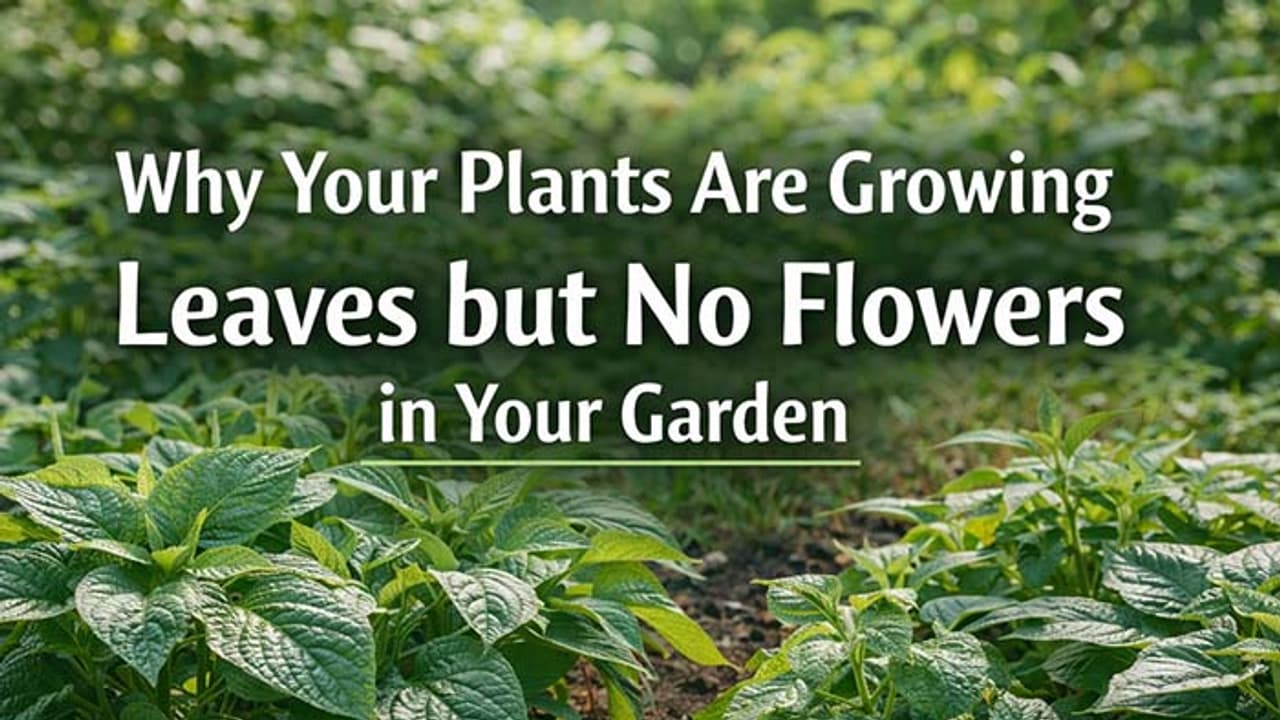
Healthy plants with lush green leaves but no flowers often indicate an imbalance in care rather than a serious problem. Understanding the key reasons behind poor blooming can help gardeners make simple adjustments and restore healthy flowering.
Many gardeners are confused when plants appear healthy with large, green leaves but produce very few or no flowers. While leafy growth shows that the plant is alive and active, flowering requires the right balance of nutrients, light, and care.
Why Your Plants Are Growing Leaves but No Flowers
Poor soil imbalanced by excess nitrogen.
Nitrogen supports leaf growth but its over-availability inhibits flowering. The super abundance of compost or nitrogenous fertilizers is usually the culprit.
Solution: Transition to a balanced fertilizer or one that favors phosphorus for bloom encouragement.
Inaccessible sunlight
Adequate sunlight for bud formation is needed by most flowering plants. Not enough light and the plant concentrates its energy on producing leaves.
Solution: Direct sunlight for at least 5-6 hours per day should be provided to plants.
Improper timing for pruning
Pruning at the wrong time can take away flower buds prior to their full development.
Solution: Know whether your plant blooms on old or new growth and prune appropriately.
Water stress
Too much or too little water puts the plants under stress and prevents them from being productive for flowering.
Solution: Water in a systematic way while ensuring its good drainage.
Temperature extremes
Hot or cold, sudden and extreme weather breaks flowering cycles.
Solution: Protect plants with shade nets or covers or shift pots when extreme conditions prevail.
Soil fertility issues
Compacted or nutrient-poor soil may block flowering even when leaves look healthy.
Solution: To increase soil fertility, add organic matter and ensure good soil aeration.
Immature Plants
Some simply aren’t mature enough to bloom yet.
Solution: Allow time for the young plants to mature.