Scientists have discovered a mysterious ‘iron bar’ in the heart of a nearby nebula that could offer a glimpse into Earth’s grizzly fate.
Scientists have discovered a mysterious ‘iron bar’ in the heart of a nearby nebula that could offer a glimpse into Earth’s grizzly fate. The strange strip of ionised iron atoms was detected slicing through the heart of the Ring Nebula, a spectacular cloud of gas and dust located about 2,283 light-years from Earth. The structure has left astronomers stunned, as nothing remotely similar has ever been observed inside a planetary nebula. The iron bar could be what is left when an Earth-like rocky world is vaporised during a star’s final act.
Stars similar to our Sun meet a dramatic end. When they exhaust their nuclear fuel, their outer layers swell outward while the core contracts and cools. Eventually, the core collapses into a dense white dwarf, no longer able to hold the star together. The star then sheds its outer layers, forming a glowing planetary nebula.
In roughly five billion years, our own Sun is expected to follow the same destructive path, expanding into a massive Red Giant and engulfing Earth.
In a newly published study, researchers suggest the never-before-seen iron structure inside the Ring Nebula may offer a disturbing preview of what Earth could look like after being destroyed by the Sun. The Ring Nebula, one of the closest and most visually striking planetary nebulae visible from Earth, is believed to have formed around 4,000 years ago when its parent star cast off its outer layers.
Its iconic ring is made up of nearly 20,000 dense clumps of molecular hydrogen gas, each roughly the mass of Earth. Because of its proximity and intense heat, the nebula has long served as a testing ground for cutting-edge astronomical instruments.
For this study, scientists examined the nebula using a powerful new device known as the Large Integral Field Unit (LIFU), installed on the William Herschel Telescope. The instrument uses hundreds of fibre-optic cables to simultaneously capture light spectra across the entire nebula, allowing researchers to map its chemical makeup in extraordinary detail.
Lead author Dr Roger Wesson, of Cardiff University and University College London, explains the breakthrough: “By obtaining a spectrum continuously across the whole nebula, we can create images of the nebula at any wavelength and determine its chemical composition at any position.
When we processed the data and scrolled through the images, one thing popped out as clear as anything – this previously unknown “bar” of ionised iron atoms, in the middle of the familiar and iconic ring.”
How this iron bar formed remains a mystery. Researchers say there are two leading explanations. It may have emerged through an unknown process during the violent ejection of the nebula as the star collapsed — or it could be an arc of plasma created when a rocky planet was caught and vaporised during the star’s earlier expansion.
Dr Wesson told the Daily Mail: “We know that there are planets around many stars, and if there were planets around the star that formed the Ring Nebula, they would have vaporised when the star became a red giant.
And the mass of iron in the bar is about what you’d expect from the vaporisation of a planet: if Mercury or Mars were vaporised, that would give a bit less iron than the bar in the Ring, while if Earth or Venus were vaporised, it would give a bit more.”
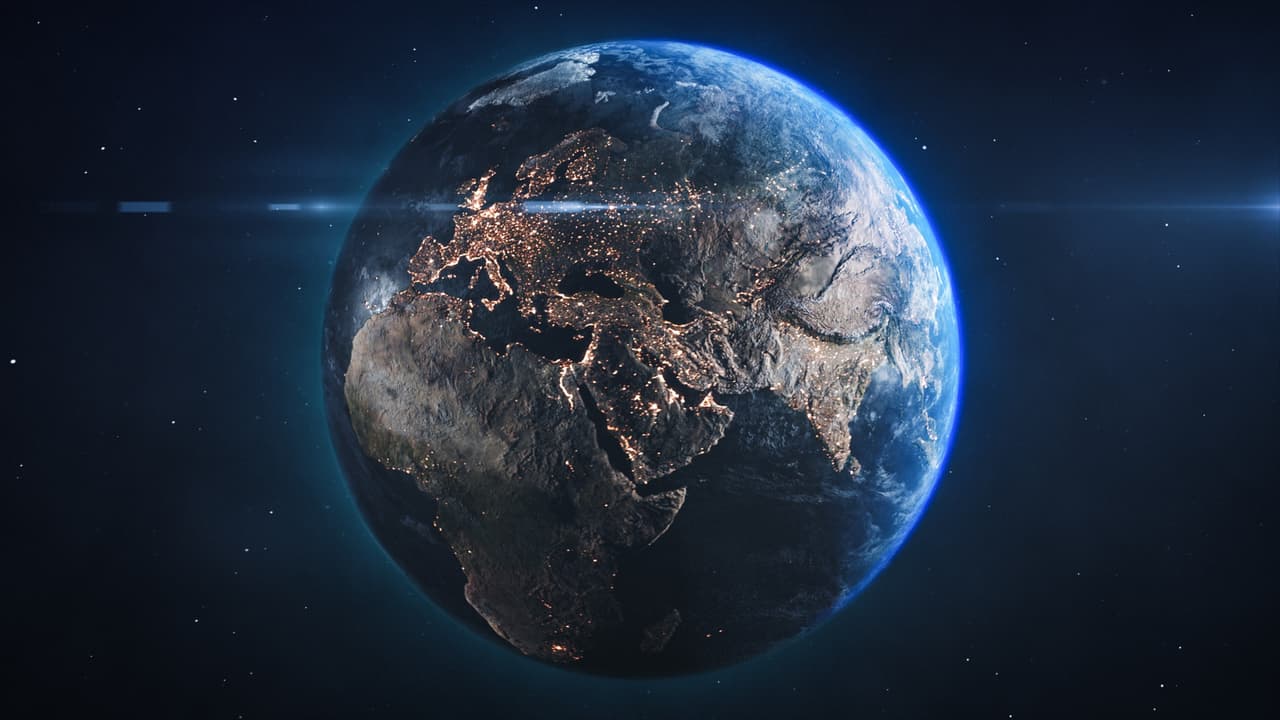
If the planetary explanation proves true, the iron bar could be a haunting glimpse into Earth’s far future — a cosmic smear of metal, all that remains after our planet is erased.
Main-sequence stars like the Sun remain stable because gravity pulling inward is perfectly balanced by the outward pressure of nuclear fusion in their cores. But once hydrogen fuel runs out, that balance collapses. As the core contracts, temperatures soar, igniting helium fusion and unleashing energy that causes the outer layers to balloon dramatically.
The result is a Red Giant — a star that can grow between 100 and 1,000 times its original size.
When the Sun reaches this phase billions of years from now, scientists believe Earth’s fate is grim. The planet may be incinerated by extreme heat or torn apart by immense tidal forces and dragged into the expanding star.
Supporting this grim outlook, a study published last year found that red giant stars are far less likely to host close-orbiting planets like Earth. While about 0.28 per cent of younger stars were found to host giant planets, that figure dropped sharply to just 0.11 per cent for stars that had already expanded into red giants.
If Earth meets such a fate, researchers say it could end up resembling the iron bar now seen inside the Ring Nebula.
Still, scientists caution against jumping to conclusions. Dr Wesson emphasised that more evidence is needed: “A vaporised planet is a possibility. But it’s not the only possibility, and we’d have to work out how the iron ended up in a bar shape if it did come from a planet.
More likely, there are iron “bars” waiting to be found in other nebulae. The more we can find, the more information we will have to determine how they formed, so we’re hunting for more of them!”
Future observations using the LIFU instrument aim to uncover similar structures in other nebulae, helping astronomers pin down their true origin.
Co-author Professor Janet Drew of University College London added,
“We definitely need to know more – particularly whether any other chemical elements co-exist with the newly-detected iron, as this would probably tell us the right class of model to pursue. Right now, we are missing this important information.”