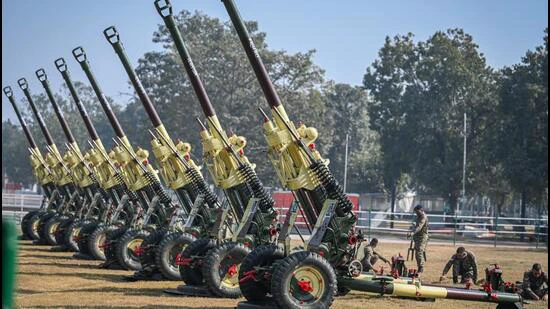
NEW DELHI: The upcoming Republic Day parade on January 26 will unfold in a new phased battle array format to showcase the military’s wide-ranging capabilities, with weapons and systems including infantry elements, tanks, artillery systems, missiles, and airpower being displayed in a sequence that shows how they are used in a combat scenario, defence secretary Rajesh Kumar Singh said on Friday.
The new format comes in the backdrop of Operation Sindoor, the four-day military confrontation between India and Pakistan in early May, following the April 22 Pahalgam terror attack in which 26 people were killed.
The 77th Republic Day parade will also bear an imprint of the ongoing restructuring in the army. Singh said the recently raised Bhairav light commando units and Shaktibaan artillery elements specialising in drone warfare will make their debut at the country’s biggest ceremonial event, which will be witnessed by 77,000 people along Kartavya Path and watched by millions on television.
The aim is to make the 90-minute parade more engaging for viewers, as earlier parades were quite stereotyped, Singh said at a media briefing.
“Given the general excitement about Operation Sindoor, the intent is to show the operational elements and weave a story of how a battle progresses from the phase of recce and logistics to the subsequent use of long-range systems, and thereafter to back-up logistics and the integration of air power,” the defence secretary said.
India launched Operation Sindoor in the early hours of May 7 and struck terror and military installations in Pakistan and Pakistan-occupied Kashmir (PoK) before the May 10 ceasefire. The clash involved fighter jets, missiles, armed drones, and a fierce artillery duel.
“The idea is to weave a story of how equipment and manpower actually get used in a battle to make it a bit more interesting. It is perhaps a bit linked to Operation Sindoor, but primarily the intent is to make it more interesting and weave a storyline rather than a stereotypical kind of parade,” Singh said.
Air elements will also be displayed in the phased battle array format, he said. This means the flypast will not be carried out at the end of the parade as in previous years – it will align with the Indian Air Force’s role in the battle order.
Indian forces bombed nine terror camps in Pakistan and PoK, killing at least 100 terrorists, and the IAF struck targets at 13 Pakistani airbases and military installations during Operation Sindoor. Also, Pakistan also lost as many as 12 to 13 aircraft, including fighter jets such as US-made F-16s and Chinese-origin JF-17s, to the IAF’s precision strikes on ground and in the air during the operation.
The Republic Day flypast will feature several platforms, including Rafales, Sukhoi-30s, MiG-29s, Apache attack helicopters, C-130J special operations aircraft, P-8I long-range maritime surveillance aircraft, C-295 transport planes, Mi-17 choppers, advanced light helicopter and light combat helicopter.
A naval contingent of the European Union (EU) will also take part in the parade, Singh said. European Union (EU) leaders Ursula von der Leyen and Antonio Costa will be the chief guests at the Republic Day celebrations – the external affairs ministry and the EU on Thursday formally announced that the presidents of the European Council and the European Commission will participate in the Republic Day celebrations.
This is only the second time that India has invited leaders of a grouping – after the Asean in 2018 – to be chief guests at the celebrations, an honour reserved for the country’s closest strategic and economic partners.
Weapons and systems to be displayed during the parade include BrahMos supersonic cruise missiles, Akash surface-to-air missiles, medium-range surface-to-air missile system, T-90 and Arjun tanks, ATAGS (advanced towed artillery gun system), Dhanush artillery gun, BMP-II infantry combat vehicles, drones and a new universal rocket launcher system.
Eighteen marching contingents and 13 bands will feature in the parade.
The Republic Day celebrations are being organised around the theme of Vande Mataram, marking 150 years since the first two stanzas of the song were published. The tableaux of six states/ government departments will showcase the theme of Vande Mataram (there will be 30 tableaux in all). The parade will also feature a large-scale cultural dance performance involving around 2500 artistes.
In a symbolic move to end VIP culture, enclosures have been named after rivers, rather than using the V1/V2 nomenclature for areas where dignitaries are seated. Likewise, enclosures at the Beating Retreat ceremony, held on January 29 every year, have been named after musical instruments.