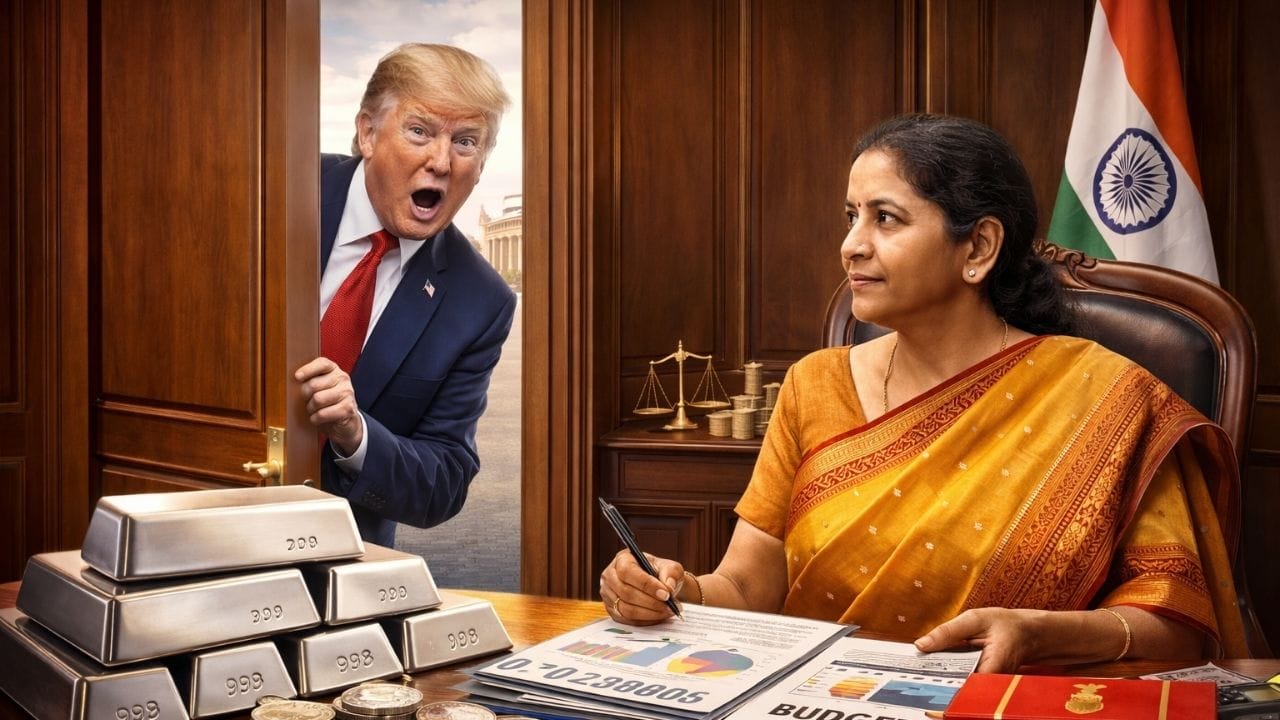
When Finance Minister Nirmala Sitharaman presents Budget 2026, Donald Trump’s name will not be in it. Still their mark will be clearly visible. This will be reflected in a careful recalibration of export projections, trade risks and India’s economic priorities.
Ajay Srivastava, founder of Global Trade Research Initiative (GTRI), says in an ET report that when India is preparing Budget 2026, the global environment is quite challenging. This is most clearly reflected in India’s relations with the US, which is India’s largest export market and is also rapidly becoming its biggest risk.
Tariff shock and its real cost
Under Donald Trump, India has already experienced how quickly trade can turn punitive. Reciprocal tariffs imposed by the US on Indian exports reached 50 percent, making India among the world’s most taxed exporters for some time. Its impact was immediate and uneven.
Now the pressure is increasing again. Last week, a proposed US law threatened to increase this pressure even further. US Senator Lindsey Graham said President Trump has “approved” the Russia sanctions bill, which would allow Washington to impose tariffs of up to 500 percent on countries that continue to buy Russian oil.
Graham said the bill is designed to give Trump broader control over major buyers of subsidized Russian crude – including India, China and Brazil. Its aim is to target the revenues that Moscow uses to fund its war in Ukraine.
For India, its consequences are already visible. According to Srivastava, between May and November 2025, India’s exports to the US fell by nearly 21 per cent, affecting labor-intensive sectors like apparel, gems and jewellery, and auto components. MSMEs dominate these sectors, where low profits lead to immediate loss of jobs.
The US’s stringent visa rules have added another layer of tension, jeopardizing service exports and remittances, which have long served as bailouts of India’s external account.
With no hope of a trade deal, access to the US market depends more on politics than economics, Srivastava says, making his role in India’s budget even stronger whether Donald Trump is invited or not.
Trade data provides relief but does not reassure
Recent figures provide momentary relief, but do not reassure. India’s merchandise trade deficit declined to $24.53 billion in five months in November due to decline in imports of gold, oil and coal.
Merchandise exports to America increased by about 10 percent month-on-month and reached $6.92 billion. Total exports increased from $34.38 billion in October to $38.13 billion in November, while imports declined drastically.
Commerce Secretary Rajesh Aggarwal said that despite the tariffs, India has maintained its hold on American exports. He also said that India and the US are close to finalizing a framework agreement, although he did not set any timeline.
He said that it is expected that both the countries will agree to the agreement to reduce tariffs. We are positively negotiating with America so that it can be completed as soon as possible. Still, the instability is evident. There was a decline of about 9 percent in exports to America in October compared to the previous year, but it improved in November.
Russia oil sanctions and political business
The sharpest aspect of the US pressure is the additional 25% punitive duty imposed on India’s imports of subsidized Russian oil. Implemented on August 1 and doubled later that month. GTRI has warned that unless Washington withdraws this ban or signs a trade deal, exports to India’s largest market may decline further. This is where Budget 2026 moves away from traditional economics and becomes more focused on managing geopolitical impacts. FTAs have been signed, but the real test lies in their implementation.
According to the ET report, India’s natural response has been to diversify markets. Over the past four years, it has signed eight free trade agreements and is negotiating with the EU, the US, the Eurasian Economic Union, Mexico, Chile and Mercosur.
But now the emphasis is changing. A GTRI report said that with 18 free trade agreements already signed and more likely in 2026, India’s priority should shift from signing agreements to deriving real export benefits from FTAs. Without strong domestic competition, these agreements may remain symbolic.
What are the expectations from Budget 2026?
Trade experts have a clear message: Budget 2026 should focus on consolidation, not just expansion. There is a need to deepen export diversification across products and value chains. India needs to move beyond assembly-based manufacturing and gain real strength in electronics, machinery and intermediate products. Logistics costs should be reduced. Customs procedures should be predictable. Service exports should add value in the areas of engineering, research & development and design. In the near term, implementing export promotion missions and obtaining relief from punitive US tariffs – particularly additional duties linked to Russian oil – are seen as essential stabilization measures.
Export target of 1 trillion dollars
The target of exports of 1 trillion dollars by the financial year 2026 is now slipping away. India’s total goods and services exports were approximately $825 billion in fiscal year 2025 and are expected to increase marginally to approximately $850 billion in 2026.
Srivastava said that we will fall short by 150 billion dollars in reaching the target of 1 trillion dollars. I think we will be able to achieve this goal only after a trade agreement with America and European Union. This may happen next year (2026), not this year (2025).
Due to weak global demand and increasing protectionism, no significant change is expected in commodity exports. Services exports, estimated at more than $400 billion, are contributing the most to this.
Diversification has started, but it is still incomplete. In the initial stages, however, limited change is taking place. Despite trade tensions with the US, exports to the rest of the world grew by about 5.5% between May and November. Srivastava said that this means that diversification has started on a small scale.
But geographical location alone will not be enough. He said that for more diversification, to export more to these countries, we also have to pay attention to the diversity of our export products. He further said that at present, there is a need to include mid to high-tech products in our export products.
The situation has become more complicated due to China’s aggressive policy. India’s challenges have increased due to China’s low-cost export strategy. Chinese companies are selling their products in large numbers in the global markets of Europe, Africa, South-East Asia and Latin America, which is reducing India’s competitiveness in many markets.
India’s exports have weakened not only to America, but also to United Arab Emirates, Britain, Germany, Australia, South Africa and Brazil. On the other hand, China has strengthened its presence in these sectors, while its exports to the US have declined. The recent US move to halve fentanyl-related duties on Chinese goods could further tilt the electronics supply chain in favor of Beijing, which could put pressure on India’s progress.
Electronics: India’s strongest support for the future
Electronics remains India’s fastest growing export sector. Between April and October 2025, electronics exports grew by nearly 38 percent to $26.28 billion, significantly narrowing the gap with petroleum exports. At this pace, electronics can become India’s second largest export sector in a few years. But this pace is also delicate. Smartphone exports declined in August and September despite strong demand from the domestic festival season, showing how quickly external performance can falter.
import barrier
With increasing pressures, Budget 2026 is likely to adopt a more interventionist approach. The government is considering higher tariffs and targeted incentives on about 100 items – ranging from engineering products and machinery to consumer goods – where imports remain high despite domestic capacity. The objective is clear: to reduce the trade deficit and reduce dependence on single source supply chains, especially China. Industry groups are already lobbying for production-related incentives, higher tariff charges and fiscal support, indicating a broader shift towards export incentives as well as import substitution.