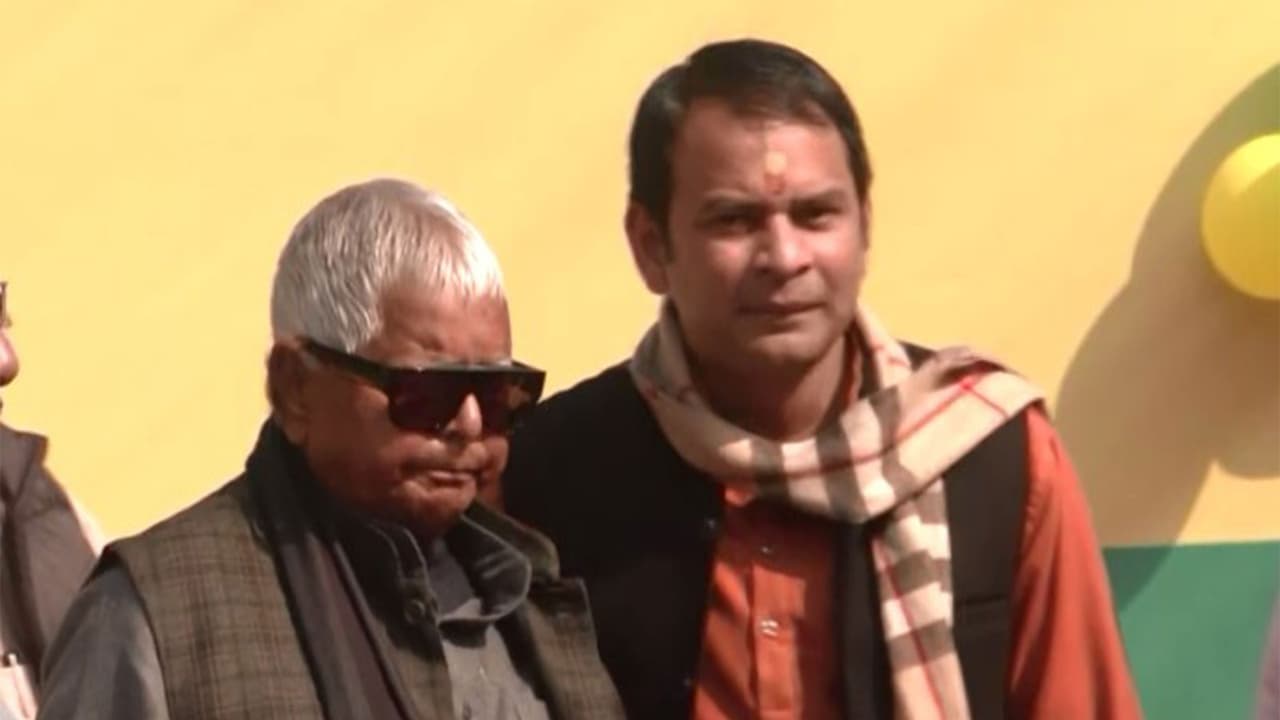
RJD chief Lalu Prasad Yadav reunited with son Tej Pratap Yadav at a ‘Dahi Chuda’ feast in Patna. Attended by prominent leaders, Tej Pratap celebrated receiving his father’s blessings, while Pashupati Kumar Paras hinted at new political equations.
Rashtriya Janata Dal supremo Lalu Prasad Yadav on Wednesday reunited with his estranged son, Janshakti Janata Dal chief Tej Pratap Yadav, at the “Dahi Chuda” program at his residence in Patna. Both were joined by several other prominent leaders, including Bihar governor Arif Mohammed Khan, Deputy CM Vijay Kumar Sinha, RLJP chief Pashupati Kumar Paras, Bihar Ministers, including Vijay Chaudhary, Sanjay Jha and others.
Speaking to the reporters, Tej Pratap said that a grand event related to “Dahi Chuda” was organised and he received the blessings of his father. “If Teju Bhaiya’s feast won’t be a super duper hit, then whose will be… A grand feast of dahi-chuda was organized… Our parents are God to us, so we’ll keep receiving their blessings… Everyone will come,” Tej Pratap Yadav told reporters.
New Political Turn in Bihar?
Meanwhile, RLJP chief Pashupati Kumar Paras said that new equations are formed on the occasion of Makar Sankranti and the family that was scattered will come together. “January 14th is here, all the planets that were there have ended. From today, a new equation will be formed. Those who were scattered in the family will come together. A new turn will come in Bihar’s politics,” he told ANI.
The Tradition of Dahi Chura
Dahi Chura, also known as Doi Chire, is a traditional, no-cook, and healthy breakfast or snack widely consumed in Bihar and the eastern parts of India. It is prepared by mixing flattened rice (chura or poha) with fresh yoghurt (dahi) and sweetening it with jaggery or sugar, often complemented with fruits like bananas and nuts. The dish is especially popular during festivals such as Makar Sankranti, where it is offered to the Sun God as a symbol of gratitude, prosperity, and good fortune.
Light and easily digestible, Dahi Chura is considered a sattvic meal rich in nutrients and protein. It is typically made by gently washing the flattened rice, mixing it with smoothened yoghurt and a sweetener, and topping it with fruits or nuts before serving. While the sweet version is most common, some also enjoy savoury variations with onions, mild spices, or mustard oil. (ANI)
(Except for the headline, this story has not been edited by Asianet Newsable English staff and is published from a syndicated feed.)