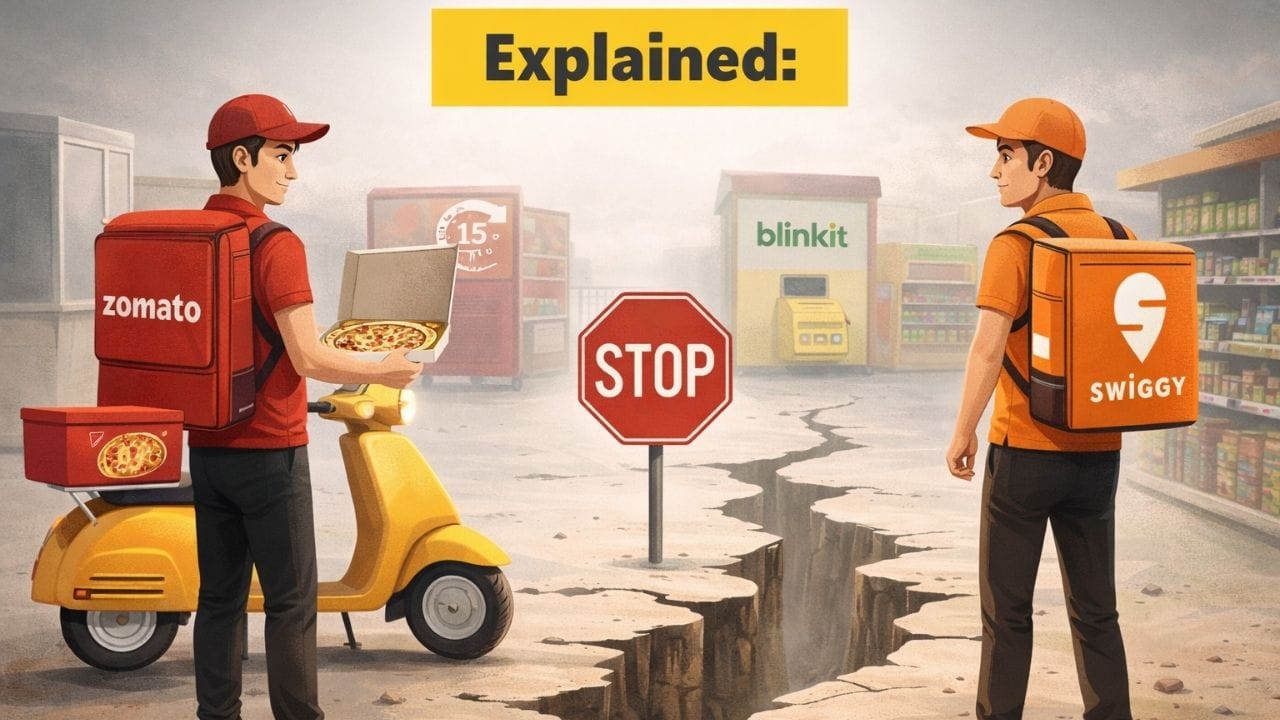
Early delivery stop!Image Credit source: AI
On January 13, 2026, a big decision related to the quick commerce industry was taken in the country, after which this entire industry has reached a turning point. Amidst the long-running gig workers strike and the trend in social media, the government took the necessary decision. The delivery service was stopped within 10 minutes and the companies were also asked to remove ads making such claims. Labor and Employment Minister Mansukh Mandaviya has asked big platforms like Blinkit, Zepto and Swiggy Instamart to remove the much-hyped “10-minute delivery” claim from their branding and advertisements. In such a situation, it has become necessary to understand how deep is the relationship of 10 minute delivery with this market and what effect its closure will have on the market. If we try to find answers to these questions.
The Union Minister made this appeal after meetings held between the Minister and senior officials of e-commerce and delivery companies, where issues like safety of riders, delivery time and working conditions were discussed. Eternal-owned Blinkit immediately removed the 10-minute delivery claim from its app and marketing. The company changed its tagline from 10,000+ products delivered in 10 minutes to 30,000+ products delivered at your doorstep. In the coming time, it is expected that other companies like Swiggy Instamart and Zepto will also take similar steps. Although this change may seem small on the surface, it may have an impact on the business model and thinking of Quick Commerce in the long run.
Decision after long battle
This step taken by the government is not sudden. The preparation behind this is quite old. Gig worker organizations went on strike across the country on 25 and 31 December. Both these days are busiest for quick commerce. Their demand was that the compulsion of 10-minute delivery should be ended and the old payment system should be brought back. Delivery partners say the pressure of very fast delivery leads to unsafe riding, pressure from the app’s algorithms and uncertainty of earnings. This is more of a reform than a strict action, allowing companies to comply with the rules without changing their entire model.
Marketing Promise vs. Ground Reality
Companies used this delivery system as their business model. 10-minute delivery was claimed loudly. Unlike Domino’s 30 minutes or free promise, there was no penalty or compulsion. Whenever there is a matter of safety on this matter, the companies have already been saying that there is no pressure on the delivery partners to deliver the orders within a fixed time. The delivery time shown to customers is always subject to change based on circumstances such as distance to the dark store, traffic, weather and rider availability. But this is only half the truth because it is not seen on the ground. Riders go in a hurry and sometimes without regard to the weather.
According to the ET report, company officials believe that removing the tagline will not have any significant impact on daily operations. In densely populated areas, where dark stores are only within 200 meters, delivery is still possible in 4-5 minutes. Companies will continue to improve roads, society entry and backend systems. That means the speed will remain, it will just not be publicized in big words.
What will be the impact on business?
Brokerage firm Elara Capital has called it mostly a cosmetic change and not a major change in the business model. According to Karan Taurani, executive vice president of Elara Capital, the 10-minute slogan was a marketing tool to attract customers post-Covid, and not a concrete service promise. Quick commerce has now become a daily habit of people in metro cities. Customers already know what the service is like. Taurani believes that the real strength of Quick Commerce will remain fast delivery, convenience and proximity, even without the 10-minute tag. Delivery usually takes 20-30 minutes, which is much faster than traditional e-commerce. In such a situation, removing the tagline will reduce the pressure on weak companies and strong companies will be able to prove themselves with consistently good service.
There will be no competition for fast delivery!
Amidst all these issues, the one question that becomes most important is whether the competition for fast delivery of goods will reduce after this. The answer to this would probably be no. Because, big e-commerce companies like Amazon and Flipkart are also emphasizing on fast delivery, hence quick commerce platforms cannot be sluggish. Ultimately, only those who have better store network, supply chain, stock management and route planning will win. However, after this decision, due to lack of big claims within the stipulated time, the competition may become a bit soft. Now the focus will not just be on minutes, but on reliable service, better products and quality. Customers will also probably adopt a slightly more flexible attitude, as long as convenience remains.
changing market trends
The trend of delivery in less than 30 minutes in India increased rapidly during the lockdown, when home delivery of daily essentials became the biggest need. While many such startups in America closed down after some time, in India the quick commerce model continued to grow stronger. Moving beyond grocery, these platforms are now delivering pillows, beauty products and medicines. The biggest reason for this is the rapidly expanding dark store network across the country.
According to Goldman Sachs estimates, India’s quick commerce industry was worth about $6 billion in FY25, which may increase to $47 billion by FY30. At the same time, real estate consultancy Savills says that by 2030 the number of dark stores in the country may reach 7,500. In such a situation, removing just one marketing tagline does not seem to have any major impact on the long-term growth of this sector.
Will the industry become stronger?
After this decision taken by the government, with the increase in rider safety and regulatory pressure in the coming times, companies can now invest more in their operational systems, store management and technology. In smaller cities, there is likely to be an increased emphasis on reliable service and local strategy rather than aggressive claims. Going back on the promise of 10-minute delivery can be considered a sign of India’s quick commerce sector becoming more mature. Speed will continue to be its hallmark, but future success will depend not just on counting minutes, but on steady and responsible growth. Companies can also be conscious about rider safety.
Also read- Now online goods will not be available in 10 minutes, government took a big decision