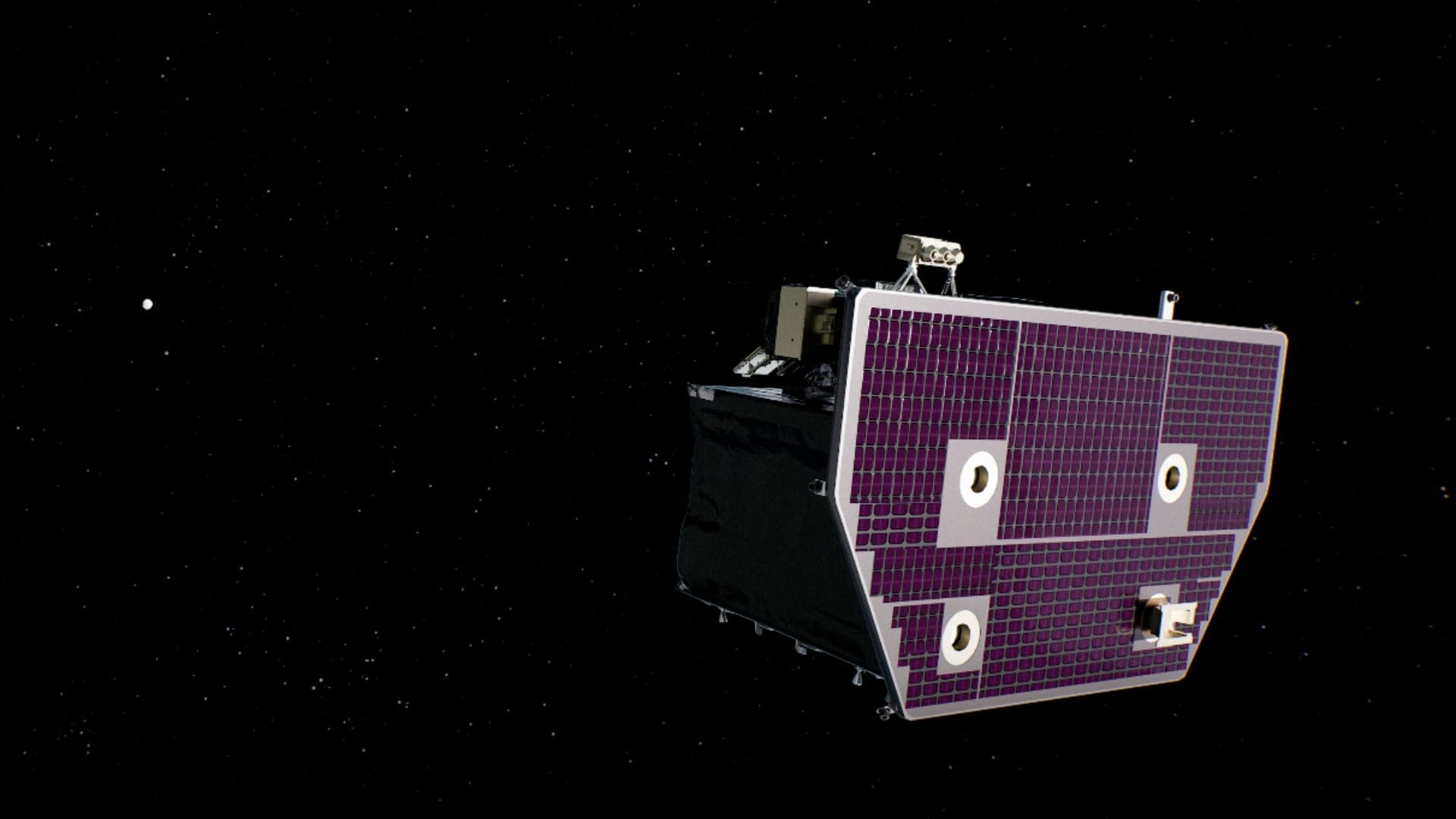
New Delhi: NASA’s Carruthers Geocorona Observatory has entered into a halo orbit around the first Lagrange point (L1) in the Sun-Earth system. This is a region of stable gravity around between the Earth and the Sun, at a distance of about 1.5 million km, where spacecraft need to expend minimal fuel to maintain their positions. The regime is popular for heliophsyics observatories, including ISRO’s Aditya-L1 mission. The spacecraft was launched along with two other heliophysics instruments by a SpaceX Falcon 9 rocket in September 2025. Since the launch, the team has been testing the instruments of the spacecraft, and have captured the first images.
The spacecraft adjusted its course as it approached L1, and has now initiated the final checkout procedures. The two-year long primary science mission is scheduled to begin in March. The Carruthers spacecraft uses a pair of cameras, a wide-field imager and a narrow-field imager to capture the most detailed images ever captured of the geocorona of the Earth, the outermost atmospheric layer that emits ultraviolet light. The mission was named in honour of George R Carruthers who invented the ultraviolet camera placed on the Moon by the astronauts on the Apollo 16 mission, that captured the very first images of the geocorona of the Earth in 1972.
The mission can go on for over 10 years
The Carruthers observatory will relay data back to the Earth twice a week through NASA’s Deep Space Network. The halo orbit around the L1 point will provide multiple angles of the exosphere to determine the shape, size and density, allowing scientists to create a 3D structure of the exosphere. Although the planned mission duration is for two years, the spacecraft has sufficient fuel on board to continue operations for over a decade. This is the first small satellite from NASA to operate at L1, and the first to provide continuous observations of the exosphere from the unique vantage point.