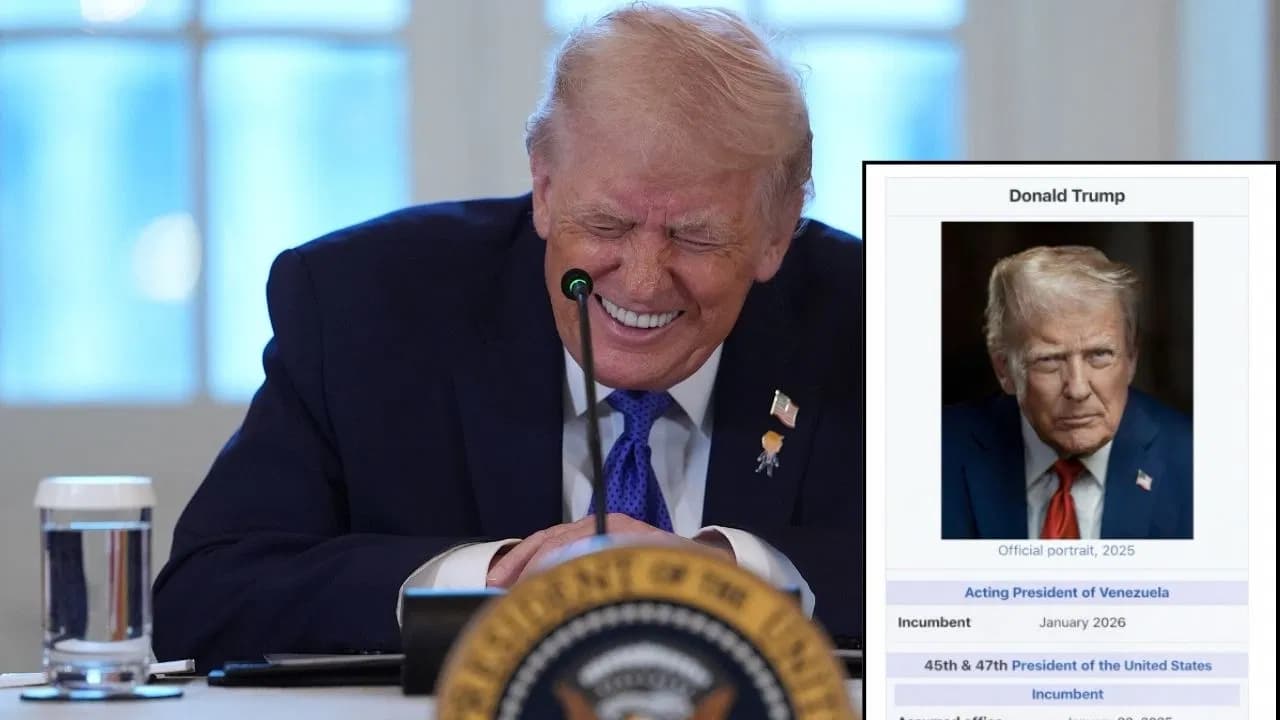
Following a US military operation that captured Venezuelan President Nicolas Maduro, Trump declared himself “Acting President of Venezuela” on social media.
In a move that has drawn global attention and sparked international debate, US President Donald Trump posted a viral image on his social media platform, Truth Social, declaring himself the “Acting President of Venezuela, Incumbent January 2026.”
The post, which resembled an edited Wikipedia profile with Trump’s official portrait and the unusual title, appeared shortly after the United States carried out a high-profile military operation that led to the capture of Venezuelan President Nicolás Maduro and his wife.
In the Truth Social post, Trump used a modified graphic that listed him as both the 45th and 47th President of the United States and as the Acting President of Venezuela, implying a level of authority over the crisis-heightened country.
The image’s designation caught the attention of global media, political analysts, and social media users alike — not least because no formal or legal mechanism in Venezuelan law or international consensus recognises a US president as Venezuela’s head of state.
The claim came on the heels of a major US-led military operation in early January, during which Trump announced that Venezuelan leader Maduro was seized during a “large-scale strike” and subsequently flown to New York to face narcoterrorism conspiracy charges.
Within Venezuela, the Supreme Tribunal of Justice had declared Vice President Delcy Rodríguez as the interim president under domestic constitutional succession, a process not influenced by foreign declarations. Rodríguez swiftly rejected the notion that Trump or the United States could legitimately assume presidential authority over Venezuela.
Hours after Maduro’s removal, Trump suggested that the United States would “run” Venezuela temporarily to ensure a stable transition, citing “security concerns” and an interest in maintaining continuity. He also invoked influence over the country’s vast oil industry, urging major American energy firms to consider investing and expanding production as part of a broader strategy to restore economic and political order.
International reactions to Trump’s declaration have been mixed and highly critical in many quarters. Governments such as China and Russia — traditional allies of Maduro, called the claim a violation of international norms and an affront to national sovereignty. Critics argue that the Truth Social post was a provocative gesture that blurred the lines between symbolic rhetoric and actual diplomatic policy, especially given that Venezuela’s actual constitutional framework does not give any foreign leader executive authority within its borders.
Within Venezuela, Rodríguez has continued to assert her legitimacy as interim president, while Maduro’s supporters have decried his capture and the US actions as illegitimate and unlawful. The controversy has reignited broader discussions about international law, sovereignty, and the limits of executive power in foreign affairs — at a time when Venezuelan leadership remains deeply contested and geopolitical tensions continue to escalate.
Overall, Trump’s self-designation as “Acting President of Venezuela” remains a symbolic and highly contentious claim, with no recognised legal or diplomatic standing, but one that has nonetheless amplified global scrutiny over the evolving political crisis in Venezuela.