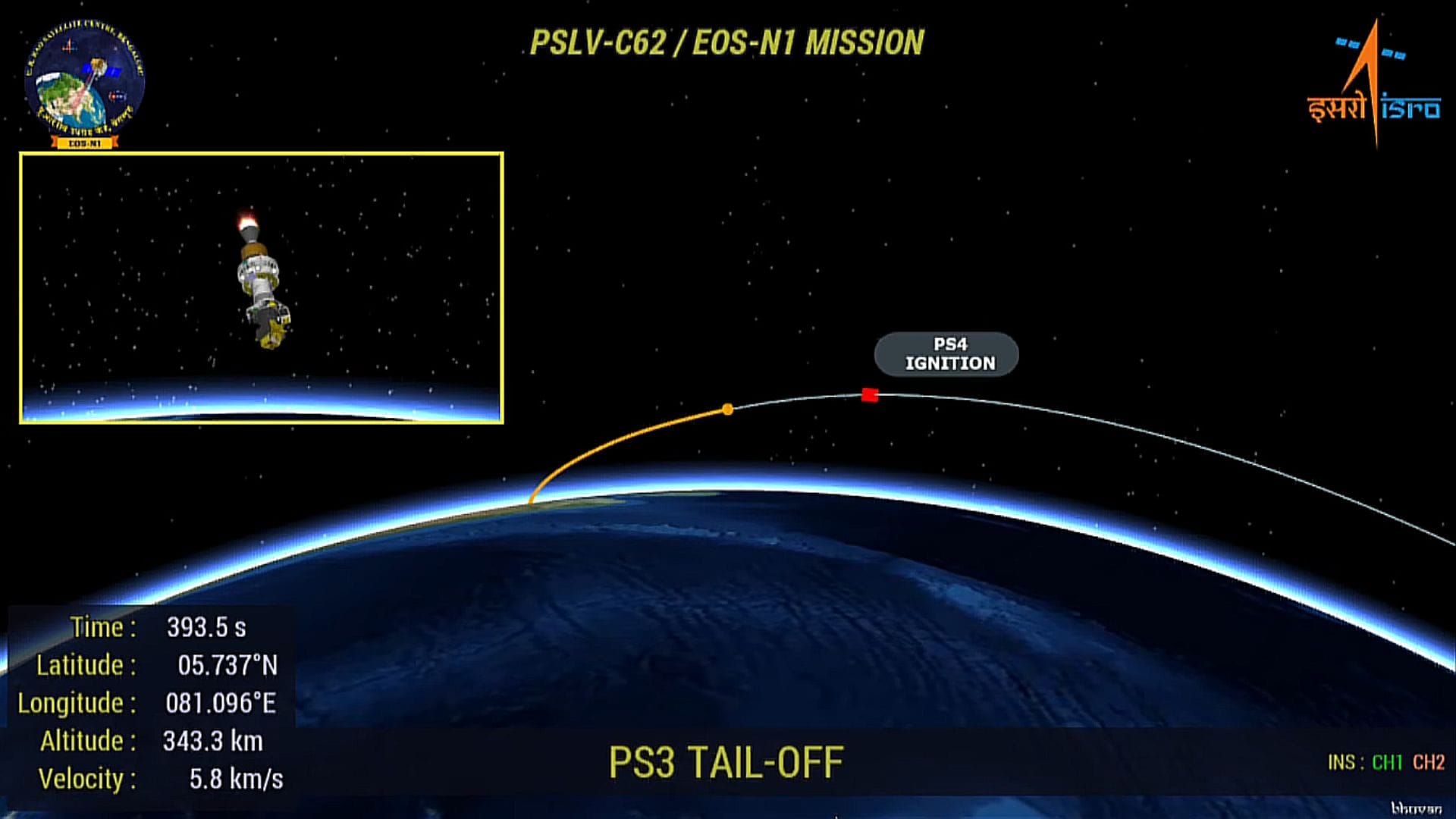
New Delhi: ISRO’s PSLV-C62 mission lifted off on the dot at 11:17 hours IST on 12 January 2025 in fair weather conditions from the First Launch Pad at India’s spaceport in Sriharikota. The first and second stage of India’s work horse rocket, known as the war horse rocket in the 2000s, performed nominally, with the payload fairing opening up like the petals of a flower and falling off 167 seconds into the flight. The nose cone of the rocket protects the payloads from the friction of the lower atmosphere, and is discarded when the rocket reaches a sufficient altitude to reduce weight. The third stage then entered into a planned coast stage. The livestream was interrupted, and then ISRO Chairman V Narayanan took the stage.
Narayanan said, “Today we had attempted the PSLV-C62/EOS-N1 mission. The PSLV vehicle is a four stage vehicle with two solid stages and two liquid stages. The performance of the vehicle up to the end of the coast stage of the third stage was as expected. Close to the end of the third stage, we were seeing little more disturbance in the vehicle roll rates, and subsequently there is a deviation episode in the flight path. We are analysing the data and we shall come back at the earliest.”
Detailed analysis has been initiated
ISRO launched the PSLV-C62 mission without fully revealing the exact causes of the failure of the previous mission, and the steps taken to prevent a recurrence. The PSLV-C61 mission launched on 18 May 2025 failed as well, also because of an anomaly in the third stage. ISRO’s PSLV is its workhorse rocket and is widely considered to be among the most reliable launch vehicles in the world. A series of back-to-back failures requires ISRO to take a close look at its rocket production pipeline down to the individual component level. The first ISRO mission of 2025 has ended in a failure.