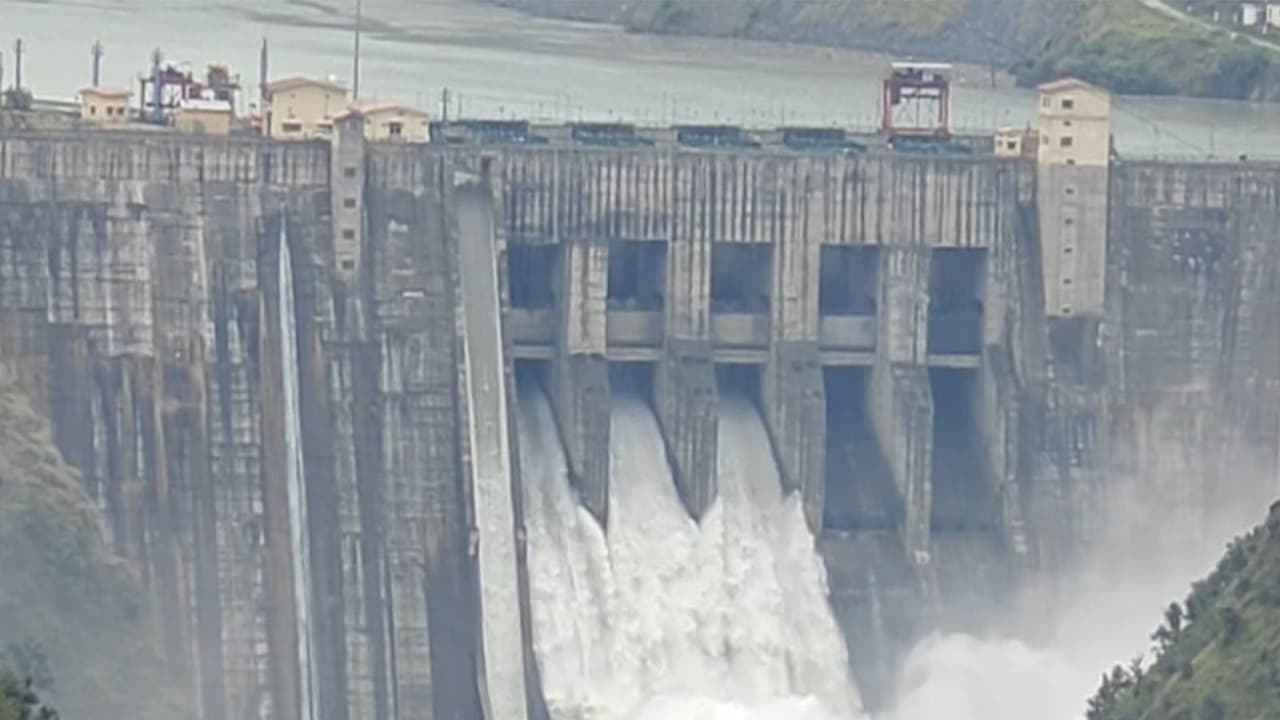
Three gates of the Baglihar Dam in J&K were opened after the Chenab River’s water level rose due to heavy rain. The move comes as India reiterates its stance that the Indus Waters Treaty with Pakistan remains in abeyance over terrorism.
Authorities on Monday opened three gates of the Baglihar Dam in Jammu and Kashmir’s Ramban district after the water level in the Chenab River rose significantly due to incessant rainfall in the Doda-Kishtwar region. The administration said it is continuously monitoring weather conditions and the river flow, with all concerned departments remaining on alert to respond to any emergency situation.
Indus Waters Treaty in Abeyance
The development comes days after India reiterated that the Indus Waters Treaty (IWT) with Pakistan will remain in abeyance until Islamabad credibly and irrevocably ends its support for cross-border terrorism. Addressing a weekly media briefing on Friday, Ministry of External Affairs spokesperson Randhir Jaiswal said India’s position on the treaty remains unchanged. “India’s position on the Indus Waters Treaty is consistent. IWT stands in abeyance in response to Pakistan’s continued sponsorship of cross-border terrorism. Pakistan must credibly and irrevocably abjure its support for cross-border terrorism,” Jaiswal said.
Earlier, on June 5, Jaiswal stated that the 1960 Indus Waters Treaty would remain in abeyance following the April 2025 Pahalgam terror attack. Speaking at the weekly media briefing earlier, Jaiswal had said, “The Indus Waters Treaty stands in abeyance in response to Pakistan’s sponsorship of cross-border terrorism,” while rejecting Pakistan’s criticism of India’s hydroelectric projects on the Chenab and Beas rivers.
The MEA also rejected the May 15, 2026 award of what it described as an “illegally constituted” Court of Arbitration (CoA) on maximum pondage and treaty interpretation. India said it has never recognised the court and considers all its proceedings and decisions “null and void.”
Earlier, on May 3, all the gates of the Baglihar Dam on the Chenab River in Ramban district remained closed more than a year after the suspension of the Indus Waters Treaty following the Pahalgam terror attack. The continued closure of the gates had highlighted the impact of the treaty’s suspension on water management and hydroelectric operations in the region.
Baglihar Project and IWT Framework
The Baglihar Hydroelectric Power Project, located on the Chenab River in Ramban district, plays a key role in hydroelectric power generation and water regulation.
The Indus Waters Treaty, signed between India and Pakistan in 1960, governs the sharing of the waters of the Indus River system. Under the treaty, India has exclusive rights over the eastern rivers – Ravi, Sutlej and Beas – while Pakistan receives the waters of the western rivers – Indus, Jhelum and Chenab. India retains limited rights over the western rivers for domestic, agricultural and run-of-the-river hydroelectric use, as specified under the treaty.
India has also been given the right to generate hydroelectricity through run-of-the-river (RoR) projects on the western rivers, subject to specific criteria for design and operation, which are unrestricted. To fully utilise the eastern river waters allocated to it, India has developed major infrastructure projects, including the Bhakra Dam on the Sutlej, Pong and Pandoh dams on the Beas, and Thein (Ranjit Sagar) Dam on the Ravi. These storage works, together with other works like the Beas-Sutlej Link, Madhopur-Beas Link, Indira Gandhi Nahar Project, etc., have helped India utilise most of the waters of the eastern rivers. (ANI)
(Except for the headline, this story has not been edited by Asianet Newsable English staff and is published from a syndicated feed.)