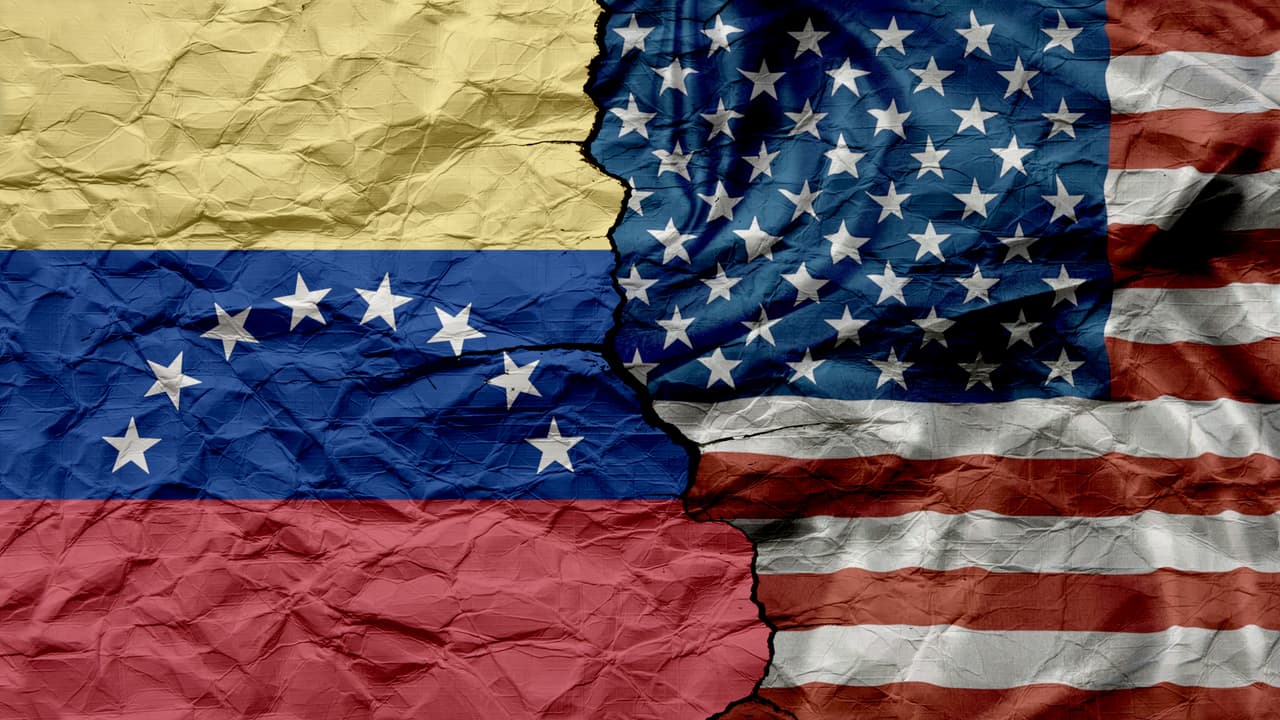
US intervention in Venezuela reshapes hemispheric power politics, raising questions on sovereignty, oil control and global order as Maduro’s removal triggers uncertainty, resistance and diplomatic fallout.
By Dr Aparaajita Pandey: The intervention in Venezuela by the United States marks one of the most significant moments in hemispheric politics since the end of the Cold War. The capture of President Nicolás Maduro and his thereby removal from politics while asserting direct influence over Venezuela’s political transition and hydrocarbon assets, the Trump’s regime has impacted not only Venezuela’s internal trajectory but has also stirred a greater global debate on sovereignty, legitimacy, and legality of the action taken by the US.
Venezuela’s Strategic Options: Between Transition and Fragmentation
As Maduro has been removed by external force, the country of Venezuela is now confronted with a legitimacy vacuum with no clear path to progress. While Maduro’s rule has struggled to find any legitimacy outside of Venezuela, his ouster in this fashion, through unilateral military action muddles the constitutional basis of the authority of the eventual successor. The successor also would need the support of the Venezuelan’s and that is one of the reasons, that any opposition or potential future leader who might enjoy the support of global players may still not be able to assume power in the country.
While it remains unclear as to what political future of Venezuela is, one option is a negotiated transition involving elements of the assembly, what remains of the state bureaucracy, civil society actors, and some relics of the supreme court as well as factions of the armed forces since they have been a part of the administration of the state for over a decade. However, there is a large chance that there isn’t much of a transformation even after this negotiation since power is concentrated with a few people and it wouldn’t be a stretch to estimate that they would like to continue holding all power. Nevertheless, such a process, could restore the Venezuelan democracy to Venezuela.
A second probability is the emergence of an interim authority that is found to be closely coinciding with Washington’s preferences, particularly regarding resource nationalism and resource privatisation. Such an interim government might find legitimacy with US and NATO allies, however, would face suspicion, backlash, and protests in Venezuela. It would also be seen as an instrument of US exploitation especially since there is historical experience that underscores such policy. Eventually such a government would lose all legitimacy.
The most threatening scenario remains disintegration of Venezuelan political authority. Pro-Maduro militias, politicized military units, or regional power brokers could resist the transition, producing a low-intensity conflict or protracted instability. Such outcomes would further delay economic recovery and entrench Venezuela’s humanitarian crisis, while also undermining the stated objectives of intervention.
Oil, Reconstruction, and Economic Sovereignty
Venezuela’s vast crude oil and natural gas reserves are pivotal to all post-intervention scenarios. Any recuperation strategy will inevitably include the rehabilitation of the hydrocarbon sector that has been devastated by sanctions, mismanagement, and lack of investment and technological innovation. It is important to note that who eventually manages to gain control of the ownership, supply, and sale of the fuel sector is inherently political.
The question of controlling the hydrocarbon sector of Venezuela is beyond the ownership, efficiency, profit, and loss. For the Venezuelan’s it is the question of resource nationalism. It is about maintaining the sovereignty of their nation-state and resisting control of a hegemonic power of the Americas that has also been ideologically opposed to the Venezuelan socialism. It would be indicative the Venezuelan struggle and American oppression and need for control and ownership that has been made apparent by the sanctions and the constant referring as a part of the axis of evil or/and troika of tyranny.
The Return of Assertive Hemispheric Power
Beyond Venezuela, the intervention sends a clear signal about the nature of U.S. strategy in the Western Hemisphere. The operation is symptomatic of a renewed prominence on geographic primacy, resource security, and strongarming, these are all elements that are evocative of the traditional US policy of constant referral of the Monro Doctrine and the term used much to the chagrin of the Latin people – ‘America’s backyard’. These have allowed, justified, and have been used to legitimise US’s repeated interventions in region.
Under Trump, foreign policy has constantly selected transactional outcomes. The Venezuela intervention exemplifies this approach: legality and multilateral consensus were disregarded for decisive action and strategic gain. This action by Washington is being interpreted as US’ agreeability for use of force, disregard for legal action, and sovereignty of other countries.
This message resonates far beyond Latin America. Middle powers and developing states, the episode underscores the vulnerability and ineffectiveness of international legal provisions in an era of revised great-power competition. For now, it has also rattled the US allies, as it raises questions about how far Washington is willing to go to enforce its will.
Global Reaction
International reactions are an amalgamation of concern and strategic restraint. Some governments see the intervention as a continuation of a threatening precedent that undermines sovereignty. Others, who have been grappling with organized crime and migration pressures, are of the opinion that this is a pragmatic approach that prioritises stability.
China and Russia have condemned the intervention in strong rhetorical terms, terming it as a violation of international law and an assertion of imperial power. However, neither appears too interested in direct confrontation. China’s response has been measured, focused on diplomatic signalling and the conservation of economic interests rather than overt escalation. For Beijing, Venezuela is significant, but not at the expense of broader strategic priorities elsewhere.
Europe has largely stuck to legal critiques, focusing on importance of sovereignty and negotiated political transitions while avoiding direct confrontation with Washington.
At the multilateral level, debates within the United Nations are likely to intensify. However, meaningful enforcement or reversal of outcomes remains improbable given power asymmetries within the international system.
In the immediate future, three underlying forces would be most likely to shape outcomes. First would be intense diplomatic contestation, specifically in multilateral forums, as their relevance also takes a hit if states decide to act in ways as unilateral, and non-chalant as the US just acted. Second, energy markets will adjust as Venezuelan oil flows are redirected, although that shouldn’t be too much an issue owing to Venezuela’s steadily dwindling supplies. Third, Venezuela’s internal political balance will continue to be volatile, with too many players attempting to grab both power and popular support and global legitimacy although the third, is not a priority for most players. However, none of these processes are indicative of rapid stabilization.
Conclusion
The US intervention in Venezuela is a crucial episode in the development of twenty-first-century power politics. For Venezuela, it is a narrow and precarious window to rebuild political legitimacy. For the United States, it signals a commitment towards dominance in the region through direct and unapologetic means. For the rest, it drives home a sobering reality that norms endure only till power allows them.
Whether this episode is successful in producing stability or causes prolonged disruption will depend less on Washington and more on Venezuela’s capacity to generate a largely honest political order and keeping control over its own hydrocarbon resources.
(Author has a PhD in Latin American Studies from SIS. JNU and is a Professor of Defence and Strategic Studies at Amity University, NOIDA)
Disclaimer: The opinions expressed are solely those of the author and do not reflect the views or stance of the organization. The organization assumes no responsibility for the content shared.