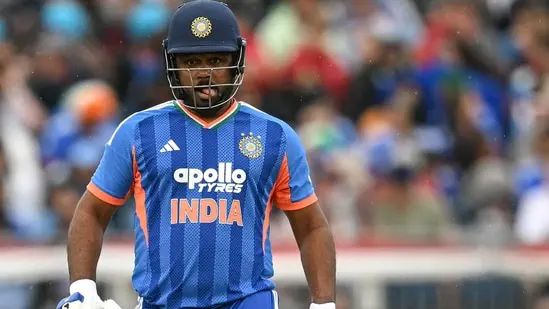
India’s decision to replace Sanju Samson with Vaibhav Sooryavanshi did not land as a routine team change. It landed with the weight of a familiar question.
Why always Sanju? Why does the axe so often seem to find him first? Why does a player with such obvious gifts, such clean ball-striking and such rare match-winning ability still live one bad week away from another selection debate?
The answer is uncomfortable because it is not as simple as injustice. Samson has never been an ordinary T20I batter. His record itself refuses that reading: 1405 runs in 57 innings, a strike rate of 155.42, three hundreds, six fifties and 84 sixes. Those are not the numbers of a timid player or a passenger. They belong to someone who can break a match open in a session, sometimes in a spell of 20 balls. But they also carry the other half of the story. His average is 27.02. His median score is only 13. He has eight ducks. Of his 57 innings, 35 have ended below 20 and 43 below 30.
That is the Sanju Samson contradiction. He is not short of impact. He is short of continuity.
Brilliance Without Continuity
Samson’s India career has rarely moved in a straight line. It has moved like lightning: sudden, spectacular, and then gone. His best days are so good that they keep the argument alive. His quieter days are so frequent that they keep the doubt alive.
The most revealing number is this: his nine scores of 50 or more have produced 793 of his 1405 T20I runs. In other words, 56.4 per cent of his career runs have come from just nine innings. Strip those away, and the rest of his T20I career reads 612 runs in 48 innings, at an average of around 13.6. That is not a small correction; it is the entire selection dilemma.
His three hundreds make the point even sharper. The scores of 111, 107 and 109 not out alone account for 327 runs, nearly a quarter of his career tally. Without those three innings, his average slips close to 21.5. Again, this does not make him a bad player. It makes him a high-variance one. India have seen the ceiling. They have also seen the floor. The problem is that both keep arriving without warning.
The pattern becomes even clearer when his innings are read not as isolated numbers, but as sequences. After scoring 77, Samson followed it with 30 not out, then 15, 5, 12 and 7. After a 58, he went 0, 0 and 29. After back-to-back statement innings of 111 and 107, he made 0 and 0. After 109 not out, he followed with 26, 5, 3, 1 and 16. The rhythm repeats: a peak, then a drop; a reminder of class, then a stretch that reopens every old question.
Even the opening role, where his numbers are stronger, does not fully rescue the argument. As an opener, Samson has 932 runs in 31 innings, at a strike rate close to 179. That is explosive. That is valuable. But even there, 18 of those 31 innings have been below 20, 14 have been single-digit scores, and five have been ducks. Seven 50-plus opening scores have given him 679 runs; the remaining 24 opening innings have produced only 253. The role has amplified his threat, but it has not removed the volatility.
This time Sooryavanshi was there
That is why the World Cup phase matters so much. For three matches, Samson seemed to have escaped the old pattern. The run of 97 not out, 89 and 89 was not merely destructive; it was repeatable. It was the version India had waited years to see – not one Sanju night, but a Sanju stretch. He was not just playing cameos. He was shaping games, returning the next day, and doing it again.
But that is also why the fall after it hurts his case. The World Cup did not become a new normal. It became a rare exception. After that three-match burst came 5, 0 and 1. The old question returned almost immediately, and this time there was a 15-year-old phenomenon waiting outside the XI.
That is where Vaibhav Sooryavanshi’s entry changes the emotional temperature of the debate. Samson was not replaced by a safe, conservative option. He was replaced by a teenager carrying the force of the future. In another situation, India might have absorbed three failures from a World Cup hero. But when the alternative is a generational talent demanding space, Samson’s lack of follow-up becomes harder to defend.
And yet, this should not be written as the end of Samson or as proof that India were always right to doubt him. That would be too harsh and too easy. His problem is not that he cannot play at this level. His problem is that he has proved he can – and then failed too often to repeat it before the next selection storm arrived.
That is why “Why always Sanju?” remains such a loaded question. It contains sympathy, frustration and evidence all at once. He has been unlucky at times. He has also made himself vulnerable at times. He has been asked to survive in a system where one failure can become a headline, but he has also given that system too many clusters of failure to use against him.
Sanju Samson’s tragedy is not that India do not know how good he can be. They know exactly how good he can be. They have seen the hundreds, the clean hitting, the tempo, the fearless starts, the World Cup surge. The tragedy is that they still cannot be sure when that version will arrive again.
So when Vaibhav walked in for Samson, it was not merely the dropping of a batter. It was the latest chapter in a career-long conflict between brilliance and trust. Samson gives India enough magic to keep believing. Then, too often, he gives them enough silence to start doubting again.