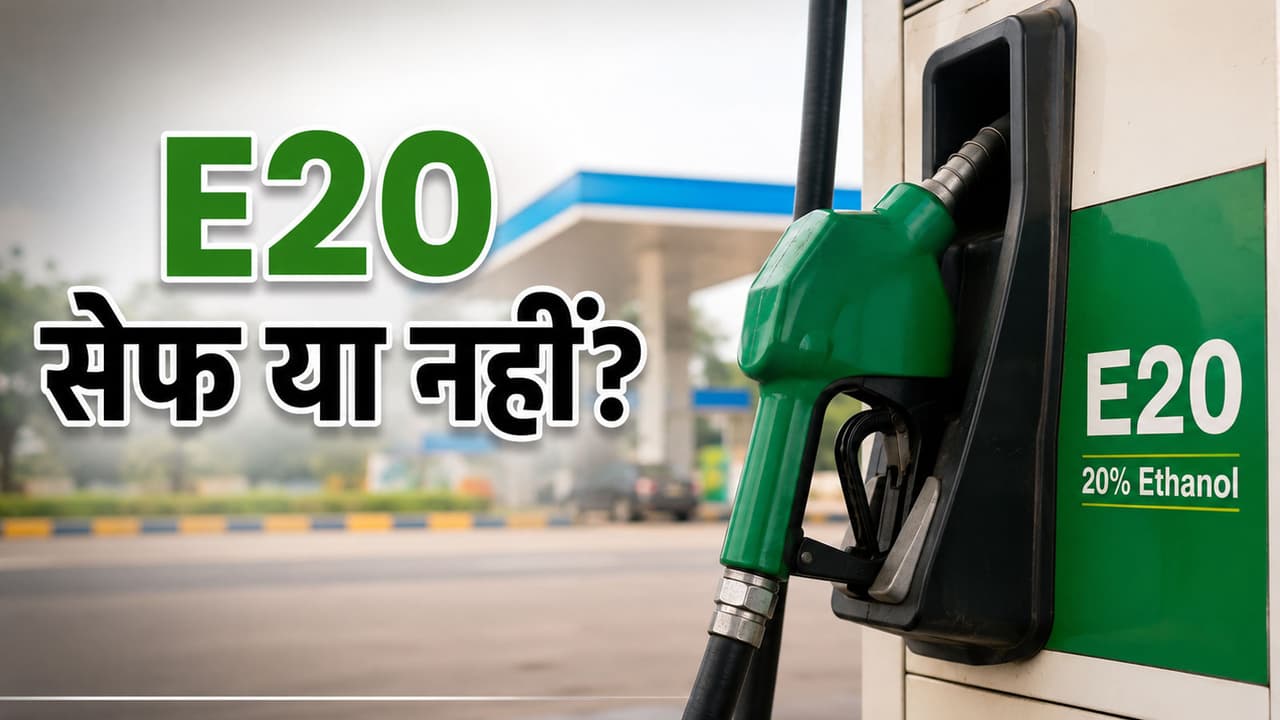
On the questions being raised regarding E20 petrol, companies like Maruti Suzuki, Toyota Kirloskar and Hero MotoCorp have expressed confidence that there is no harm found in it even in old vehicles.
E20 Fuel Impact: Many types of talks are going on across the country regarding E20 petrol. Some people consider it better for the environment, while others have a question whether it is safe for old vehicles? Can this cause damage to the engine? Will mileage be reduced? Now all these questions have been answered openly by big experts of automobile and energy sector. Auto industry giants, including the country’s largest car manufacturer Maruti Suzuki and Toyota, held a joint press conference in Delhi and clearly said that E20 petrol was not introduced in a hurry, but it was implemented after years of testing and research.
Will E20 harm old vehicles?
The biggest fear and question is that pouring this petrol in vehicles which are not E20 certified i.e. 3-4 year old vehicles will cause corrosion in the engine or parts will break. On this, Maruti Suzuki’s Senior Executive Officer (Corporate Affairs) Rahul Bharti dispelled all the fears of the customers. He said that in the financial year 2025-26, Maruti Suzuki serviced a total of 2.84 crore cars. Of these, more than 1.5 crore cars were more than 3 years old, which were not E20 certified. Maruti Suzuki claims that in the field reports of these more than 1.5 crore old vehicles, not a single case of engine rust, wear or damage to any component due to E20 petrol has come to light. The vehicles are running perfectly.
Does E20 petrol reduce mileage?
There is also a big concern regarding E20 petrol that it may reduce the mileage. According to Maruti Suzuki, the calorific value (energy capacity) of E20 petrol is about 3 to 3.5% less than that of E10. This means that there is a slight difference in mileage only to this extent. Meaning, if your car gives a mileage of 20 km per liter, then with E20 petrol it will reduce to about 19.4 km (difference of only 0.6 km per liter). According to experts, this slight decrease in mileage is compensated by the big benefits of E20 petrol. Ethanol mixed petrol gives better acceleration (pick-up) to the vehicle, increases anti-knocking (smoothness of the engine) and has much less pollution as compared to pure petrol. Apart from this, things like low tire pressure, wrong gear change, sudden braking and poor maintenance cause much more damage to the mileage.
What did Toyota say?
Vikram Gulati, Country Head, Toyota Kirloskar Motor, clarified that ethanol is not a new or dangerous fuel, but it is a high-performance and clean fuel that has been in use since the early 1900s and even in formula racing. He told that E20 has been launched in the market only after conducting very stringent and international level tests on old vehicles. He also clarified that the recently launched E85 stations are only for flex-fuel vehicles and not for normal vehicles. On the questions being raised regarding the impartiality of testing agencies, Gulati said that the rules of testing are not decided only in India, India is a member of UNECE and the testing process is completely standardized at the international level. According to him, these agencies also test the vehicles being exported, hence no compromise can be made with these protocols.
Hero MotoCorp’s reply
Ashutosh Verma, Chief Business Officer of Hero MotoCorp, one of the world’s largest two-wheeler companies, also confirmed that in the analysis of their service data, no case of any kind of additional damage to bikes or scooters due to E20 petrol has been found.
Beware of fake ‘fixing kits’ available in the market
The experts present on the panel have also given a very important warning to the vehicle owners. Nowadays many people in the market are claiming to sell ‘Retrofitment Kit’ to make old vehicles E20 compatible. Maruti Suzuki made it clear that the companies have designed the vehicles far beyond the safety standards. There is no such official kit available in the market and such technologies are currently limited only to the Research and Development (R&D) level. Therefore, do not waste your money by getting any fake kit installed from outside.
E20 fully conforms to BIS standards and BS-VI emission norms
Vartika Shukla, former CMD, Engineers India Limited (EIL), said that the ethanol blending program has been designed in consultation with all stakeholders and is based on scientific evidence and intensive testing by automobile manufacturers. He informed that E20 fuel fully complies with BIS standards and BS-VI emission norms and is uniformly available at petrol pumps across the country.