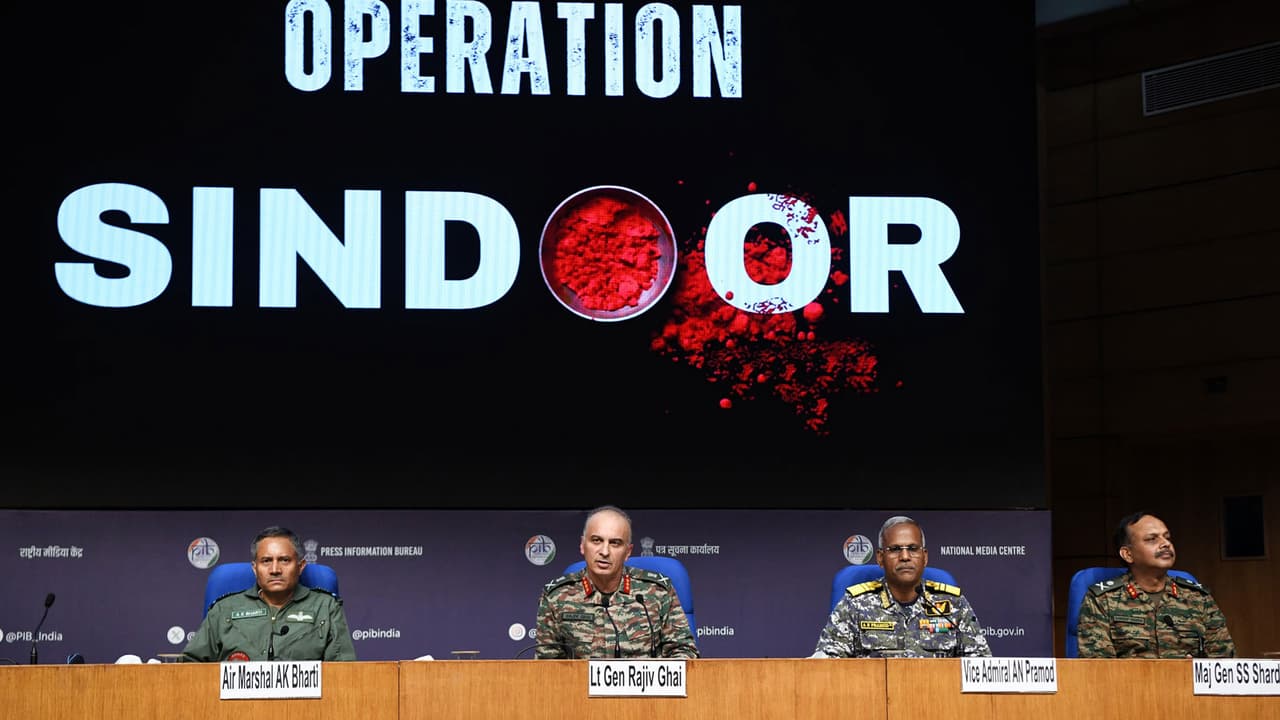
Operation Sindoor marked India’s military action in decades. Launched after Pahalgam attack, it saw strikes on terror camps in Pakistan, strong defence response and major strategic shifts. It redefined India’s zero-tolerance policy on terrorism.
The year 2025 will be remembered as a defining moment for India’s national security. At the heart of this shift was Operation Sindoor, the Indian military’s largest and most complex combat mission in nearly 50 years. The operation was launched to punish Pakistan for its continued support of cross-border terrorism and to send a clear message that India will no longer tolerate such attacks.
Triggered by the brutal terror attack in Pahalgam, Jammu and Kashmir, where 26 innocent civilians lost their lives, Operation Sindoor reshaped India’s security thinking. It showed a new level of military readiness, political resolve, and strategic clarity, marking a watershed year for the defence establishment.
Pahalgam terror attack, sparks decisive military response
In April, the nation was shaken by the horrific terror strike in Pahalgam. The attack caused nationwide grief and anger. The government held Pakistan responsible for backing the terror groups involved, citing long-standing evidence of cross-border support.
After days of internal assessment and diplomatic messaging, India decided that a strong military response was unavoidable. Officials made it clear that the aim was not war, but accountability.
Precision strikes launched under Operation Sindoor
In the early hours of May 7, India launched Operation Sindoor. The armed forces carried out precision missile strikes on nine major terror camps located in Pakistan and Pakistan-Occupied Kashmir.
According to official estimates, at least 100 terrorists were eliminated. The targets were carefully chosen to avoid civilian areas while hitting key operational hubs of terror groups. Among the locations struck were:
- Jaish-e-Mohammed headquarters in Bahawalpur
- Lashkar-e-Taiba base in Muridke
- Terror infrastructure in Sialkot, Muzaffarabad, Kotli, Bhimber, and nearby regions
The strikes were swift, coordinated, and highly accurate.
Political message against nuclear blackmail
Prime Minister Narendra Modi described the operation as a clear assertion of India’s political will. He said India would no longer accept threats or nuclear blackmail from Pakistan.
The government stressed that the strikes were aimed only at terror camps, not civilians or the Pakistani state. India also informed Pakistan immediately after the operation that it did not wish to escalate the situation further.
Pakistan’s retaliation and India’s strong counter-response
Despite India’s message, Pakistan launched retaliatory military actions. These attempts were met with a strong and measured response by Indian forces. India activated advanced defence systems including:
- Integrated Counter-UAS Grid
- S-400 Triumph missile systems
- Barak-8 and Akash surface-to-air missiles
These systems successfully blocked incoming threats and protected Indian assets.
Heavy damage to Pakistani military infrastructure
During the counter-operations, India inflicted significant damage on Pakistan’s military capabilities. Official sources confirmed hits on:
- Hangars at three locations
- Radar systems at four sites
- Command and control centres at two locations
- Runways at two air bases
The strikes reduced Pakistan’s ability to continue hostilities.
New era of multi-domain warfare on display
Operation Sindoor highlighted a new form of warfare. It showed seamless coordination between the Army, Navy, and Air Force, backed by modern technology.
The operation featured extensive use of drones, counter-drone systems, precision missiles, and real-time intelligence. Defence experts described it as India’s entry into modern, multi-domain warfare.
Hostilities end but new security ‘normal’ emerges
Military actions stopped on May 10, following talks between senior army officials through a hotline. While the fighting ended, the message was clear. India had set a new normal: any terror attack would invite swift and decisive action across the border.
Prime Minister Modi later said India had only ‘paused’ its actions and would closely watch Pakistan’s future behaviour.
Navy deployment strengthens deterrence
As part of a broader deterrence strategy, the Indian Navy deployed its carrier battle group, submarines, and aircraft at full combat readiness after the Pahalgam attack. This ensured maritime security and sent a strong signal of preparedness.
India also used non-military tools to shape the situation. A major step was the suspension of the Indus Waters Treaty of 1960. Pakistan depends heavily on the Indus river system for farming and daily water use. The move added long-term strategic pressure.
Air force claims and aircraft losses
In October, Air Chief Marshal A P Singh stated that at least 12 Pakistani aircraft, including US-made F-16s, were destroyed or damaged.
While India acknowledged some aircraft losses, Chief of Defence Staff Gen Anil Chauhan rejected Pakistan’s claim of shooting down six Indian jets as false.
Focus on China and maritime security
Throughout 2025, India maintained a strong posture along the 3,500 km Line of Actual Control with China. Surveillance was increased to closely monitor PLA movements.
At sea, India expanded its presence in the Indian Ocean, responding to rising Chinese activity.
Nuclear submarine programme gains momentum
Navy Chief Admiral Dinesh K Tripathi announced that India’s third nuclear-powered submarine, INS Aridaman, is nearing commissioning.
This strengthens India’s underwater nuclear deterrence, alongside INS Arihant and INS Arighat.
Major defence deals and missile tests
India signed a major agreement with France to buy 26 Rafale Marine jets for aircraft carrier INS Vikrant. The defence ministry also pushed forward Project 75 India to acquire six stealth submarines.
In August, India successfully tested the Agni-5 ballistic missile, capable of striking targets up to 5,000 km away.
Strengthening global defence partnerships
Despite trade tensions, India and the United States signed a 10-year defence framework pact to support a free and open Indo-Pacific. India also expanded defence ties with several other nations during the year.
Operation Sindoor changed how India responds to terrorism. It combined military power, political clarity, and strategic planning. The events of 2025 proved that India is prepared to defend itself across land, air, sea, space, and cyber domains.
For India’s defence forces, this was not just a response, it was a reset.