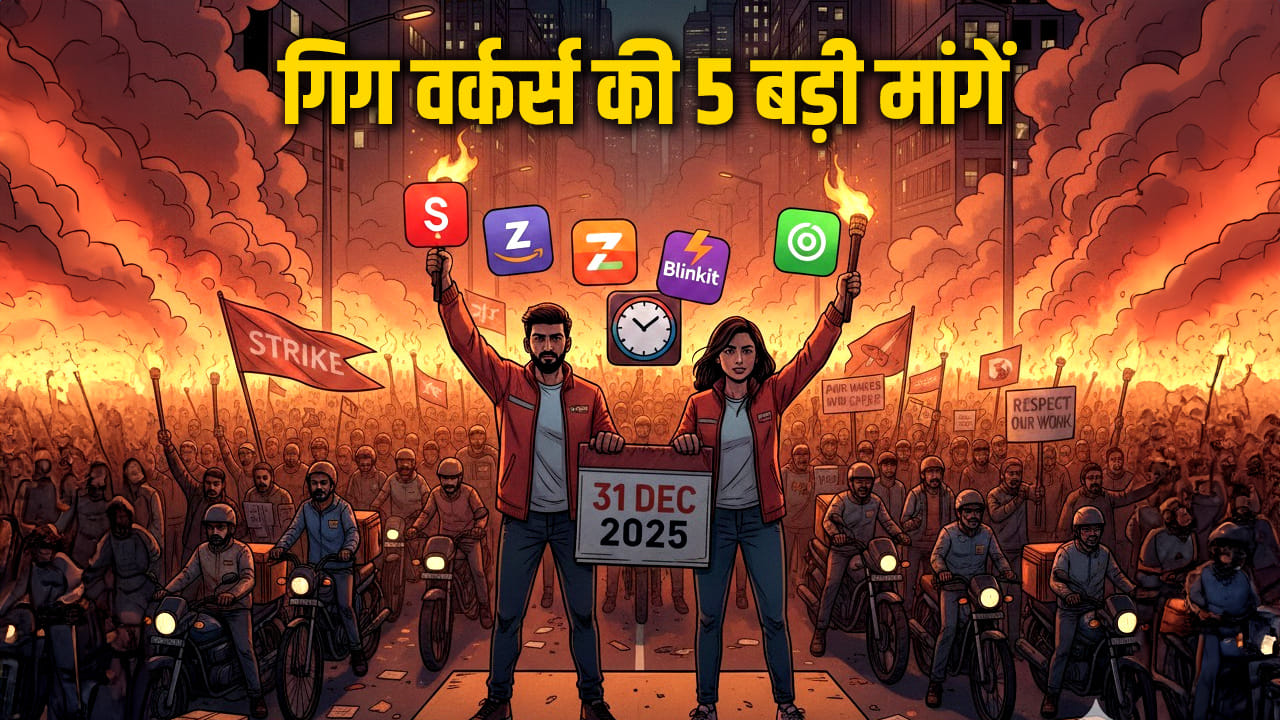
Fearing the strike, platforms like Swiggy-Zomato have increased the incentives for gig workers.
Even before the New Year, the companies have suffered a major blow due to the strike by gig workers. All delivery workers including Swiggy, Zomato, Amazon, Flipkart announced a nationwide strike. The union of gig workers says that despite our demands, the companies are not paying attention to them. The companies neither pay them proper salaries nor guarantee security. The 10-minute delivery model is causing accidents for gig workers on the roads. After day and night delivery amidst sun, cold and rain, facilities like insurance or health insurance are not provided by the company. However, after the strike started on Wednesday, the companies announced to increase the incentive amount of delivery employees.
Zomato has said to pay Rs 150 per order. At the same time, they have also been exempted from fine during busy times. Not only this, Swiggy has given an opportunity to delivery workers to earn up to Rs 10,000 on 31st December and 1st January. Now the question is, what are gig workers, which employees fall in this category, India or China, which country has the maximum number of gig workers, what are their demands and how much do they earn?
What are gig workers?
These are employees who are not permanent. They get salary on the basis of work. If you understand in simple language, the more work, the more salary. For example, the salary received after one day of food delivery or a freelance employee. Their payment is not fixed, it increases or decreases according to their work. Zomato, Swiggy, Blinkit delivery boys are examples of gig workers.
According to the Ministry of Labor and Employment, a person who works outside the traditional employer-employee relationship or participates in their business and earns from it is called a gig worker.
The term gig economy was coined in 2009 by Tina Brown, former editor of The New Yorker. Its purpose was to show how people working in the economy adopt projects while transacting through digital markets.
India, China or America, where has the most gig workers?
According to the report of The Economist, the highest number of gig workers is in China. Their number here is 2 crores. The report claims that China has such a large number of gig workers that it can create problems for other countries. This will reshape China’s economy and society in the coming years. As technology is reshaping the labor market, China’s gig workers can set an example for countries around the world. There are about 1 crore gig workers in India, while there are 12 lakh in Malaysia.
According to NITI Aayog’s ‘India’s Growing Gig and Platform Economy (2022)’ report, the number of gig workforce in India is expected to reach 2.35 crore by 2029-30. Both urban and rural economies are increasingly dependent on gig workers for everyday services, mainly due to the growing demand for instant home delivery. Platforms providing home based services like Urban Company and BigBasket are rapidly gaining popularity.
How much do gig workers earn?
How much gig workers earn depends on different platforms. Their earnings are decided based on the distance of the restaurant from the customer’s home. Data from research conducted by PAIGAM and the University of Pennsylvania in this regard say, about 50% of delivery workers earn ₹201-600 per day, while about 43% of cab-based gig workers earn less than ₹500 per day.
What are the demands of gig workers?
Gig workers have five main demands. The union says that they should be given the old payout. The old payout was Rs 80 and Rs 60 per order. The rule of delivery within ten minutes should be stopped completely. The app should stop being controlled by algorithms. Companies should stop blocking workers’ IDs and gig workers should be protected with respect.
In the BBC report, Sheikh Salauddin, President of Telangana Gig and Platform Workers Union, says that the fees of delivery workers are being reduced day by day. Earlier, Rs 80 and Rs 60 were available per order. Now 10, 20 and 15 rupees are being given for it. They claim that companies are earning huge profits, but gig workers are getting a very less share.
Also read: Why India-China dispute over Galwan Valley? Dragon got chilli from Salman’s film