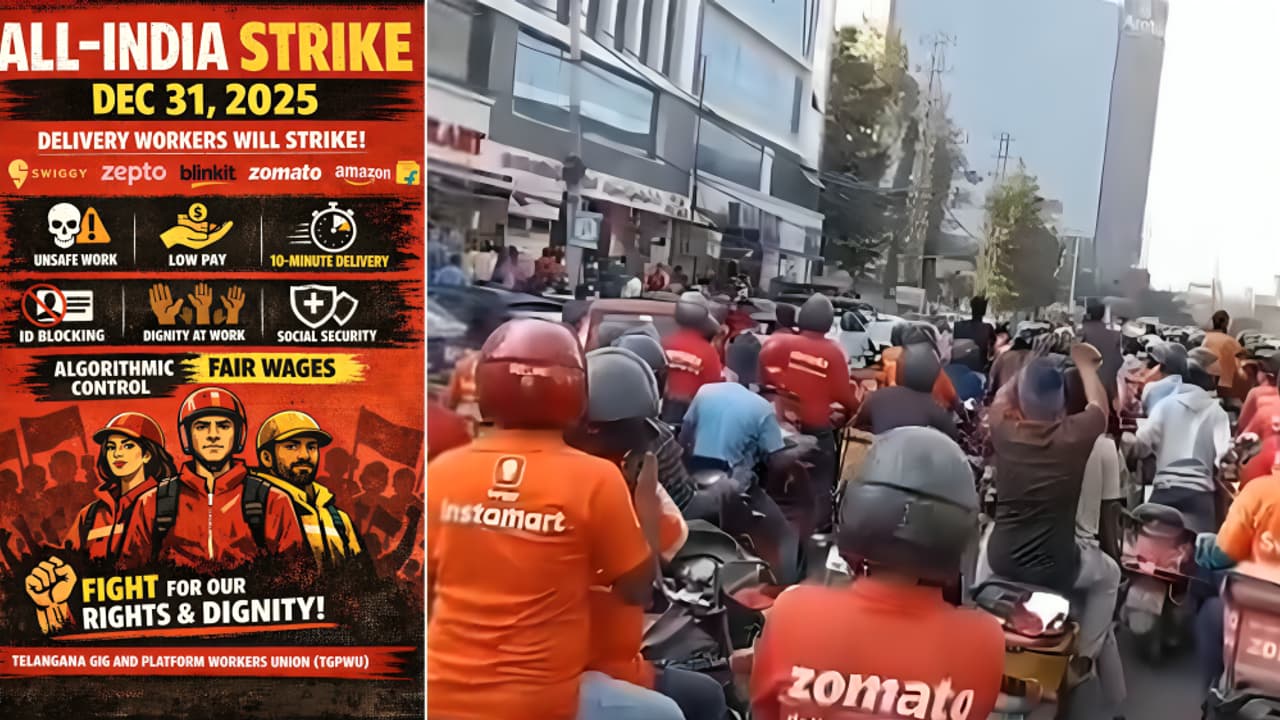
Gig workers across India are holding a nationwide strike on December 31, demanding the removal of 10-minute delivery options and restoration of fair pay systems. Unions say fast delivery promises force unsafe driving and reduce earnings.
As world prepares to welcome the New Year, thousands of food and grocery delivery workers across India are getting ready for a nationwide strike on December 31. The protest is being organised by gig worker unions across the country and could seriously disrupt delivery services during peak hours.
The workers say they are no longer able to cope with unsafe work pressure, falling pay, long working hours, and a complete lack of social security. At the centre of the protest is a strong demand: remove the 10-minute delivery option and bring back the old payout system that paid workers fairly.
Union leaders warn that what people saw on December 25 was only a preview. On New Year’s Eve, they say, the impact will be much bigger.
Who is leading the strike and why it matters
The strike call has been led by the Telangana Gig and Platform Workers Union (TGPWU) and supported by the Indian Federation of App-Based Transport Workers (IFAT). These groups represent delivery riders and drivers working for major platforms such as Swiggy, Zomato, Zepto and Amazon.
TGPWU President Shaik Salauddin said gig workers across India are united like never before. According to him, more than 1.5 lakh workers are now backing the movement, and many more are expected to join on December 31.
“This is not just about one day. This is about dignity, safety and survival,” Salauddin said while speaking to news agency ANI.
What happened on December 25: ‘Just the trailer’
The protest has already begun in stages. On December 25, gig workers across India held demonstrations and digital strikes by switching off their delivery apps. Salauddin said that around 40,000 workers participated nationwide on that day. The impact was immediate.
“Because of the protest, 50 to 60 per cent of orders were delayed,” he said.
He warned that December 31 will be far more disruptive.
“What happened on December 25 was just the trailer. The real picture will be seen on December 31,” Salauddin added.
Scroll to load tweet…
The main demand: Remove the 10-minute delivery option
One of the strongest demands from gig workers is the complete removal of the 10-minute delivery guarantee offered by several platforms. According to workers and union leaders, this promise creates dangerous pressure. Delivery riders feel forced to ride fast, break traffic rules, and take risks just to avoid penalties. Under the current system, even small delays can lead to:
- Loss of incentives
- Lower ratings
- Abuse from customers
- Threat of account suspension
Workers say none of this comes with job protection, health cover, or accident insurance.
Riders say speed is rewarded, safety is ignored
Many delivery workers say the apps only reward speed. Traffic conditions, weather, road quality, and safety are ignored. In cities like Patna, this pressure has turned daily work into a life-threatening task.
Twenty-five-year-old delivery rider Kishan Kumar explained how it works.
“Each order has a fixed time. If we are late, the app cuts our pay automatically,” he said. “When roads are empty, many riders go at 80 or even 90 kmph because the app only understands speed.”
He admitted that riders often drive on the wrong side of the road.
“We don’t do this because we want to. We do it because we have no choice,” he said.
Old payout system must return, unions say
Another major demand is the restoration of the old payout structure. Salauddin said that earlier, especially during festivals like Dussehra, Diwali and Bakrid, workers were paid fairly. Incentives were clear, predictable, and worth the effort.
“That system must be implemented again on a regular basis,” he said.
Workers claim that recent changes in payment systems have reduced earnings sharply. Many say they now have to work 14 to 16 hours a day just to earn enough.
Algorithm control and lack of clarity
Union leaders have also criticised the algorithm-based management system used by platform companies. According to Salauddin, algorithms now control almost every part of a worker’s life:
- Order allocation
- Incentives
- Ratings
- Penalties
“The algorithm controls workers’ businesses,” he said. “Incentives are not paid properly, and there is no clarity.”
Workers say they do not know why payments change, why bonuses disappear, or why their accounts get blocked.
Allegations of intimidation by companies
The unions have accused aggregator companies of trying to scare workers into silence. Salauddin alleged that:
- Bouncers are being deployed near warehouses
- Worker IDs are being blocked
- Team leaders and area managers are threatening workers
“This kind of pressure will not work,” he said.
Despite these claims, union leaders say support for the strike continues to grow.
Support from women-led gig workers’ union
The strike has also been backed by the Gig & Platform Services Workers Union (GIPSWU), India’s first women-led national trade union for gig workers. GIPSWU National Coordinator Nirmal Gorana said thousands of workers have already taken part in earlier actions.
On December 25, around 5,000 workers in Delhi NCR went offline as part of a digital protest.
“The December 31 strike shows our collective strength and how much the economy depends on gig workers,” Gorana said.
What GIPSWU is demanding from governments
GIPSWU has urged both central and state governments to step in. Their key demands include:
- Minimum per-kilometre pay rates
- Safety measures for women workers
- Maternity and emergency leave
- Legal recognition of platform workers as “workers” under labour laws
The union says gig workers are still treated as “partners” on paper but denied basic labour rights in real life. Political backing: AAP MP calls for ban on fast delivery apps
The protest has also received political support. Aam Aadmi Party Rajya Sabha MP Raghav Chadha has renewed his call to ban 10-minute delivery apps. He said companies have built billion-dollar valuations on the hard work of gig workers while offering them little protection.
“If one group is under immense pressure in this system, it is gig workers,” he said.
Chadha warned that fast delivery guarantees force riders into unsafe behaviour.
Scroll to load tweet…
Scroll to load tweet…
Scroll to load tweet…
Scroll to load tweet…
Call to limit working hours
Chadha also proposed setting fixed working hours for gig workers. He said the current system pushes people to work 14 to 16 hours a day just to earn incentives.
“No worker should be forced to risk their life for a bonus,” he said.
What customers should expect on December 31
With workers planning to switch off their apps, customers in major cities may face:
- Long delivery delays
- Limited rider availability
- Order cancellations during peak hours
Unions say they regret the inconvenience but argue the strike is necessary.
“This is the only way our voices are heard,” Salauddin said.
As the countdown to New Year begins, gig workers across India are preparing for what they say is a crucial moment in their struggle.
This strike is not only about pay. It is about safety, dignity, and recognition. Workers say they want fair rules, clear payments, and protection from dangerous pressure. Whether companies or governments respond remains to be seen. But on December 31, the people who keep India fed may finally make the country stop and listen.
(With ANI inputs)