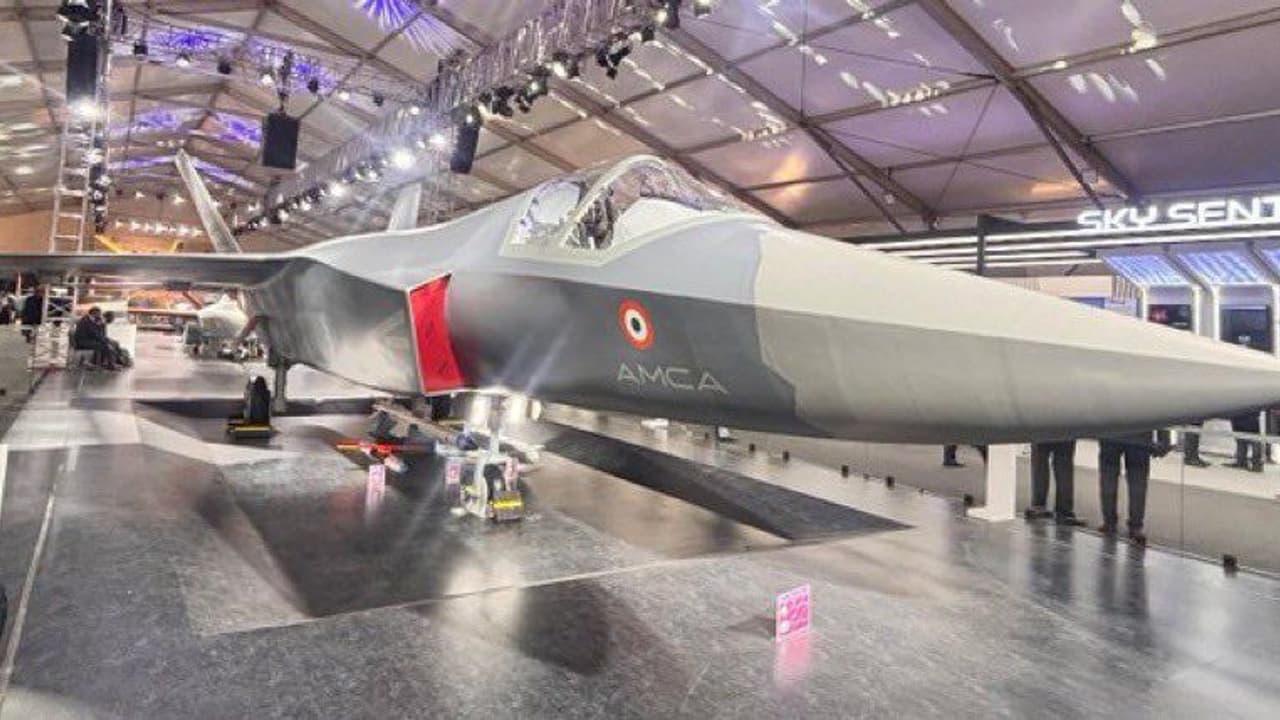
Will the AMCA project be able to put India at par with countries like America, Russia and China? Will India’s defense production become faster and self-reliant with the entry of private companies? Will the Indian Air Force’s declining squadron numbers get a big boost from a fifth-generation fighter jet like the AMCA?
New Delhi: India has taken a huge step towards making its fighter aircraft industry self-reliant. The Defense Ministry has issued a Request for Proposal (RFP) on Tuesday. In this, private companies have been invited to make prototypes of Advanced Medium Combat Aircraft (AMCA). This is India’s attempt to build its first fifth generation stealth fighter jet.
The Aeronautical Development Agency (ADA), which operates under the Defense Ministry, has invited qualified bidders to build five flying prototypes and one structural test specimen of the AMCA. AMCA is a twin-engine, medium weight, multi-role and low maneuverability aircraft, which is being developed to meet the requirements of the Indian Air Force (IAF).
According to the RFP, whichever company wins the bid will have to create the entire manufacturing infrastructure, integrate advanced systems, assist in flight testing and ultimately, become the backbone of the country’s future fighter aircraft production.
What is AMCA?
AMCA is being considered as India’s answer to fifth generation fighter aircraft like America’s F-35 Raptor, China’s J-35 and Russia’s Su-57. Its designing is such that it can easily remain hidden from enemy radar. For this, radar absorbing material and special structure has been used in it. It will be a twin-engine aircraft that can carry its weapons hidden inside – a major hallmark of stealth design. It can perform a variety of missions, from establishing its dominance in the air to attacking on the ground.
AMCA has been developed by ADA. This is the same Bengaluru agency which designed the Tejas Light Combat Aircraft. Tejas was primarily built by state-owned Hindustan Aeronautics Limited (HAL), but there is a major change in the AMCA programme. The government is looking for a private sector partner to make the prototype. This is indicative of a larger policy of opening up defense production to Indian private industry.
What work needs to be done?
The selected industry partner will be responsible for preparing the prototype from start to finish. This includes building the aircraft structure, assembling and integrating the avionics, engines, hydraulic, fuel, electrical and flight control systems, and setting up testing facilities and ground support infrastructure.
Timeline and Milestones
The AMCA program is divided into 14 mandatory and indicative contractual milestones, which will last for 84 months – i.e. seven years – from the date of the purchase order. The last date for bid submission is July 27, 2026. As per the RFP, delivery of the structural module and first flight of the first prototype should take place within 30 months, while all five prototypes should fly within 64 months from the date of purchase order. 1,800 flight test sorties must be completed within 84 months. The special thing is that the winning bidder will have to form a completely new company within three months of being declared the winner.
strategic importance
The strategic importance of the AMCA program is immense. The Indian Air Force currently has a mix of older Soviet-era MiG-29s as well as Sukhoi Su-30MKI, Rafale, Mirage 2000 and the indigenous Tejas Mk1A. The Air Force has been expressing concern about the declining number of its squadrons for a long time. The sanctioned strength of 42 squadrons has reduced to about 30.
A fifth generation aircraft with AMCA-like capability will put India among the select club of countries that can design and produce such platforms. However, the program has faced several years of delays in approving funding and finalizing the design.