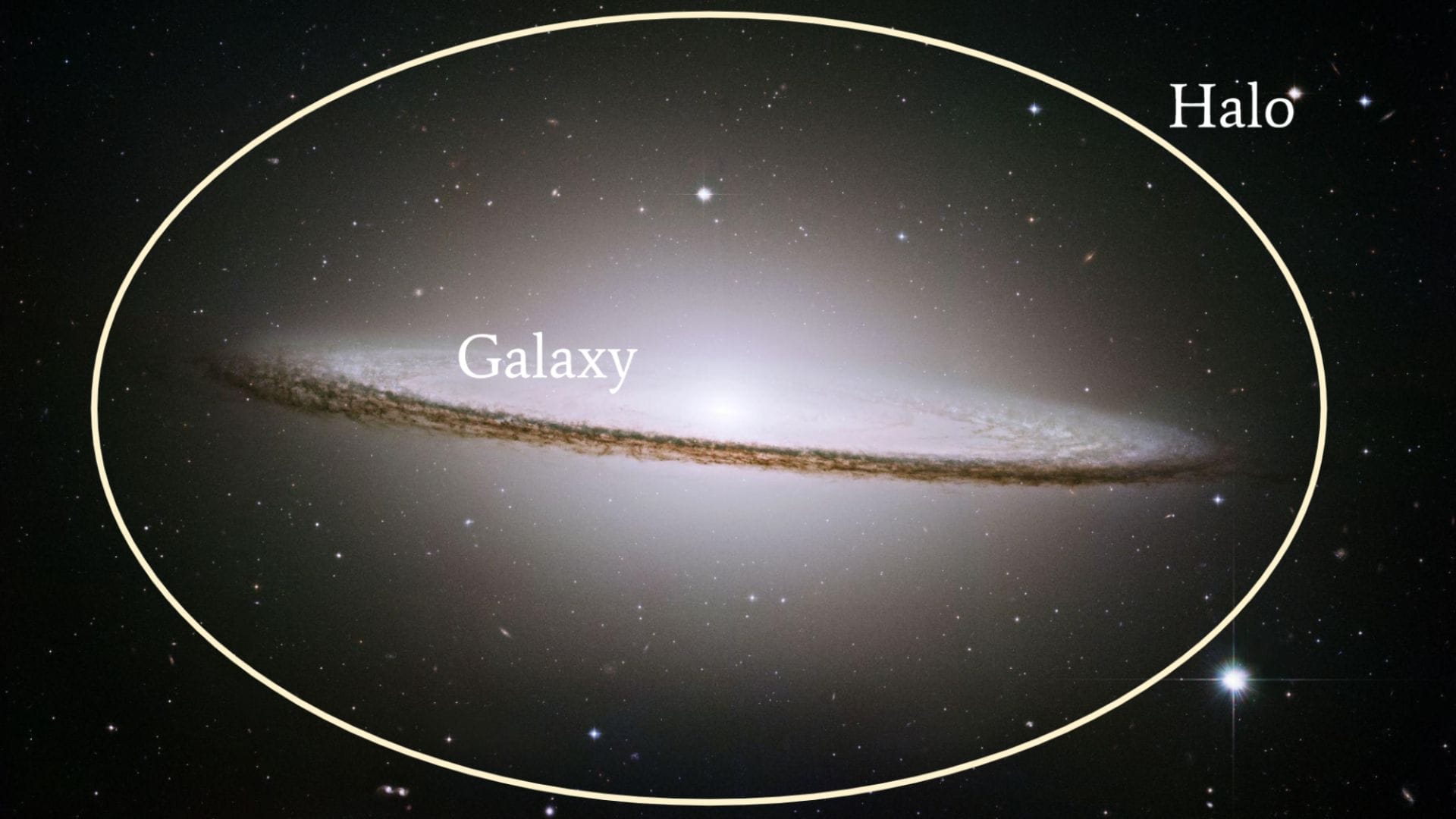
New Delhi: Researchers from The Raman Research Institute have determined that the material in the voids between galaxies or the intergalactic medium may be influencing the measurements of haloes of galaxies, or the diffuse envelope of gas and dust that extends well beyond the visible galaxies. The study has far-reaching implications as these haloes, rich in dark matter, is what holds the galaxies together, ensuring that the stars do not get thrown off. These haloes can extend to between 10-20 times beyond the visible sizes of galaxies, and contains most of the mass of the galaxy.
Mapping the distribution of gases in the haloes, known as the circumgalactic medium is what connects the galaxy to the cosmic web, a large-scale filamentary scaffolding that pervades the universe. The circumgalactic medium mediates the inflow and outflow of gas from and to the galaxy, and plays a major role in the evolution of the galaxy, how many new stars it forms, and how rapidly. Astronomers estimate the mass of the circumgalactic medium using ionised oxygen as a proxy, using the light from a background object passing behind the galaxy. The elements in the foreground galaxy absorb particular wavelengths, revealing the chemical inventory.
The problem with the method
The approach is problematic because the light gets absorbed while traveling in the line of sight from the distant foreground light source, the foreground galaxy which is also distant, and the intergalactic distances in between. So the oxygen absorbtion is from all the ionised oxygen in the space in the middle, and there is no way to tell apart the oxygen in the circumgalactic medium from the oxygen in the intergalactic medium. The new research indicates that most of the oxygen detected in the circumgalactic medium is actually from the intergalactic medium. A paper describing the research has been published in The Astrophysical Journal. One of the study authors, Kartick Sarkar says, “We are challenging the notion that the entire ionized oxygen belongs to CGM.”