Mirza Ghalib was born on December 27, 1797 in Agra, Uttar Pradesh.
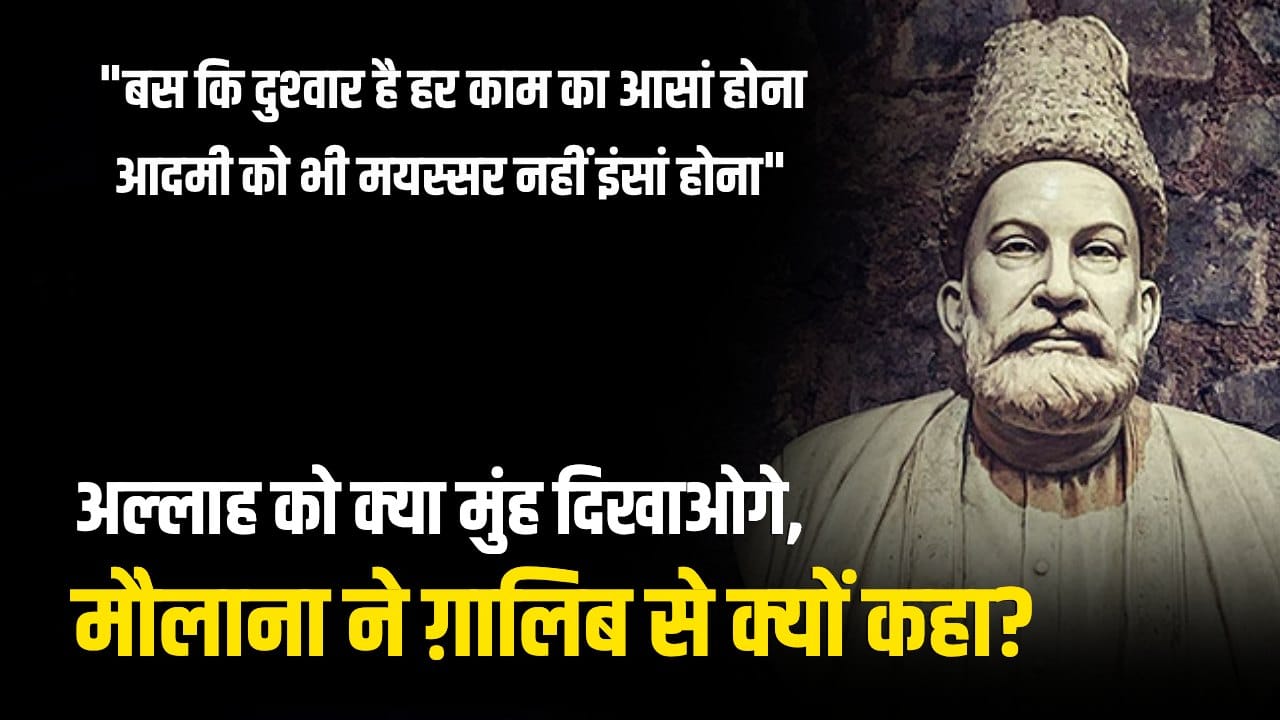
Mirza Ghalib never paid any attention to religious restrictions. An example of this comes from an incident of Diwali. When Maulana taunted him after seeing the Diwali mark on his forehead. Ghalib, the magician of words, gave such an answer that Maulana became speechless. Read interesting story on Ghalib’s birth anniversary.
If Ghalib himself had written about himself, “There are other good poets in the world, it is said that Ghalib has a style of narration and this was not his boast. Even after more than one and a half century has passed since his departure from the world, his influence in the world of poetry continues. His poetry is reflected in the hearts and minds of many people. His couplets range from Nashistas and Mushairas. Seminars and research on his poetry are repeated in various universities. Apart from his poetry, his life has also been discussed.
In reality, the emperor of poetry Ghalib struggled with poverty throughout his life. Liquor was needed. Gambling was also necessary. The hobbies were royal. It was the waning evening of the court of Mughal emperor Bahadur Shah Zafar. On this, the real favor of the king was on the master poet Zauq. Nevertheless Ghalib made a place in the court. But within a few days, after the war of 1857, the star of the Mughal Sultanate sank. Amidst these difficult circumstances, Ghalib’s troubles increased further. But he created something unique. On the occasion of his birth anniversary, read some stories related to him.
Even a man does not have the opportunity to be a human being.
Ghalib had nothing to do with religious restrictions. There was no question like Hindu-Muslim among friends. There was nothing like his own or alien to him in happiness, sorrow and festivals. There was no objection to the colors of Holi and in the happiness of Diwali, Hindus used to stay together with friends from lighting of lamps to fireworks. After the puja at a friend’s house on Diwali, he was given prasad sweets but tilak was not applied on his forehead. Ghalib objected to this. Said why was he not vaccinated? Then the Pandit vaccinated him also.
Tikka on the forehead and Diwali sweets in hand. It is said that the Maulvi he met on the way taunted him. Asked what face will you show to the one above? Being a Muslim, tilak on the forehead and Diwali sweets in hand! Where did the great Ghalib get into religious dilemmas? He went ahead saying, if Barfi is a Hindu then is Emirati a Muslim? Ghalib had faith only in humanity. they wrote,
“The only difficulty is that every task is easy.”
Even a man does not have the opportunity to be a human being.”

Job seeker, riding in a palanquin
Of course the financial condition was poor. But Shahana was only fond of nature. Was waiting for the grace of Mughal court. But how will the train of life run till then? There was a need for a Persian teacher in Delhi College. There was no lack in Ghalib’s ability. But Ghalib, who wanted a job, was not ready to compromise with his honour. Job seeker Ghalib reached college in a palanquin. The matter did not stop here. He wanted those who wanted to be given jobs to get down from the palanquin when they came to receive him at the gate.
In fact, Ghalib was expecting the same respect as a poet in the Governor’s court while asking for a job. After a long wait, college secretary Thomson came to the gate. Said that there is a difference between coming to the Governor’s court as a poet and coming for a job interview. But Ghalib was not going to agree! At this time he had forgotten the needs of his household. His poetic temperament dominated him.
Ghalib ordered the people carrying the palanquin to return saying that I had agreed to do the government job because it would increase my respect further. Not so that it decreases.
We are there from where even we don’t get any news about us.
Alcohol was Ghalib’s weakness. He was addicted to gambling, for which he was once sentenced to six months imprisonment. But despite all his poverty, he could not get rid of these hobbies. He did not care about what would be cooked at home and from where he would get the ration, vegetables and vegetables.
As soon as he got the money in his hand, his steps would move towards the tavern. To arrange money, he kept asking his friends also. Kept making rounds of moneylenders also. The Mughal Sultanate had ended. He kept running from Rampur to Calcutta for pension. He also wrote letters to please the British Queen. Sometimes I get hold of something. There was disappointment on many occasions. Amidst such a scene, Ghalib wrote,
We are from where we also
we don’t hear anything
die wishing to die
death comes but does not come
‘Ghalib’, which way will you go to Kaaba?
but you don’t feel ashamed
Now go to a place where there is no one
At one time, Ghalib had great expectations from the Mughal court. But then in the court of Bahadur Shah Zafar, the king was kind to Ustad Zauq. When Ghalib could establish his position there, within a short time the British forces wreaked havoc on Delhi. The emperor was taken prisoner and sent to Rangoon. The British selectively hanged the emperor’s descendants, supporters and all the innocents. Beat mercilessly. Destroyed entire Delhi. Amidst his scars and the atrocities of the British who were trying to erase his old identity, Ghalib used to remember the Delhi for which he had immense love.
He wrote to a friend, “The fort, Chandni Chowk, the crowded markets of Jama Masjid, the weekly walk on the Jamuna bridge and the annual fair of flower sellers. Nothing is left. There used to be a city of this name. Now the British were building the Delhi of their choice and finding himself unknown and alone in his own city, a sad Ghalib wrote,
Now go to a place where there is no one
There should be no one like us and no one should be like us.
Dear, now Allah is Allah only.
After the destruction of the Delhi court, Ghalib’s concern was twofold. The lives of those close to the court were in danger. Ghalib somehow survived. The next concern was how to meet the expenses? The British had also captured Awadh. The Nawab of Rampur obliged. Fixed pension of Rs 100 per month. But Ghalib did not get along well with him. Had to wait for that amount also.
Ghalib pinned his hopes on the British Crown. Wrote ballads in his honour. Sent them through the Governor. Write direct letters also. Went to Calcutta also with the same hope. But only hopelessness prevailed. There were gems in his poetry. What he wrote became a legacy for the present and future generations. His pen was scattering pearls of words but his empty pocket was making him disappointed. In his last days, he wrote to the Nawab of Rampur, My condition has gone from bad to worse. Out of the stipend of Rs 100 given by you, I have only Rs 54 left. Whereas I need around Rs 800 to save my honour. ,
During this time, in a letter written to Munshi Hargopal Tafta, Ghalib described his condition as follows, “Neither I am free. Nor imprisoned. Nor sick. Nor healed. Neither happy. Nor unhappy. Neither alive nor dead. I just live. I still eat bread every day and drink alcohol if I get it. When death comes, I will die. I will go away. Neither am I God’s.” I am thankful, nor do I complain about him.” Ghalib, born on 27 December 1797, breathed his last on 15 February 1869.
Dum-e-vaapseem bar-sar-rah hai
Dear, now Allah is Allah only.
Also read: IAS is a public servant, not an MP-MLA, why so? Court raised questions in former MLA Kuldeep Sengar case