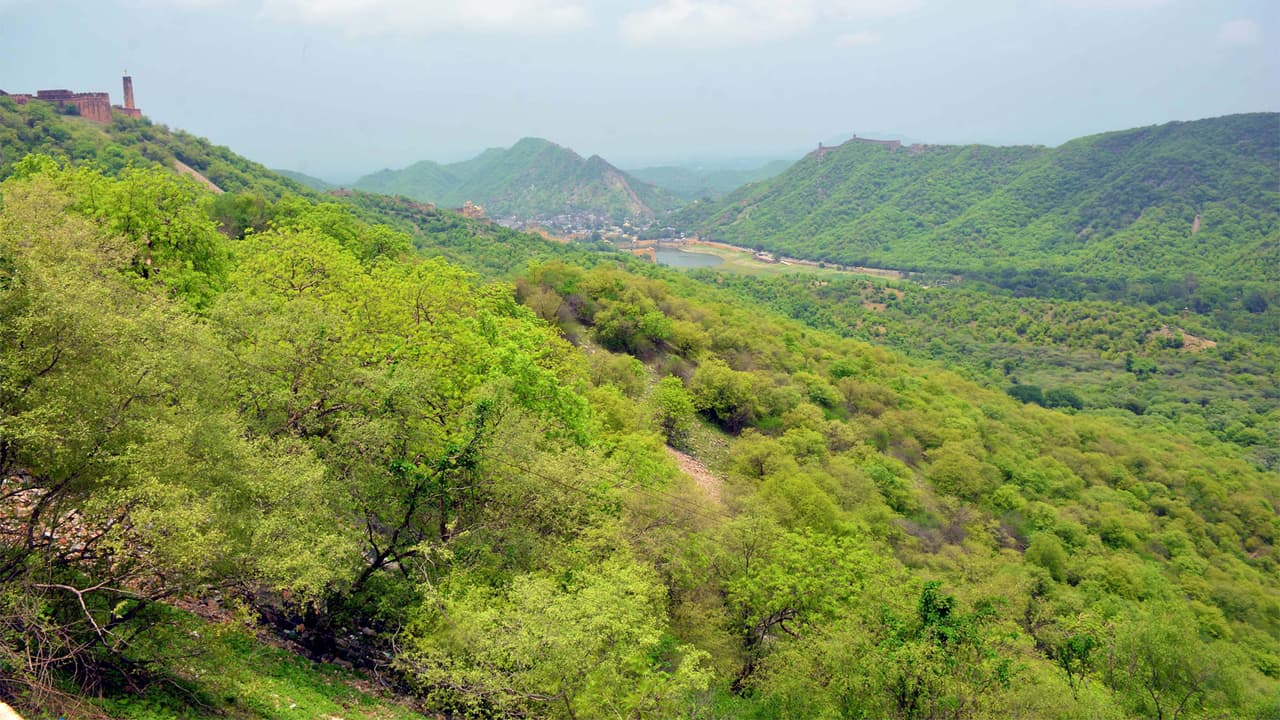
The Supreme Court order of 20 November 2025 did not promote mining in the Aravalis, but imposed a ban on new mining leases and strict regulation. The 100 meter standard is a mapping tool only. The claim of opening up of 90% area on social media is misleading. The real challenge is transparent implementation.
New Delhi. After the Supreme Court’s order of 20 November 2025, widespread public concern regarding the Aravalli mountain range has come to the fore through the #SaveAravalli campaign on social media. This concern is natural considering the ecosystem importance of Aravali. But the notion that the Supreme Court has weakened environmental protections or paved the way for large-scale mining is legally wrong. This obscures the real purpose of the court order.
Supreme Court order does not promote any kind of mining
In reality this order does not promote mining in any way. On the contrary, the Supreme Court has tightened regulatory controls. Under the order, there is a complete ban on new mining leases in the Aravalli region until a Sustainable Mining Management Plan (MPSM) is prepared for the entire landscape. The scheme is to be prepared through a scientific and institutional process by the Indian Council of Forestry Research and Education (ICFRE) under the Ministry of Environment, Forest and Climate Change. This cannot be called a pro-mining step from any point of view.
The 100 meter scale is widely misunderstood.
The most controversial aspect of this order is the widely misunderstood scale of “100 meters from local relative altitude”. It is not an ecosystem evaluation but an operational mapping tool for mining regulation. In the past, varying and vague definitions of Aravali by different states and departments have encouraged illegal mining. A uniform, map-verifiable norm aims to eliminate this administrative ambiguity. It is also important to understand that the definition adopted for mining regulation does not eliminate other environmental protection regimes. Forest lands, wildlife corridors, ridge areas, eco-sensitive zones (ESZ) and protected areas are still protected under their respective statutory laws. To say that all areas below 100 meters altitude are now out of conservation is factually incorrect.
Lies being spread on social media
The most widely publicized claim on social media that “90 per cent of Aravali area has been opened up for mining” is not a judicial finding but a propaganda based on conjecture. The actual demarcation will depend on the mapping done by the Survey of India and the zoning prescribed in the MPSM. Such numerical claims are nothing more than speculation before these processes are completed. Some critics also say that the Supreme Court has deviated from its earlier orders given around 2010. But the court takes decisions according to the circumstances. In the year 2025, the Court was faced with the problem of illegal mining spread in many states and weak enforcement. In such a situation, the directive on uniform definition, ban on new leases and scenario level planning is an attempt to strengthen regulation, not to weaken it.
Court has always been protective for Aravali
History also confirms this view. M.C. In Mehta v. Union of India, the Supreme Court had banned mining and groundwater exploitation in the Aravalli and Ridge region, recognizing that the region is a significant ecological barrier. The institutional tendency of the court has always been protectionist in the context of Aravali. Ultimately, the fear that the order will deregulate construction activities wrongly conflates different legal areas. Land use planning, forest clearances, ESZ norms and environmental impact assessments are as applicable today as before. The November order does not make any changes to these arrangements. Now the real test is not in sloganeering but in implementation. Only transparent mapping, strong zoning and strict enforcement will ensure real conservation of the Aravalis. Misinformation, even if spread in good faith, risks distracting from this accountability.