You could call it the Year of Hope, the Year of the Underdog, or even the Year of Redemption. You could paint a picture of David slaying Goliath, of monoliths falling, or even of tyrants being overthrown.
You could wax philosophical about the rise of a new breed of champions, the emergence of the latest version of the modern global athlete, or even a generational awakening.
There was enough in 2025 for each of these sporting hyperboles to be in play. And while they may be exaggerations – for no one can judge the march of human excellence in real time – it was indeed an extraordinary year of power shifts in sport across continents, disciplines and arenas.
From tracks to courts and the pitch to the field, the signs of a renaissance were hard to miss. The grains of sand that shift with the wind, silent and unseen, gathered enough mass in 2025 to topple the dune.
For a tennis world still coming to terms with the departures of Roger Federer and Rafael Nadal and the decline of Novak Djokovic, the next rivalry exploded so emphatically that the gash was healed without a scar.Jannik Sinner and Carlos Alcaraz, who first met as teenagers in 2019, in a nondescript Challenger in Alicante, elevated their hunger to beat each other by splitting the four Grand Slams and juggling the No 1 ranking. So staggering is this rivalry that Sinner and Alcaraz played 3,302 points against each other in 2025 – and won exactly 1,651 each. With this incredible statistic, the passing of the baton after the Age of the GOATs was complete.
FLANNELS AND PYJAMAS
The drama on the cricket field first unfolded in England when Temba Bavuma led South Africa to victory – in a final he wasn’t expected to be in, against a team he wasn’t supposed to beat.The World Test Championship triumph against Australia not only erased the tag of “chokers” attached to South Africa since their return from the Apartheid ban, it brought to the fore a new kind of captaincy.The Bavuma Blend draws on different strands from his life: his birth into a rejuvenated nation that wanted to unify rather than seek revenge, his rise as a batsman at a time when his peers thought he was being favoured because he is Black, his burning desire to get the team to finally win big tournaments, and the constant awareness that he is a pioneer for his race.
Barely a month after this management lesson, India’s new skipper Shubman Gill showcased his brand of leadership on an England tour in which his young team were expected to face a Bazball battering after the Test retirements of Virat Kohli and Rohit Sharma.Instead, in the second Test at Edgbaston, Gill galvanised his troops by stepping out and making a stand in a manner that skippers can sometimes do.
His immaculate, chanceless 269 in the first innings and run-a-ball 161 in the second innings didn’t just shatter a dozen Test records. It invigorated the dressing room, propelling India to a famous victory in that match, and eventually to an enthralling 2-2 tied series that felt like a win.
This power shift, sandwiched though it was between two home Test series defeats for India, came a few weeks after Royal Challengers Bangalore won their maiden IPL title in 18 attempts, to tick a box on Kohli’s bucket list in the winter of his career. But the icing of the cake for Indian cricket would come from the most unexpected quarter.
 Ignored and patronised for decades, women’s cricket first entered the national consciousness in 2017, when Harmanpreet Kaur smashed 171 off 115 deliveries against Australia in the World Cup semi-final at Derby, forcing people to turn on their TVs and prompting paeans on social media.
In 2025, with Kaur as captain, the national team changed the narrative forever over two unforgettable nights in Navi Mumbai. If Jemimah Rodrigues refused to give up in a 339-run semi-final chase against Australia, Shafali Verma emerged as the unlikely hero with bat and ball in the final against South Africa.The emotional celebrations, with several stalwarts of yesteryear in the winning huddle, illustrated how the triumph was the culmination of a long, lonely battle for recognition.
AND THE REST…
 Out on the Formula 1 track, Englishman Lando Norris ended Max Verstappen’s 1,457-day reign in a thrilling finale at Abu Dhabi in which any of three drivers (Oscar Piastri was the third) could have been crowned world champion, after a gruelling 2025 season.
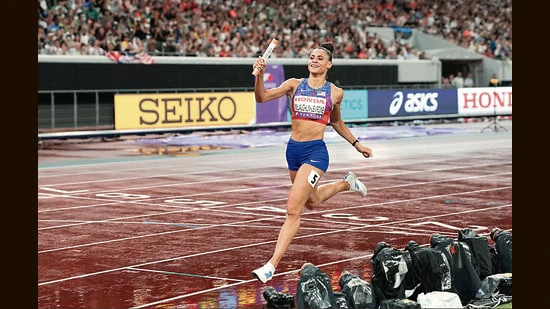
At the World Athletics Championships in Tokyo, Sydney McLaughlin-Levrone completed her switch from 400m hurdles to 400m flat with the second-fastest time ever, and her American compatriot Melissa Jefferson-Wooden took the 100/200 double with timings that inched ever closer to those set during the 1980s Dope Decade that the sport has long struggled to shrug off.
India’s Neeraj Chopra broke the 90m mark for the first time, but he and his great rival Nadeem Ashraf of Pakistan – they are the 2020 and 2024 Olympic javelin champions respectively – could not get on the podium at the Tokyo worlds.
To cap off the year of power shifts, Paris Saint-Germain ended their decades-old quest for a UEFA Champions League title at the start of the summer. Only for an equally parched club to be sitting on top of both the UCL and English Premier League as 2025 draws to a close. So, will Arsenal, at long last, topple the dune in 2026? Fingers crossed.