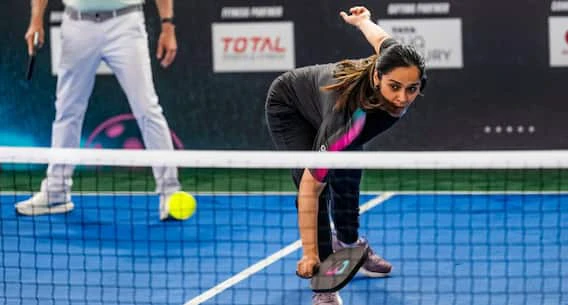
Pickleball has taken the sports world by storm, blending elements of tennis, badminton, and table tennis into a fast-paced, social, and easy-to-learn game.
Whether you are a beginner or looking to build your own court, here is the definitive guide to everything pickleball in 2025.
The Pickleball Court: Dimensions & Layout
One of the reasons for pickleball’s popularity is its compact size, making it much more accessible than a full-sized tennis court. In fact, you can fit four pickleball courts into the space of a single tennis court.
Standard Size: A regulation court is a rectangle measuring 20 feet wide and 44 feet long. This size is used for both singles and doubles play.
The Net: The net stands 36 inches high at the sidelines and has a slight “dip” to 34 inches at the center.
The Kitchen (Non-Volley Zone): This is the most unique part of the court. It is a 7-foot area on both sides of the net where players are prohibited from volleying (hitting the ball in the air).
Service Boxes: The area behind the kitchen is divided into two 10×15-foot service boxes (Left and Right).
Essential Equipment
You don’t need much to get started, but choosing the right gear can significantly impact your performance.
Paddles (Not Rackets): Unlike tennis rackets with strings, pickleball paddles are solid. They are typically made of wood, composite, or graphite.
Graphite/Carbon Fiber: Offers more control and a lightweight feel.
Composite/Fiberglass: Generally provides more “pop” or power.
The Ball: A pickleball is a hollow, perforated plastic ball, similar to a wiffle ball.
Indoor Balls: Have 26 larger holes and are softer for better control on smooth surfaces.
Outdoor Balls: Have 40 smaller holes and are heavier to resist wind.
Footwear: It is highly recommended to wear court shoes rather than running shoes. Court shoes provide the lateral (side-to-side) stability needed to prevent ankle injuries during quick rallies.
Core Rules of the Game
Pickleball is easy to pick up but has a few specific rules that differentiate it from other sports:
The Underhand Serve: All serves must be hit underhand, with contact made below the waist. The serve must be hit diagonally to the opponent’s service box and must clear the kitchen.
The Two-Bounce Rule: This is the most important rule for beginners. After a serve, the ball must bounce once on the receiver’s side and then once on the server’s side before anyone can hit a volley.
Scoring: You can only score points when your team is serving. Most games are played to 11 points, and you must win by a margin of 2.
The Kitchen Rule: You cannot step into the non-volley zone (the kitchen) to hit a ball out of the air. You can only enter the kitchen if the ball has already bounced there.
Why Is It So Popular?
Because the court is smaller, there is less running involved compared to tennis, making it a “low-impact” sport perfect for all ages.
However, at a competitive level, it requires lightning-fast reflexes and strategic “dinking” (soft shots into the kitchen) to outmaneuver opponents.