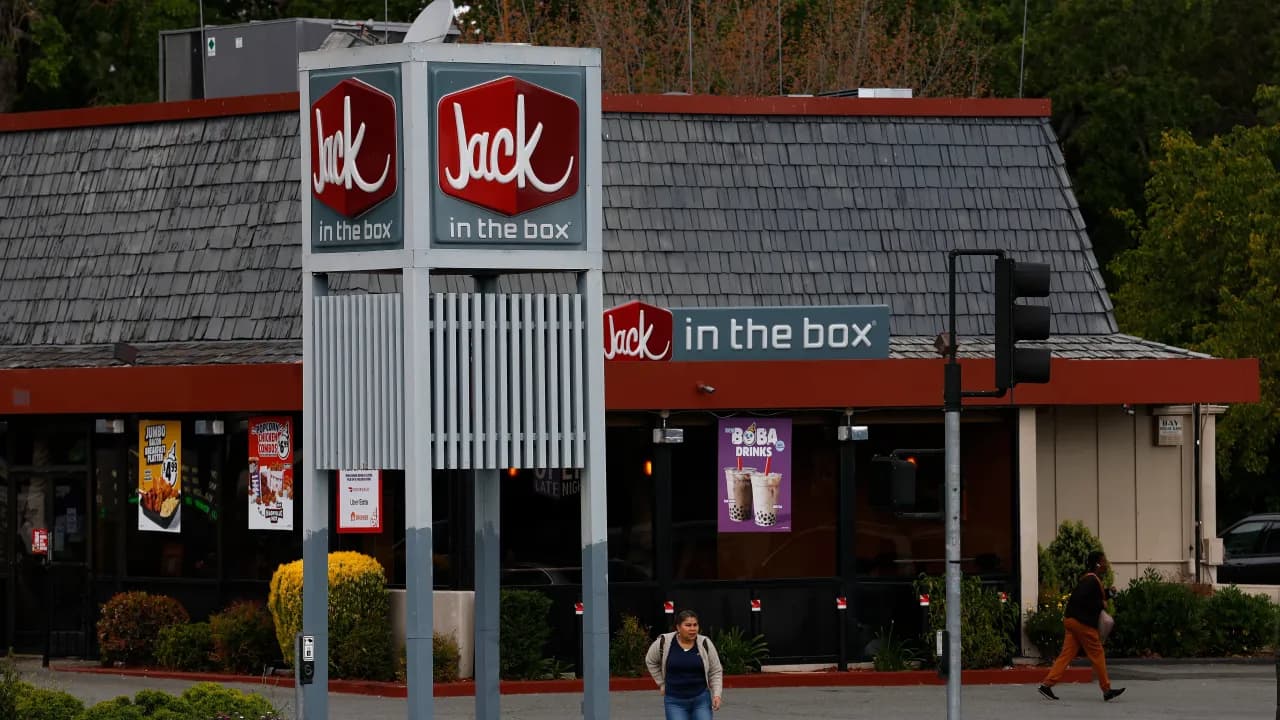
Jack in the Box may take a bigger hit than rivals McDonald’s and Shake Shack, as the fast-food industry struggles with changing consumer preferences and a wobbly macro environment.
- In April, as part of a turnaround effort named the “Jack on Track” plan, the company announced its intention to shut about 80 to 120 restaurants by the end of this year.
- Jack in the Box in July adopted a ‘poison pill’ plan effective immediately after activist investor Sardar Biglari’s hedge fund amassed 9.9% of the fast-food chain’s stock.
- In December, the company finally completed the sale of Del Taco and Jack in the Box CEO Lance Tucker said that it represents meaningful progress in simplifying its business model and reducing debt.
It has been anything but a smooth ride for America’s fast-food chains this year, and few have felt the pressure quite like Jack in the Box. Rising ingredient costs, a pullback in discretionary spending, and an increasingly crowded value-meal battlefield have all converged to squeeze the chain at a vulnerable moment.
As the year winds down, Jack in the Box finds itself deep in turnaround mode, closing underperforming locations and grappling with the lingering challenges of its Del Taco acquisition. The pain has shown up squarely in the stock: shares are down more than 50% this year, battered as the company’s core customer base cuts back on dining out amid persistent inflation and economic strain.
Jack in the Box Closures
In April, as part of a turnaround effort named the “Jack on Track” plan, the company announced its intention to close about 80 to 120 restaurants by the end of this year, with the remaining underperforming restaurants closing thereafter, based on their respective franchise agreement termination dates.
Jack in the Box said it was implementing a block-closure program, which is projected to result in the closure of nearly 150-200 underperforming restaurants, most of which have been in the system for over three decades.
In November, the company said that, as of Sept. 28, Jack in the Box opened 31 new restaurants and closed 86 restaurants for fiscal year 2025.
Del Taco Struggles
In 2021, Jack in the Box, to build on demand for dining out, bought Del Taco for $12.51 per share in cash in a transaction valued at about $575 million. But this year, the company is backing out of the losses from Del Taco and selling it to Yadav Enterprises for $115 million in cash. Del Taco operates and franchises more than 550 Del Taco restaurants.
In the fourth quarter, Del Taco’s system same-store sales declined 3.9%. During the time, the company said that the pending sale of Del Taco may not be completed on the anticipated terms or timeline, or at all. It added that even if the sale is completed, the company might not realize the expected strategic or financial benefits.”
In December, the company finally completed the sale of Del Taco, and Jack in the Box CEO Lance Tucker said that it represents meaningful progress in simplifying its business model and reducing debt.
The Year Of The Poison Pill
In July, Jack in the Box adopted a ‘poison pill’ plan effective immediately after activist investor Sardar Biglari’s hedge fund amassed 9.9% of the fast-food chain’s stock.
Public companies adopt a “poison pill” plan, or shareholder rights plan, to deter hostile takeovers. Biglari Capital had privately informed the company that it now owns 9.9% of the shares and intends to increase its stake.
Fast Food Chains And Value War
The year has seen a notable decline in traffic to fast-food chains in the United States, with McDonald’s acknowledging slowing customer demand, particularly among lower- and middle-income groups, due to price increases nationwide.
It has put major chains to compete by offering value and combo meals for as low as $5, a strategy that has helped pull in customers to the stores. In November, to heat the war, Jack in the Box launched its “Munch Better Deals” lineup.
The company said that the crave-packed meals start at $7 and include Brunchie Meal, Lunchie Meal, and Gremlins Midnight Meal.
In a double-whammy situation, Jack in the Box is also facing higher raw material costs, mainly a rise in beef prices due to low cattle herds resulting from drought in U.S. farmlands. In November, the company said that from a commodity standpoint, the largest inflationary category was beef.
The company’s core consumer group of Hispanics, which is highly dominant in Texas, California and the U.S. Southwest, has been cutting back on dining at its restaurants, a trend Jack in the Box noted has been “pretty consistent” since the beginning of the year.
What Is Retail Thinking?
Retail sentiment on Jack in the Box improved to ‘neutral’ from ‘bearish’ territory a week ago, with message volumes at ‘low’ levels, according to data from Stocktwits.
Sentiment on burger giant McDonald’s dipped to ‘bearish’ from ‘neutral’ a week ago, while on Shake Shack, the sentiment also dropped to ‘bearish’ from the ‘neutral’ territory over the past week.
Shares of Jack in the Box have declined over 53% in the last 12 months, while McDonald’s jumped 10% and Shake Shack fell 33% in the same period.
For updates and corrections, email newsroom[at]stocktwits[dot]com.<