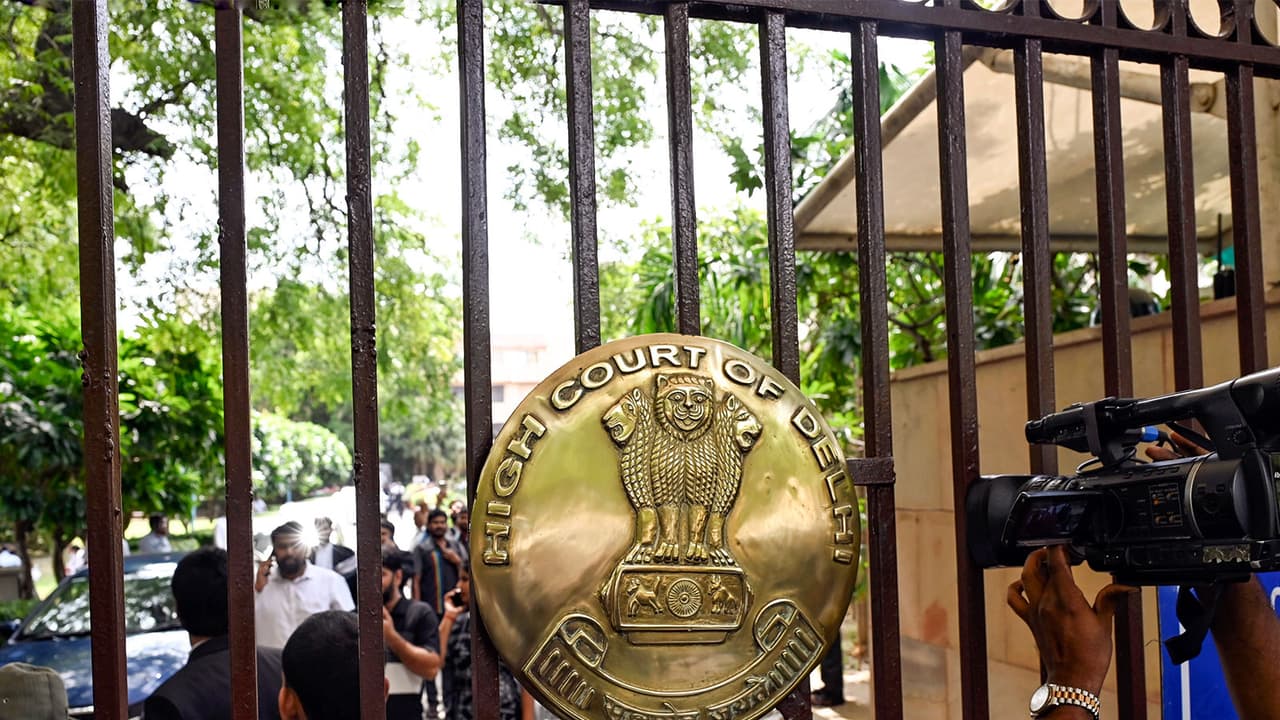
Delhi High Court has struck down the amendment in DANIPS/DANICS service rules, terming it arbitrary. The court raised questions on the Centre’s decision to extend the promotion eligibility date to July 1 and directed MHA to develop a new mechanism in two months.
The court called the amendments arbitrary
New Delhi [भारत]July 1 (ANI): The Delhi High Court has upheld the decision to quash the 2022 amendments to the service rules governing the Delhi, Andaman and Nicobar Islands Police Service (DANIPS) and the Delhi, Andaman and Nicobar Islands Civil Service (DANICS). The court held that these amendments suffered from arbitrariness, as the Central Government failed to explain why it changed the crucial date for promotion eligibility to July 1 instead of January 1.
Affirming the decision of the Central Administrative Tribunal (CAT) to quash the gazette notifications introducing the amendments, the High Court modified the tribunal’s directions. The court said that the courts cannot compel the executive to amend statutory rules in a particular manner. Instead, it directed the Ministry of Home Affairs (MHA) and the Department of Personnel and Training (DoPT) to adopt a rational process and evolve an appropriate mechanism within two months.
The court directed that until new amendments are notified, January 1 following the year of examination will be considered as the crucial date for determining “accepted service” for DANIPS and DANICS officers.
Centre’s petition rejected
A division bench of Justice Anil Kshetrapal and Justice Amit Mahajan disposed of the writ petitions filed by the Union of India challenging the two CAT orders dated January 16, 2025. In these orders, the Delhi, Andaman and Nicobar Islands, Lakshadweep, Daman and Diu and Dadra and Nagar Haveli (Police Service) (Amendment) Rules, 2022 and related Civil Services Amendment Rules were repealed.
The dispute arose from the 2022 amendments, which changed the crucial date for determining promotion eligibility from 1 January to 1 July, to align it with the date from which “sanctioned service” was calculated.
Centre’s argument and court’s comment
The Center argued that these amendments removed the anomalies arising from two different cut-off dates and ensured timely promotions. Rejecting the Centre’s challenge, the High Court said that although policy decisions are generally beyond judicial interference, courts can intervene where a policy is arbitrary, discriminatory or violative of the constitutional guarantees under Articles 14 and 16.
The bench said the tribunal had earlier observed in 2018 that maintaining different dates for calculation of sanctioned service and determination of promotion eligibility discriminates against DANIPS officers, thereby delaying their promotions and adversely affecting their induction into the Indian Police Service (IPS). The central government had never challenged that old decision.
The court observed that despite those findings, the DoPT rejected the Home Ministry’s proposal to adopt January 1 as a uniform date without assigning any reasons. It was observed that despite the High Court giving special opportunity to the Center to place the relevant material on record, no record explaining the decision-making process was produced.
The bench held that the lack of any rational justification made the amendments clearly arbitrary and upheld the tribunal’s decision to strike it down.
impact on officials
The court also said that merely shifting both the calculation of sanctioned service and promotion eligibility to July 1 did not resolve the gross discrimination highlighted in the previous suit. Instead, it continued to disadvantage DANIPS and DANICS officers by reducing their effective sanctioned service by six months compared to officers of the Armed Forces Headquarters Civil Service (AFHQCS), another Group ‘B’ service where January 1 remains the benchmark.
The bench also held that the calculation of sanctioned service from July 1 adversely impacts the future induction of officers into the IAS and IPS by delaying their eligibility and affecting the seniority as compared to direct recruits.
Amendment of tribunal order
However, the High Court disagreed with a part of the tribunal’s order, which specifically directed the government to amend the service rules by fixing January 1 as the crucial date. The court held that although tribunals can strike down arbitrary rules, they cannot determine the precise manner in which statutory rules should be made or modified. It is the responsibility of the rule making authority to remove the defect.
Accordingly, the court directed the MHA and DoPT to adopt a rational process and formulate a mechanism to remove the anomalies identified by both the tribunal and the High Court, so that no prejudice is caused to DANIPS and DANICS officers. Instructions have been given to complete this process within two months on priority basis. Pending such amendments, the court ordered that 1 January following the year of examination will be considered as the crucial date for determining the length of service for DANIPS and DANICS officers, as is the practice followed in AFHQCS. (ANI)
(Except for the headline, this story has not been edited by Asianetnews Editorial staff and is published from a syndicated feed.)