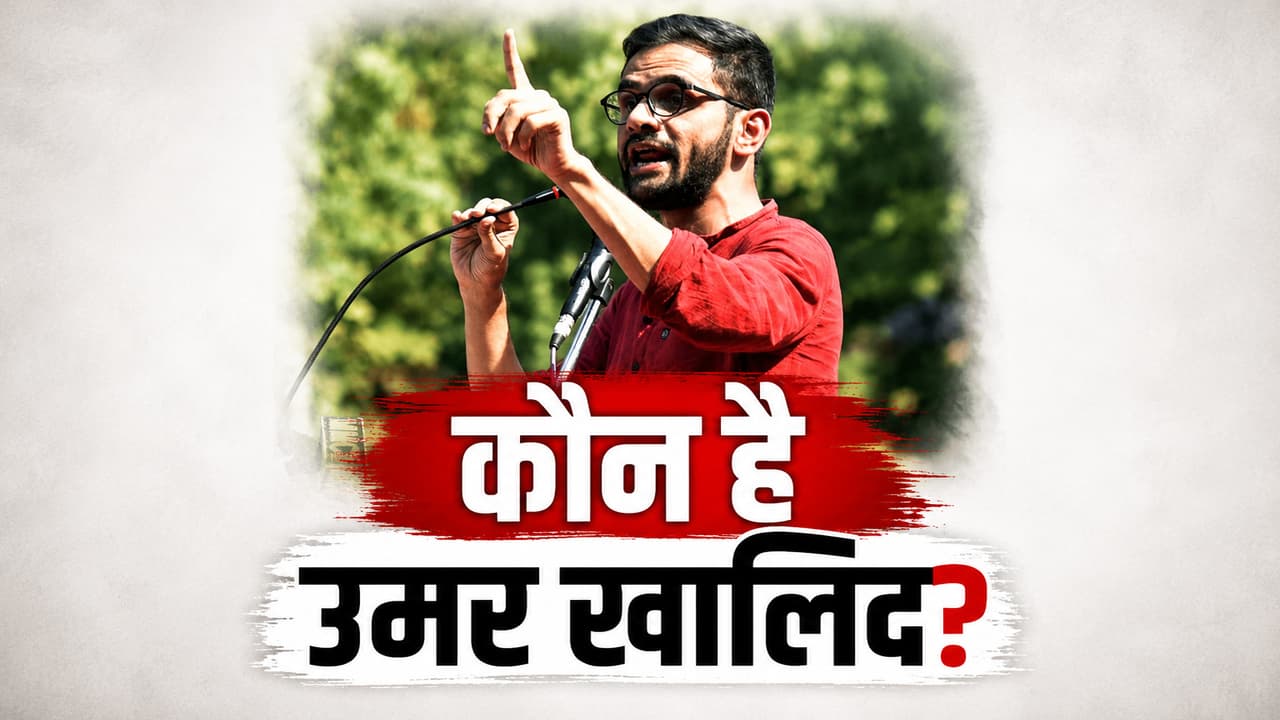
In the first interview, Umar Khalid, who is jailed in the Delhi riots case, talked about the mental impact of jail, politics, society and his new bail petition.
Umar Khalid News: Student leader and activist Umar Khalid, who has been in jail since September 2020 in the Delhi riots case, has given his first interview after almost six years. He spoke on a range of issues including the mental impact of his time in jail, the charges against him, the political climate of the country and his new bail plea. In an interview given to ‘The Guardian’, Omar Khalid said that being in jail without trial for a long time has had a deep impact on his mental health and personal life. At the same time, Bharatiya Janata Party (BJP) says that India’s judicial process is independent and the legal action against them is not politically motivated.
‘The years in jail affected my humanity and mental balance’
Umar Khalid said that the impact of being in jail for a long time was not only physical but also mental. He said that many times his fellow prisoners in jail also addressed him as a “terrorist” on the basis of his public image. According to Khalid, such perception affects his humanity. He said that many times it feels as if his identity in the eyes of people has been limited to just one allegation.
‘My identity became an image’
Khalid said that when a person’s identity is limited to only a positive or negative image, it becomes difficult for him to maintain his personal identity and mental balance. He said that even those who sympathize with him often forget that he is also a normal human being, who has fears, weaknesses and shortcomings. According to him, the years spent in jail have taken a toll on both his mind and body and have increased his mental concerns.
On what charges were the arrests made in the Delhi riots case?
Umar Khalid was arrested under the Unlawful Activities (Prevention) Act (UAPA) in September 2020. He was accused of being one of the key accused in the alleged larger conspiracy of the 2020 Delhi riots and the plot to bring about a violent change of power. Khalid has consistently denied all these allegations. On the other hand, the Bharatiya Janata Party says that India’s judicial process is independent and the legal proceedings in this case are not politically motivated.
What did Omar Khalid say on the political atmosphere of the country?
Umar Khalid said that despite being in jail, there has been no change in his thinking regarding the current political environment of the country. He expressed concern over the increasing spread of hate speeches and misinformation in the society. He said that according to him, “post-truth” i.e. a situation where emotions and misinformation have more influence than facts, has increased rapidly in India.
‘I feel alone’
The former Jawaharlal Nehru University (JNU) student leader also questioned the silence of opposition parties, civil society and some social activists. He said that after being in jail for six years, he feels depressed and at times he also feels alone. He said that the silence of political parties and social organizations in matters of action against opponents emboldens the government to take more action.
‘Will not answer hatred with hatred’
Umar Khalid said that despite being in jail for a long time, he has not changed his views. Reiterating his message given during the 2019 anti-Citizenship Amendment Act (CAA) protests, he said that he does not believe in responding to violence with violence and hatred with hatred. According to him, if hatred is spread in the society, it should be responded to with love and peace.
Court seeks reply from Delhi Police on new bail petition
A few weeks ago, a Delhi court had issued a notice to Delhi Police on the fresh bail plea of Umar Khalid in the Delhi riots case. Additional Sessions Judge of Karkardooma Court, Sumedh Kumar Sethi has fixed July 4 for the next hearing in this case.
What is said in the new bail petition?
In his new bail petition, Umar Khalid has cited the change in circumstances. He met Supreme Court Justice B.V. Nagarathna and Justice Ujjwal Bhuyan referred to a judgment delivered on May 18. This decision was related to granting bail to Jammu and Kashmir resident Syed Iftikhar Andrabi in a narco-terror case being investigated by the NIA.
Which decision did the Supreme Court refer to?
The Supreme Court had expressed serious objection to the reasoning process adopted in a decision dated January 5 this year. The court had said that in that decision, the important principles laid down by the three-judge bench in the case Union of India vs KA Najeeb (2021) were not properly implemented. In that decision, it was held that if the trial of an accused does not start for a long time and he is in jail for a long time, then relief can be granted under Section 43D(5) of UAPA despite the legal restrictions on bail.
Questions were also raised on instructions related to protected witnesses
The Supreme Court had also objected to the direction which said that Umar Khalid and Sharjeel Imam can demand re-hearing of their bail plea only when the interrogation of the protected witnesses is completed or a year has passed. The court had also raised questions on this instruction.