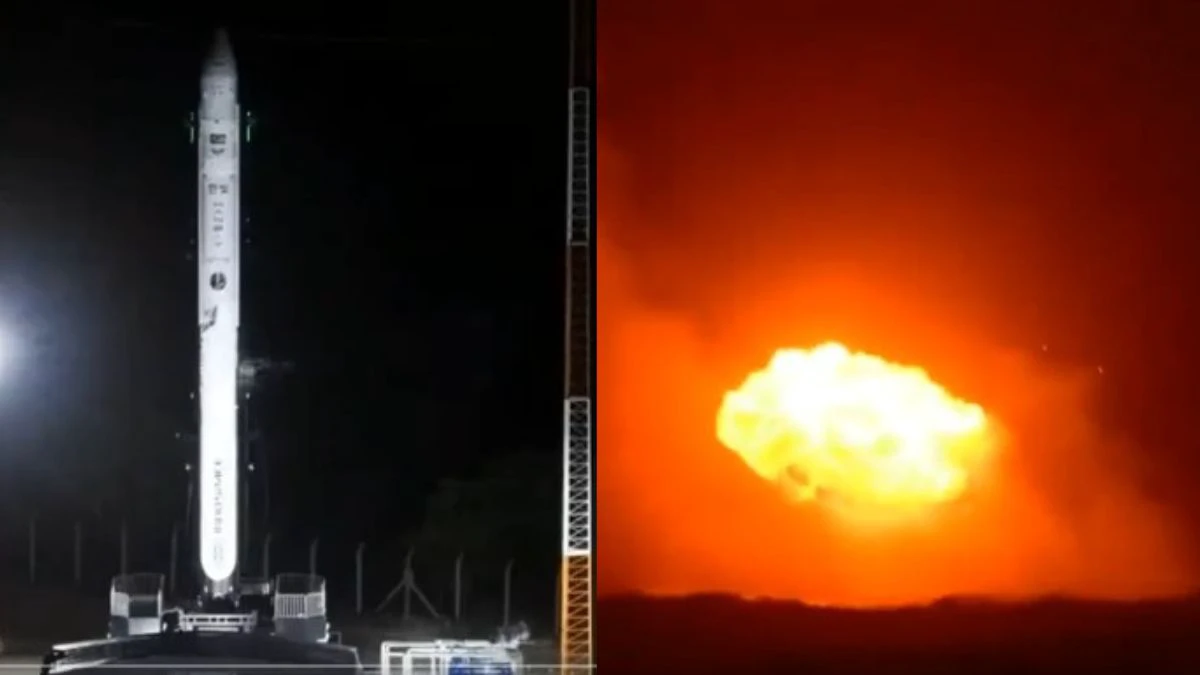
South Korea’s first commercial orbital rocket, Hanbit-Nano, crashed shortly after liftoff from Brazil, dealing a setback to the country’s private space ambitions.
Developed by Innospace Co., the two-stage small satellite launch vehicle lifted off from the Alcantara Space Center late Monday local time but fell back to the ground within about 30 seconds due to an abnormality, the company said.
The rocket launched at 10:13 pm Monday (local time), corresponding to early Tuesday in South Korea. The crash occurred within a designated ground safety zone, and authorities confirmed there were no casualties or additional damage.
Launch Footage Shows Flames After Takeoff
Video footage from a YouTube livestream showed flames emerging immediately after liftoff, moments before the broadcast was suspended. The Hanbit-Nano was carrying five small satellites that were to be deployed into a 300-kilometre low Earth orbit.
If successful, the mission would have marked the first time a private South Korean company placed a customer satellite into orbit, a milestone for the country’s fast-growing commercial space sector.
Rocket Designed For Small Satellite Market
Hanbit-Nano is a two-stage small satellite launch vehicle built to serve the rapidly expanding global smallsat market. Its first stage is powered by a hybrid engine generating 25 tons of thrust, burning liquid oxygen and paraffin.
The second stage can operate in two configurations, one using liquid oxygen and paraffin, and another burning liquid oxygen and liquid methane. The latter fuel combination is increasingly favoured in the space industry for its higher efficiency and cleaner combustion.
The rocket is designed to carry payloads of up to 90 kilograms into sun-synchronous orbit, commonly used for Earth observation, climate monitoring and surveillance missions.
Multiple Delays Before Final Launch Attempt
The failed mission followed a series of postponements. Initially scheduled for November 22, the launch was delayed several times due to technical issues. A November 23 attempt was scrapped after error signals were detected in the ground system.
Further delays pushed the launch to December 18 and then December 20 due to an abnormality in the first-stage cooling system. Another issue involving the second-stage liquid methane tank led to a final delay until December 23.
As December 23 was the final day of the launch window approved by the Brazilian Air Force, Innospace proceeded with the attempt despite unfavourable weather conditions, which delayed liftoff by about 13 minutes.
Following the launch failure, Innospace shares plunged close to the KOSDAQ market’s 30 percent daily lower limit. Despite the setback, Innospace founder and chief executive Kim Soo-jong struck an optimistic note.
“Although the launch did not reach its planned final outcome, an important achievement was that we successfully collected flight, propulsion and operational data that can only be secured in actual flight conditions,” Kim said. He added that the company plans technical improvements and aims to attempt another commercial launch in the first half of next year.